Bamboo plates are often promoted as a natural alternative to disposable plastic and lightweight paper plates. However, buyers and consumers usually have several practical questions before using them:
- Are bamboo plates compostable?
- Can bamboo plates go in the microwave?
- Can they be heated in an oven?
- Can disposable bamboo plates be washed and reused?
- Are bamboo plates dishwasher safe?
- Should used bamboo plates go into composting, recycling or general waste?
The answer depends on what the finished plate is actually made from.
A plate molded from 100% bamboo fiber is very different from a reusable plastic plate containing bamboo powder. Although both products may be marketed as “bamboo plates,” they do not have the same composition, heat resistance, care instructions or end-of-life options.
PANABAM molded bamboo fiber plates are made from 100% bamboo fiber, with no other material ingredients added. They contain no added plastic, PLA, melamine, synthetic resin or surface coating.
This article explains how genuine molded bamboo fiber plates differ from bamboo composite dinnerware and how to evaluate their compostability, temperature resistance, reusability and disposal options.
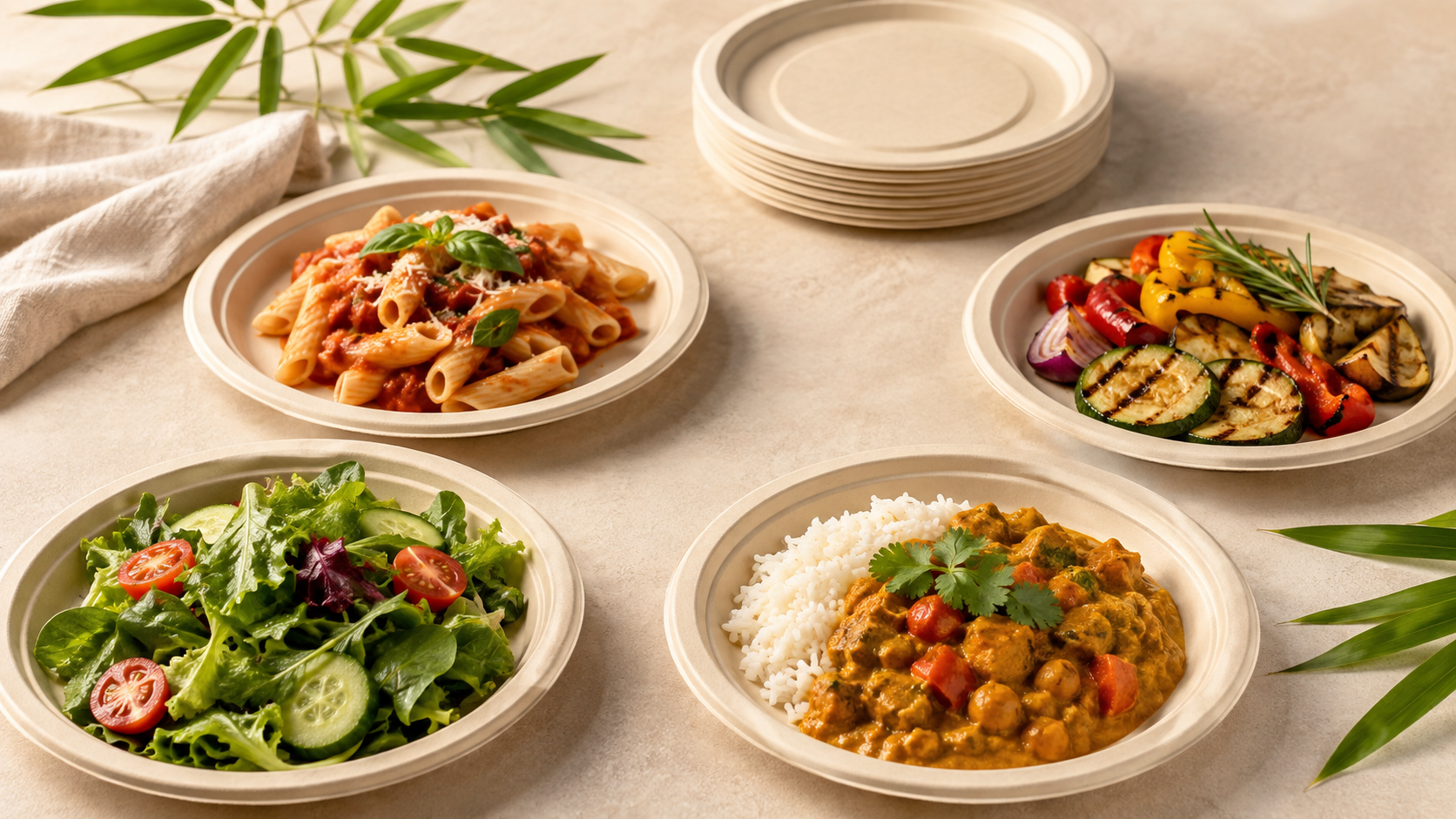
PANABAM disposable plates are molded from 100% bamboo fiber with no added plastic, PLA, melamine, synthetic resin or coating.
Quick Answer
PANABAM molded bamboo fiber plates are made from 100% bamboo fiber and are designed for single-use foodservice.
They can undergo natural breakdown under suitable environmental conditions. In PANABAM’s outdoor soil observation in Chengdu, China, a tested plate showed extensive visible disintegration within 54 days.
Selected PANABAM bamboo fiber plates have also been tested under a wide temperature range. Under the applicable internal test conditions, the tested products tolerated:
- Temperatures as low as -50°C
- Oven heating at 200°C for one hour
However, disposable bamboo fiber plates are not intended to be washed in a dishwasher or repeatedly reused as permanent dinnerware.
| Bamboo plate type | Material composition | Compostable? | Microwave safe? | Reusable? | Dishwasher safe? |
|---|---|---|---|---|---|
| PANABAM molded bamboo fiber plate | 100% bamboo fiber with no other material ingredients | Can break down naturally; certification and local acceptance should still be verified | Suitable when tested and used according to product instructions | Designed for single use | No |
| Pressed bamboo veneer plate | Thin sheets cut from bamboo, sometimes with adhesives or coatings | Product-specific | Product-specific | Limited use only | Usually no |
| Bamboo-plastic composite plate | Bamboo powder or fiber mixed with plastic resin | Generally no | Usually not recommended unless specifically approved | Yes | Only when labeled |
| Bamboo-melamine dinnerware | Bamboo powder or fiber combined with melamine resin | No | Usually no | Yes | Product-specific |
The word “bamboo” alone does not prove that a product is plastic-free, compostable, microwave safe or suitable for repeated washing.
What Are Bamboo Plates Actually Made From?
Before deciding whether a bamboo plate is compostable, reusable or safe for heating, buyers should identify the product category.
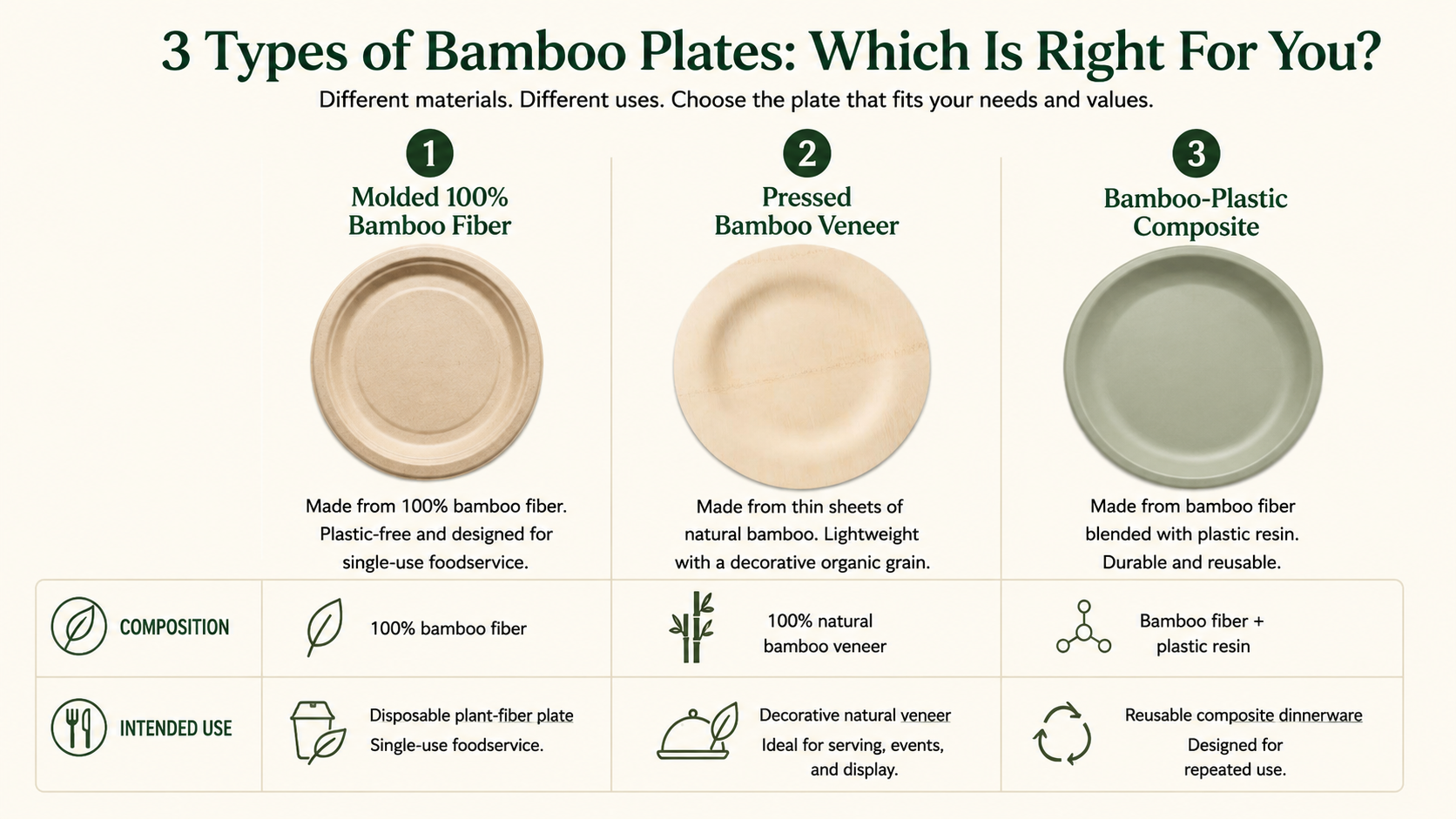
1. Molded Bamboo Fiber Plates
PANABAM molded bamboo fiber plates are made from 100% bamboo fiber.
The bamboo fiber is formed into the required plate shape under heat and pressure. No plastic, PLA, melamine, synthetic resin, surface coating or other material ingredient is added to the finished plate.
This composition distinguishes PANABAM plates from bamboo-plastic composite products.
The dense molded structure provides the rigidity and food-holding performance required for disposable foodservice applications, including:
- Restaurants and cafés
- Catering and events
- Takeaway meals
- Hotels and hospitality
- Institutional foodservice
- Meal preparation
- Retail tableware packs
- Private-label packaging projects
Depending on the selected model, molded bamboo fiber plates can be used for dry, wet, oily, hot or cold foods.
Explore PANABAM’s range of disposable plates and food trays for wholesale foodservice, catering and private-label projects.
2. Pressed Bamboo Veneer Plates
Bamboo veneer plates are made from thin sheets cut directly from bamboo stalks.
They usually have a visible natural grain and are often selected for:
- Weddings
- Cocktail events
- Appetizers
- Desserts
- Food tasting
- Premium catering
- Decorative food presentation
The performance and end-of-life properties of veneer plates depend on whether the finished product contains adhesives, coatings, inks or other surface treatments.
They should therefore be evaluated separately from molded bamboo fiber plates.
3. Reusable Bamboo Composite Plates
Some colorful, smooth or plastic-like products are sold as bamboo dinnerware even though bamboo is only one part of the material.
These products may contain:
- Bamboo powder
- Melamine resin
- Polypropylene
- Other plastic polymers
- Synthetic binders
- Protective surface finishes
They may be washable and reusable, but they are not 100% bamboo fiber plates.
The European Commission’s bamboo-plastic food-contact materials guidance explains that many plastic food-contact products containing ground bamboo have been marketed as natural or environmentally friendly products even though they are plastic composites.
This EU enforcement issue should not be confused with molded tableware made entirely from bamboo fiber. However, it demonstrates why buyers should always request the complete material composition instead of relying on the word “bamboo.”
Are Bamboo Plates Compostable?
PANABAM bamboo fiber plates are made entirely from bamboo fiber and contain no added plastic, PLA, melamine, synthetic resin or surface coating.
Because the finished plate contains only bamboo fiber, it does not have the plastic-resin structure that prevents many bamboo composite products from breaking down naturally.
However, three separate concepts should not be confused:
- Material composition
- Natural degradation
- Certified compostability
A declaration that a plate is made from 100% bamboo fiber confirms what the product contains.
A natural-environment observation shows how a tested product behaved under particular real-world conditions.
A compostability certification evaluates the finished product according to defined test conditions and acceptance criteria.
These forms of evidence are related, but they are not interchangeable.
Biodegradable and Compostable Do Not Mean Exactly the Same Thing
“Biodegradable” is a broad term indicating that a material can be broken down by biological activity under suitable environmental conditions.
The word alone does not explain:
- Where the material will break down
- How long the process will take
- What temperature is required
- Whether industrial equipment is needed
- Whether visible fragments will remain
- Whether the result will meet a composting standard
“Compostable” is a more specific claim. It generally refers to a product that breaks down under defined composting conditions without leaving unacceptable residues or harmful effects.
The US Federal Trade Commission advises companies to qualify compostable claims when a product cannot be safely composted at home or when suitable municipal or industrial composting facilities are not widely available. See the FTC’s summary of the Green Guides.
For this reason, responsible suppliers should clearly distinguish among:
- Commercially compostable
- Industrially compostable
- Home compostable
- Biodegradable
- Naturally degradable
- Observed to disintegrate under specific outdoor conditions
PANABAM’s 54-Day Outdoor Natural-Environment Observation
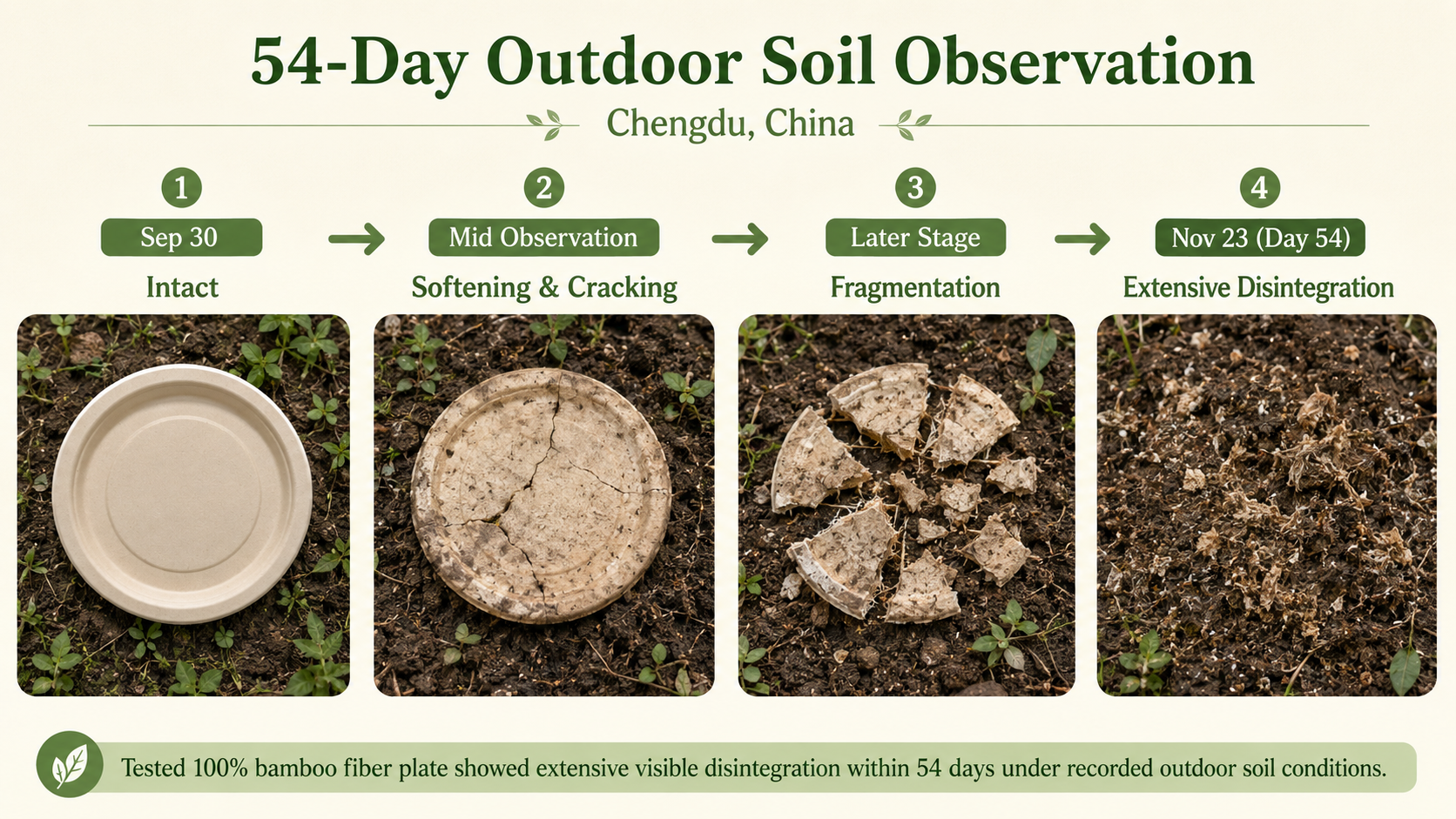
To better understand how molded bamboo fiber plates behave outside controlled laboratory conditions, PANABAM conducted an outdoor natural-environment observation in Chengdu, China.
The observation began on September 30 and ended on November 23, covering a total period of 54 days.
A molded bamboo fiber plate was exposed to an outdoor soil environment and natural seasonal conditions, including:
- Direct soil contact
- Natural moisture
- Rainfall and humidity
- Naturally occurring microorganisms
- Changing daytime and nighttime temperatures
- Biological and plant activity
Photographs were taken during the observation to record visible changes in the plate.
During the 54-day period, the plate gradually:
- Absorbed moisture
- Lost surface strength
- Became softer
- Developed cracks
- Separated into smaller fiber-based sections
- Lost most of its original plate shape
- Showed extensive visible disintegration
By November 23, less than two months after the observation began, the tested plate had undergone substantial visible breakdown under the recorded outdoor conditions in Chengdu.
PANABAM observation result: Under the recorded outdoor soil conditions in Chengdu, the tested 100% bamboo fiber plate showed extensive visible disintegration within 54 days.
What the 54-Day Observation Proves
The observation provides first-hand evidence showing how the tested PANABAM plate behaved in a real outdoor soil environment.
It demonstrates that:
- The plate was capable of natural structural breakdown.
- The material absorbed moisture and lost its molded form.
- The plate separated into progressively smaller fiber-based sections.
- Extensive visible disintegration occurred within 54 days under the recorded conditions.
This is valuable practical evidence because it records the performance of the complete finished plate rather than only describing bamboo fiber as a raw material.
What the Observation Does Not Prove
The 54-day observation should not be presented as equivalent to standardized industrial or home-compostability certification.
It does not prove that:
- Every bamboo plate will break down within exactly 54 days.
- Every PANABAM product model has the same degradation rate.
- The plate is automatically certified for home composting.
- The plate is automatically certified for industrial composting.
- The same result will occur in every country, climate or season.
- The product will break down at the same rate in landfill.
- Every visible fragment was converted into mature compost within 54 days.
Natural breakdown can vary according to:
- Soil temperature
- Moisture
- Rainfall
- Microbial activity
- Oxygen availability
- Product thickness
- Product weight
- Product shape
- Whether the plate is buried
- Whether it is broken into smaller pieces
- Local climate
- Seasonal conditions
The most accurate statement is therefore:
The tested PANABAM 100% bamboo fiber plate showed extensive visible disintegration within 54 days under the recorded outdoor soil conditions in Chengdu, China.
Buyers who require a certified compostability claim should request third-party documentation for the exact finished product.
In North America, buyers can use the BPI certified product database to verify whether a specific company, product or SKU is covered by BPI certification.
For European projects, buyers may request testing against applicable compostability requirements, such as EN 13432, where relevant to the product and intended claim.
Commercial Composting vs Home Composting
Commercial composting facilities usually operate under managed conditions involving controlled:
- Temperature
- Moisture
- Oxygen
- Aeration
- Microbial activity
- Particle size
- Processing time
Home composting is generally less controlled and often operates at lower temperatures.
A product suitable for commercial composting may not break down at the same rate in a home compost bin. Similarly, a product that shows natural breakdown in outdoor soil should not automatically be marketed as certified home compostable.
Can a Used Bamboo Plate Go Into Compost?
A used bamboo plate should only enter an organics or composting stream when:
- The complete finished product is suitable for the intended composting route.
- The local facility accepts disposable fiber tableware.
- The plate does not contain materials excluded by the facility.
- It is placed in the correct collection bin.
- The facility accepts the type and amount of food residue present.
The US Environmental Protection Agency notes that commercially compostable foodservice ware only provides an effective composting route when it is collected separately and sent to an appropriate facility. It also highlights that access to suitable facilities is limited in many locations. See the EPA guidance on sustainable foodservice ware.
Before selecting compostable serviceware for a foodservice project, buyers should confirm whether the local waste operator accepts the exact product category.
Are Bamboo Plates Microwave Safe?
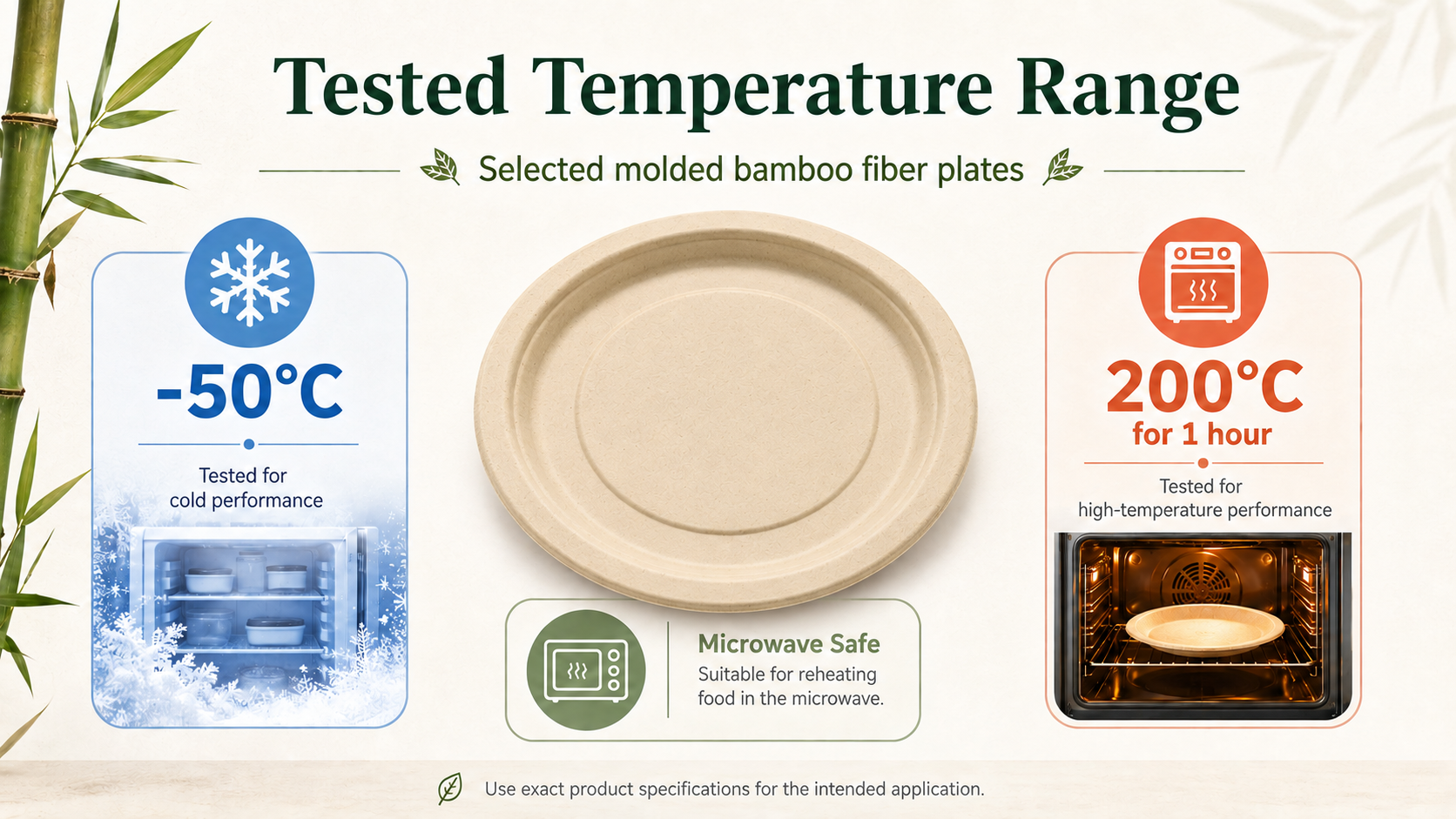
Some molded bamboo fiber plates are suitable for microwave reheating, but microwave performance should be confirmed for the exact product.
PANABAM 100% bamboo fiber plates are designed for hot- and cold-food applications. Selected products have been tested across a wide temperature range.
However, microwave performance can vary according to:
- Plate size and thickness
- Food weight
- Heating time
- Microwave power
- Food moisture
- Oil and fat content
- Sugar content
- Whether the plate is empty
- Whether the plate has already been used
- The material of any separate lid or film
High-fat and high-sugar foods can become hotter than water-rich foods. A plate that performs well during ordinary reheating may still dry out, discolor or deform if it is heated for too long.
Microwave Use Guidelines
When the selected bamboo fiber plate is approved for microwave use:
- Use it mainly for reheating rather than prolonged cooking.
- Follow product-specific time and power guidance.
- Do not microwave an empty plate.
- Do not expose the plate to direct flame.
- Do not place it against an exposed heating element.
- Avoid repeatedly reheating the same disposable plate.
- Confirm that any separate lid or film is microwave compatible.
- Stop heating if the plate deforms, discolors or produces an unusual odor.
- Support the bottom when removing very hot or heavy food.
For more detailed heating guidance, read Are Disposable Bamboo Plates Microwave Safe?.
Can Bamboo Plates Go in the Oven?
Under PANABAM’s internal test conditions, the tested bamboo fiber plates tolerated oven heating at 200°C for one hour.
This supports certain oven-heating applications when the exact product model is approved and used according to its specification.
However, “oven safe” should not be interpreted as an unlimited claim.
Oven performance can be affected by:
- Product model
- Plate size
- Wall thickness
- Plate depth
- Food weight
- Food moisture
- Oil and sugar content
- Oven type
- Actual temperature accuracy
- Air circulation
- Distance from heating elements
- Direct contact with hot metal surfaces
- Heating duration
- Repeated heating cycles
A microwave-safe product is not automatically oven safe, and oven suitability does not mean that a plate can be used for:
- Grilling
- Broiling
- Open-flame cooking
- Stovetop heating
- Direct contact with exposed heating elements
Buyers should confirm the applicable temperature and time specification for the exact model being ordered.
Can Bamboo Fiber Plates Be Used for Frozen Food?
Under PANABAM’s internal test conditions, the tested bamboo fiber products tolerated temperatures as low as -50°C.
This supports their potential use in applications such as:
- Frozen prepared meals
- Frozen desserts
- Cold-chain foodservice
- Refrigerated meals
- Meal preparation
- Freezer storage before reheating
However, frozen-food performance involves more than the plate itself.
Buyers should also evaluate:
- Lid fit
- Seal integrity
- Food expansion during freezing
- Moisture migration
- Condensation
- Stacking pressure
- Transportation vibration
- Thawing conditions
- Transfer from freezer to microwave or oven
Application testing should be conducted using the buyer’s actual food, filling weight, lid system, storage time and reheating method.
Are Bamboo Plates Reusable?
Some bamboo products are reusable, but disposable molded bamboo fiber plates are not designed as permanent dinnerware.
A disposable bamboo plate may still look firm after one meal. However, this does not mean it has been designed or tested for repeated washing, drying, storage and food-contact cycles.
Repeated use may cause:
- Moisture absorption
- Loss of rigidity
- Surface roughening
- Edge deformation
- Oil entering the fiber structure
- Food residue remaining in the material
- Reduced heat resistance
- Reduced microwave performance
- Hygiene concerns
For restaurants, caterers and institutional foodservice operators, reusing a product intended for single use may also create hygiene and process-control risks.
The recommended use cycle is:
- Use the plate for one foodservice occasion.
- Collect it after use.
- Separate it according to local waste rules.
- Send it to an accepted composting or waste stream.
Can You Reuse a Disposable Bamboo Plate Once?
A lightly used plate may appear physically intact, but PANABAM does not recommend treating disposable molded fiber plates as reusable tableware.
The plate has not necessarily been designed or validated for:
- Washing with detergent
- Repeated soaking
- Repeated drying
- Dishwasher cleaning
- Multiple microwave cycles
- Long-term food storage
- Multiple food-contact cycles
For food safety and predictable product performance, use it according to its intended single-use application.
Are Bamboo Plates Dishwasher Safe?
Disposable molded bamboo fiber plates are generally not dishwasher safe.
Dishwashers expose tableware to conditions that are very different from briefly holding hot food:
- Prolonged hot water
- Detergent
- Water pressure
- Repeated soaking
- High-temperature drying
- Mechanical movement
A disposable bamboo fiber plate may:
- Absorb water
- Lose stiffness
- Swell around the edges
- Warp
- Develop a rough surface
- Crack or separate
- Retain food residue
- Become unsuitable for further food contact
Putting a disposable plate in a dishwasher also conflicts with its intended single-use design.
What About Reusable Bamboo Dinnerware?
Some durable bamboo composite plates may be labeled dishwasher safe. These are different from PANABAM’s 100% molded bamboo fiber plates.
Reusable bamboo dinnerware may contain:
- Melamine
- Polypropylene
- Synthetic resin
- Laminated bamboo
- Protective surface finishes
The synthetic material that provides washing durability may also prevent the product from being compostable.
A dishwasher-safe claim does not prove that a product is:
- Microwave safe
- Oven safe
- Plastic-free
- Compostable
- Biodegradable
Always check each claim separately.
Are Bamboo Plates Recyclable?
Used bamboo fiber plates should not automatically be placed in a standard paper recycling bin.
Although bamboo is a plant fiber, recycling acceptance can be affected by:
- Food contamination
- Oil and grease
- Moisture
- Product shape
- Product size
- Local sorting equipment
- Local recycling policies
Many paper-recycling systems do not accept food-contaminated disposable tableware.
The correct approach is to ask the local recycler whether it accepts the exact type of molded fiber product.
What Is the Best Disposal Route?
The appropriate disposal route depends on the product and the waste infrastructure available in the destination market.
| Situation | Recommended action |
|---|---|
| Verified compostable product and an accepting facility is available | Place it in the designated organics collection stream |
| Product has appropriate home-composting verification | Follow the applicable home-composting instructions |
| Clean molded fiber item accepted by the local recycler | Follow the recycler’s sorting requirements |
| Product composition is unknown | Do not assume it is compostable or recyclable |
| Bamboo-plastic composite product | Follow local plastic or general-waste rules |
| Food-contaminated plate with no accepting composting facility | General waste may be the available disposal route |
Even a plant-fiber product will not necessarily break down efficiently when it is buried in landfill without suitable oxygen, moisture and biological activity.
Product selection and waste collection should therefore be planned together.
How Can Buyers Verify Bamboo Plate Claims?
For importers, distributors, restaurant groups, retailers and private-label buyers, environmental and performance claims should be supported by product-specific information.
1. Request the Complete Material Composition
The supplier should clearly identify whether the plate is made from:
- 100% bamboo fiber
- Mixed plant fibers
- Bamboo veneer
- Bamboo powder mixed with plastic
- Bamboo fiber combined with melamine
- Another composite formulation
For PANABAM molded bamboo fiber plates, the declared composition is:
100% bamboo fiber, with no other material ingredients added.
The plates contain no added:
- Plastic
- PLA
- Melamine
- Polypropylene
- Synthetic resin
- Surface coating
Separate components such as lids, labels, sleeves and external packaging should be evaluated independently because they may use different materials.
2. Verify the Exact Finished Product
A report for a raw material or a different product model may not represent the plate being purchased.
Documentation should match the exact:
- Model number
- Size
- Color
- Product weight
- Thickness
- Manufacturing process
- Printing
- Customized version
- Production location
3. Review Food-Contact Documentation
Depending on the destination market and application, buyers may request:
- Material composition declaration
- Food-contact migration testing
- FDA-related compliance information
- EU food-contact testing
- LFGB test reports
- PFAS-free declarations or test reports
- Heavy-metal testing
- Microwave testing
- Oven-temperature testing
- Low-temperature testing
The documents should cover the exact product ordered.
Learn more about PANABAM’s factory and quality control process.
4. Separate Composition From Certification
A material declaration confirms what a plate is made from.
A test report evaluates performance under defined conditions.
A certification verifies conformity with a particular certification scheme or standard.
These documents serve different purposes and should not be presented as interchangeable.
For example:
- “Made from 100% bamboo fiber” is a composition statement.
- “Showed extensive visible disintegration within 54 days” is an observation result.
- “Tested at 200°C for one hour” is a heat-performance statement.
- “Certified compostable” requires applicable certification evidence.
5. Confirm the Intended Application
Before recommending a plate, the supplier should understand the buyer’s real operating conditions.
Important information includes:
- Hot or cold food
- Dry, wet or oily food
- Acidic food
- Meal weight
- Holding time
- Microwave reheating
- Oven heating
- Freezing
- Refrigerated storage
- Transportation conditions
- Required disposal route
A plate used for pastries has different requirements from one used for hot curry, grilled meat, sauce or oily food.
Practical Buyer Checklist
Before placing a wholesale order for bamboo fiber plates, verify the following:
- Is the plate made from 100% bamboo fiber?
- Are any other plant fibers mixed into the material?
- Does it contain plastic, PLA, melamine or synthetic resin?
- Is there a coating on the food-contact surface?
- Does the material declaration cover the exact finished plate?
- Is product-specific PFAS documentation available?
- Which food-contact reports are available?
- Is the product suitable for hot, oily and wet foods?
- What microwave conditions have been tested?
- Has the exact product been tested for oven use?
- What maximum temperature and duration were tested?
- What minimum temperature was tested?
- Is the product suitable for frozen-food applications?
- Is standardized compostability testing or certification available?
- Are natural-degradation observations supported by dated records?
- Does the destination composting facility accept molded fiber tableware?
- Is the plate intended for single use or repeated use?
- Can the supplier provide samples for application testing?
Samples should be tested using the buyer’s actual:
- Food
- Portion weight
- Holding time
- Heating method
- Lid system
- Transportation process
- Freezing and thawing cycle
Which Bamboo Plates Are Best for Foodservice?
For restaurants, catering companies, distributors, retailers and hospitality buyers, molded 100% bamboo fiber plates can provide a practical alternative to conventional disposable plastic or lightweight coated paper plates.
Depending on the product model, benefits may include:
- Good rigidity
- Resistance to oil and moisture
- Suitability for hot and cold food
- Multiple sizes and shapes
- Compartment options
- Stackable carton packing
- Natural or white finishes
- Microwave reheating capability
- Freezer compatibility
- Certain oven-heating applications
- Private-label packaging
- A potential composting route where accepted
However, the best bamboo plate is not simply the product with the strongest environmental marketing claim.
It is the product that combines:
- Transparent material composition
- Verified food-contact safety
- Reliable foodservice performance
- Accurate temperature information
- Clear use instructions
- Responsible environmental claims
- A realistic disposal route
Browse PANABAM’s 100% bamboo fiber plates and food trays for catering, takeaway, retail and private-label projects.
Frequently Asked Questions
Are all bamboo plates compostable?
No.
Molded bamboo fiber plates and untreated bamboo veneer plates may break down naturally, depending on their complete composition and disposal conditions.
Bamboo-plastic and bamboo-melamine composite plates are generally not compostable as finished products.
Always check the complete material composition and product-specific evidence.
Are PANABAM bamboo plates made entirely from bamboo fiber?
Yes.
PANABAM molded bamboo fiber plates are made from 100% bamboo fiber, with no other material ingredients added.
They contain no added plastic, PLA, melamine, synthetic resin or surface coating.
Do PANABAM bamboo plates contain plastic?
No.
The molded bamboo fiber plates covered in this article contain no added plastic, polypropylene, PLA, melamine or synthetic resin.
Separate lids, labels, sleeves or packaging components should be evaluated independently.
Are PANABAM bamboo plates coated?
No.
PANABAM 100% bamboo fiber plates are manufactured without an added plastic or PLA surface coating.
How quickly do PANABAM bamboo fiber plates break down naturally?
In PANABAM’s outdoor natural-environment observation in Chengdu, China, the tested 100% bamboo fiber plate showed extensive visible disintegration within 54 days.
The observation ran from September 30 to November 23.
Actual breakdown time may vary according to soil, temperature, moisture, microorganisms, product thickness, climate and seasonal conditions.
Does the 54-day observation mean the plate is certified home compostable?
No.
The observation demonstrates visible natural breakdown under specific outdoor soil conditions in Chengdu.
It is not equivalent to standardized home-compostability or industrial-compostability certification.
Can bamboo plates go in a home compost bin?
Only place a plate in home compost when the finished product has appropriate home-composting verification or instructions.
Natural degradation and industrial compostability do not automatically prove home compostability.
Can you microwave disposable bamboo plates?
Selected molded bamboo fiber plates can be suitable for microwave reheating when tested and used according to their product instructions.
Avoid prolonged cooking, repeated heating and microwaving an empty plate.
Can PANABAM bamboo plates go in the oven?
Under PANABAM’s internal test conditions, the tested bamboo fiber plates tolerated oven heating at 200°C for one hour.
Buyers should confirm the specification for the exact model because plate size, thickness, food type, food weight and heating conditions can affect performance.
Can bamboo fiber plates be used for frozen food?
Under PANABAM’s internal test conditions, the tested bamboo fiber products tolerated temperatures as low as -50°C.
This supports potential frozen-food and cold-chain applications. However, the complete packaging system should be tested for the intended freezing, transportation and thawing process.
Can bamboo plates go directly from the freezer to the oven?
Do not assume that low-temperature and oven testing automatically prove that every plate can be transferred directly from -50°C to a 200°C oven.
Rapid temperature change, food moisture, product design and heating conditions can affect performance. Conduct application testing for the intended process.
Can disposable bamboo plates be washed and reused?
Disposable molded bamboo fiber plates are designed for single use.
Washing may weaken the fiber structure and create hygiene concerns. Repeated reuse is not recommended.
Are bamboo plates dishwasher safe?
Disposable molded bamboo fiber plates are generally not dishwasher safe.
Some durable bamboo-plastic composite products may be dishwasher safe, but they belong to a different product category.
Are bamboo plates recyclable?
Not automatically.
Food contamination, oil, moisture, product shape and local recycling policies can prevent acceptance. Confirm with the local recycler before placing used bamboo plates in a paper-recycling bin.
Are bamboo plates better than paper plates?
It depends on the products and application.
Molded bamboo fiber plates may offer greater rigidity and resistance to wet or oily food than lightweight paper plates. However, both products should be evaluated for material composition, coatings, food-contact safety, performance and local disposal options.
Do bamboo plates contain PFAS?
A product made from bamboo is not automatically proven to be PFAS-free.
Buyers should request a product-specific PFAS declaration or test report where required.
Are reusable bamboo plates compostable?
Usually not.
Many reusable bamboo products contain melamine or another synthetic resin to provide washing durability and water resistance. That resin generally prevents the finished product from being compostable.
Conclusion
Whether a bamboo plate is compostable, microwave safe, oven safe, reusable or dishwasher safe depends first on what the finished product is made from.
PANABAM molded bamboo fiber plates are made from 100% bamboo fiber, with no other material ingredients added.
They contain no added:
- Plastic
- PLA
- Melamine
- Synthetic resin
- Surface coating
This clearly distinguishes them from reusable bamboo-plastic and bamboo-melamine composite dinnerware.
PANABAM’s first-hand observations and internal testing have also shown that selected molded bamboo fiber plates can perform under demanding conditions:
- A tested plate showed extensive visible disintegration during a 54-day outdoor natural-environment observation in Chengdu.
- The tested products tolerated temperatures as low as -50°C under the applicable test conditions.
- The tested products tolerated oven heating at 200°C for one hour under the applicable test conditions.
These findings provide useful evidence of material behavior and foodservice performance, but all claims should remain product-specific and condition-specific.
The 100% bamboo fiber composition and 54-day observation do not automatically equal standardized compostability certification. Similarly, high- and low-temperature test results should not be interpreted as unlimited-use guarantees for every product model or heating process.
Wholesale buyers should verify:
- Complete material composition
- Exact product model
- Food-contact documentation
- PFAS status
- Microwave and oven test conditions
- Minimum and maximum tested temperatures
- Intended food application
- Compostability evidence
- Local waste infrastructure
PANABAM supplies 100% bamboo fiber plates and trays for foodservice, catering, takeaway, retail and private-label projects.
Available support may include:
- Product specifications
- Material composition information
- Food-contact documentation
- Temperature-test information
- Product samples
- Carton and loading details
- Logo and packaging customization
- Application guidance
Looking for plastic-free bamboo fiber plates for wholesale or OEM projects? Contact PANABAM to request available sizes, samples, packing information and applicable compliance documents.