The best bamboo disposable plate supplier is not always the company with the lowest unit price or the longest certificate list. A reliable choice is a supplier that can identify the exact product, explain its material and components, map documents to the quoted SKU, provide a representative sample, and commit to workable production and packing terms. This guide gives buyers a supplier research list and a practical method for comparing evidence, samples, MOQ, lead time, customization and quality control.
Disclosure: PANABAM publishes this guide and appears in the supplier list. Buyers should apply the same verification standards to PANABAM that they apply to every other supplier.
Table of Contents
- How should buyers use this supplier list?
- What should a buyer define before contacting suppliers?
- How can buyers verify the actual material?
- What food-contact evidence should a supplier provide?
- How should product performance be evaluated?
- Should buyers choose a manufacturer, trader or distributor?
- What should buyers test in a sample?
- How should buyers compare MOQ and lead time?
- How should custom projects be assessed?
- Why do packaging and logistics data matter?
- What quality controls should buyers ask about?
- How can buyers build a final supplier shortlist?
- Frequently asked questions
How Should Buyers Use This Supplier List?
Use the list as a starting point, not as a ranking. First identify which companies appear relevant to your product and market. Then compare every shortlisted supplier with the same product brief, evidence request and sample test.
This guide is designed for supplier research and comparison. However, company websites, product ranges and sales models can change. For that reason, inclusion below does not mean that a supplier is currently approved, certified or suitable for every project.
| Supplier or sales channel | Country and business model | Verified plate relevance | First point to verify |
|---|---|---|---|
| PANABAM | China; manufacturer and export supplier | Molded bamboo-fiber plates and other foodservice packaging | Current SKU, material version, supporting documents and standard-versus-custom terms |
| bambu | United States; product brand with wholesale programs | Veneerware bamboo-veneer plates rather than molded bamboo-fiber plates | Current availability, destination coverage and product-specific documents |
| PacknWood | United States market; foodservice brand and distributor within the French First Pack group | Bamboo plates and broader catering packaging | Product origin, manufacturer documentation, stock model and delivery coverage |
| Joanne Hudson | United States; online retailer | Retail listings for bambu Veneerware and other bamboo plate brands | Current availability, because multiple bamboo plate listings were shown as sold out when checked |
| Bio and Chic | United States; wholesale and retail foodservice supplier | Bamboo plates, bowls, cutlery and catering products | Whether the selected product and documents are independent from or shared with the PacknWood/First Pack range |
| Pandabode | United Kingdom; online retailer with a trade and wholesale channel | Small-pack disposable bamboo plates | Current stock, trade terms, product origin and whether the offer fits import-scale purchasing |
| FoodBizSupply | United States; commercial restaurant-supply distributor | Bamboo sheath and Bamboo Studio plates sold by the case | Brand, material construction, current inventory and delivery coverage |
| Good Start Packaging | United States; foodservice packaging distributor | Bamboo-veneer plates from third-party brands as part of a wider packaging catalog | Brand, material construction, document scope and current stock for the selected item |
| Jenvita, formerly iBambo | United States; Florida-based consumer and wholesale bamboo-products brand | Disposable bamboo paper plates and related bamboo products | Exact plate construction, wholesale terms and product-specific evidence |
| Pick On Us | United States; wholesale foodservice and hospitality distributor | Bamboo plates and other bamboo tableware | Product origin, current case options, customization scope and delivery coverage |
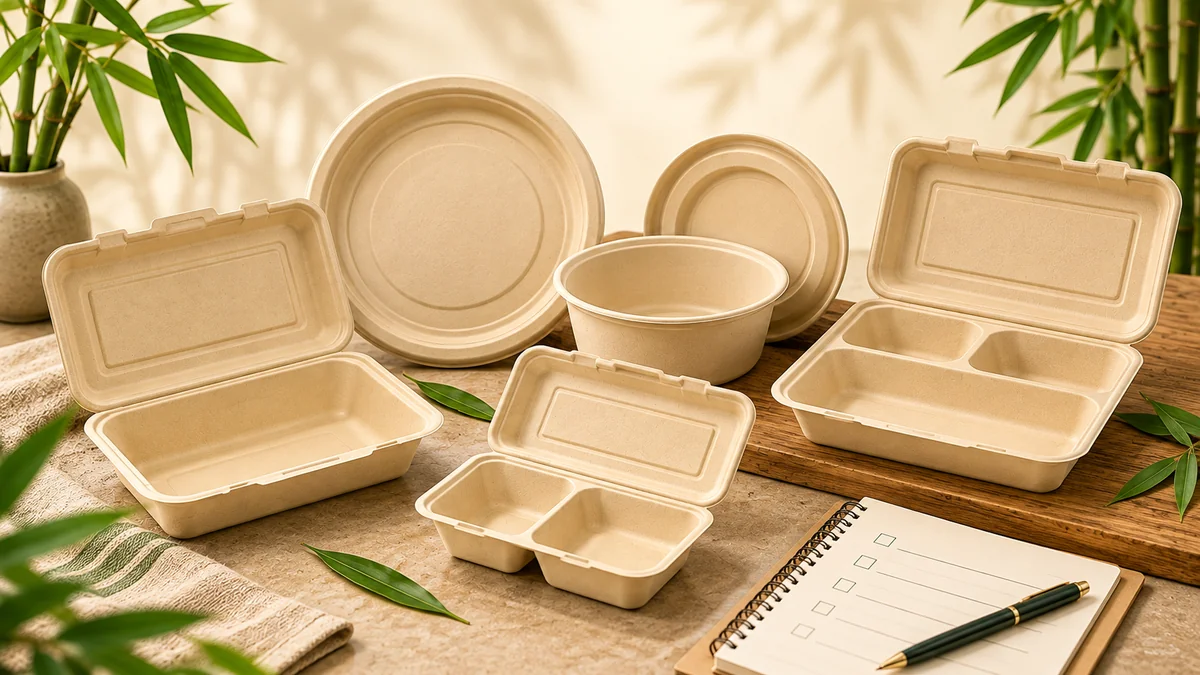
This list intentionally avoids unsupported labels such as “best,” “leading,” “fully certified” or “highest quality.” Those labels require a transparent scoring method and current evidence. I would rather give buyers a repeatable evaluation process than present an unverified winner.
What Should a Buyer Define Before Contacting Suppliers?
Define the product, intended use, target market, quantity, customization and required documents before asking for a quotation. Otherwise, suppliers may quote different products under the same broad description.
“Bamboo plate” can describe several constructions. One supplier may mean a molded bamboo-fiber plate. Another may offer a mixed plant-fiber product, bamboo leaf, bamboo veneer or a coated composite. Even when two products have the same diameter, their material, weight, compartment structure and packing may differ.
I recommend sending the same short brief to every supplier:
| Required input | Example of a clear buyer instruction |
|---|---|
| Product format | Round plate, square plate or compartment plate |
| Size | Nominal size plus required millimetre dimensions if critical |
| Food application | Dry food, moist food, oily food or another defined use |
| Service conditions | Expected temperature, contact time and transport conditions |
| Market | Country where the finished product will be sold or used |
| Quantity | Estimated initial order and annual demand by SKU |
| Customization | Standard item, logo, colour, packaging change or new structure |
| Delivery | Destination and preferred Incoterm |
| Evidence | Required specification, reports, declarations or certificates |
This common brief reduces false price comparisons. It also makes missing answers visible early, so the buyer does not discover a material or packing difference after approving a price.
How Can Buyers Verify the Actual Material?
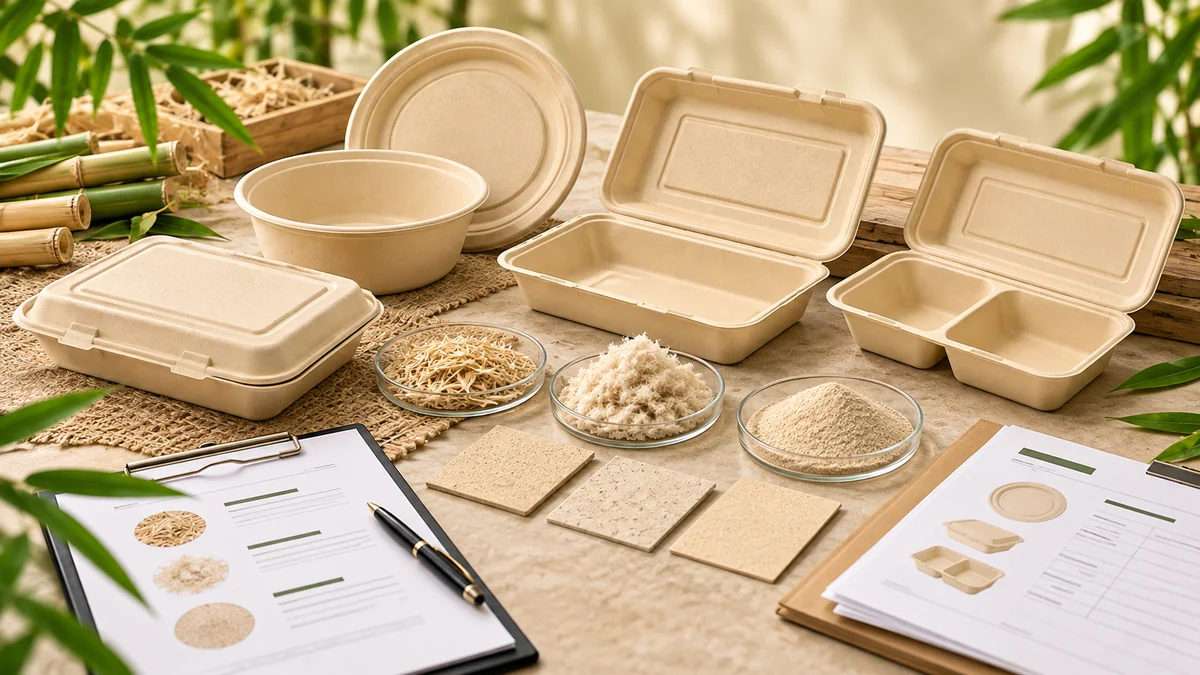
Ask for the composition of the finished product body and identify every separate component. Then compare the quotation, product specification, sample label and supporting documents to confirm that they describe the same material version.
A general label such as “bamboo,” “plant based” or “eco-friendly” is not a complete material specification. Buyers should ask whether the product includes other fibres, additives, coatings, films, colourants, printing, adhesives, lids or accessories.
| Material question | Why it matters | Useful evidence |
|---|---|---|
| What fibres are used and in what confirmed proportion? | Similar-looking products may use different formulations | Current product specification and manufacturer declaration |
| Are additives or barrier agents used? | Additives can change performance, evidence scope and disposal claims | Material declaration with component scope |
| Is there a coating, film or lamination? | A coating may affect food contact, recycling or compostability claims | Component specification and applicable report |
| Is printing or colour added? | Ink and colour may require separate review | Artwork, ink declaration or applicable evidence |
| Is there a separate lid or accessory? | A claim about the plate body may not cover another component | Separate lid/accessory material record |
| What changes trigger re-evaluation? | A new material, factory or process may invalidate earlier evidence | Written change-control process |
How Can a Buyer Detect a Material Mismatch Between the Quote and the Sample?
A material mismatch is not always obvious by looking at the sample. Two plates can have the same colour and shape but use different fibre blends, additives or surface treatments. So I do not treat appearance as proof of composition. I compare four records: the quotation, the specification, the sample identification and the evidence package.
First, I check whether every record uses the same supplier SKU or an explicitly linked version. If the quotation says “100% bamboo fiber” but the specification only says “plant fiber,” the description is not yet aligned. If a test report describes a different colour, coating or sample name, the supplier should explain the mapping rather than asking the buyer to assume equivalence.
Second, I check the dates. A new quotation may refer to a current formulation while the report or declaration covers an older version. The newest date is not automatically the correct answer, but a version difference should trigger a question. Buyers should ask what changed and whether the supporting evidence is still applicable.
Third, I record the scope of each statement. A declaration for the product body does not automatically cover a lid, label, ink or coating. This matters because a supplier may correctly describe one component while the complete packaging system contains additional materials.
Finally, I ask the supplier to confirm the relationship in writing. A short product-to-document mapping is often more useful than another marketing brochure. It shows the quoted SKU, current material version, relevant document and any excluded component. If the supplier cannot close the mismatch, I keep the material status pending and avoid making a final purchasing decision.
What Food-Contact Evidence Should a Supplier Provide?
A supplier should identify what was tested, which component was covered, the test method or requirement, the date, the result, the limitations and the documented relationship to the quoted SKU.
Food-contact reports, material declarations, quality-system certificates and compostability certificates answer different questions. A long document list is not useful if none of the documents can be connected to the product being purchased.
| Evidence field | Buyer question |
|---|---|
| Issuer | Who issued the report or declaration? |
| Date and identifier | Is the document current and traceable? |
| Sample description | What exact product or material was tested? |
| Component scope | Product body, lid, coating, print or complete package? |
| Test basis | Which method, regulation or customer requirement was referenced? |
| Market scope | Which destination market was considered? |
| Result | What did the report actually find? |
| Limitations | What does the document explicitly exclude? |
| Product mapping | Why does the supplier believe it applies to the quoted SKU? |
For the United States, the FDA regulates food-contact substances through specific authorizations and requirements. It does not issue a general “FDA certificate” for every finished disposable plate. Buyers should therefore ask what regulation, notification, test or other basis supports an “FDA” statement. The FDA’s own guidance explains how food-contact substances and components are regulated: Food Packaging & Other Substances that Come in Contact with Food and Determining the Regulatory Status of Components of a Food Contact Material.
Why Does One Test Report Not Automatically Cover Every SKU?
One report may be relevant to several related products, but the relationship must be explained. A laboratory tests the sample it receives under the stated method and conditions. The report does not automatically evaluate every size, factory, colour, coating, lid or later material version sold by the supplier.
When I review report coverage, I separate the laboratory result from the supplier’s product-family rationale. The laboratory can describe the tested sample and result. The supplier may then explain why other products share the same formulation and relevant process. Those are two different statements, and both should be visible.
For example, size differences may not change the material. However, a coating, printed logo, colourant, separate lid, altered fibre blend or different production site may create a new question. Buyers should not assume that a report for an unprinted product body also covers printed or coated variants. They also should not assume that a report for one component proves the suitability of the complete package.
A practical coverage review has three steps. First, identify the tested sample precisely. Second, list the characteristics that must remain equivalent: material, additives, coating, print, colour, process and manufacturing controls. Third, define the change triggers that require a new review. If the supplier can document that logic, the report may support a clearly defined family. But the wording should still say that the relationship is based on a supplier or manufacturer assessment, not that the laboratory independently certified every SKU.
This distinction protects both sides. The buyer receives a more accurate evidence package, and the supplier avoids promising a scope that the original report did not establish.
How Should Product Performance Be Evaluated?
Define the actual food, temperature, contact time, loading and transport conditions. Then ask for product-specific evidence or test a sample under those conditions. Generic performance labels are not enough.
Words such as “waterproof,” “oil-proof,” “leak-proof,” “microwave safe,” “oven safe” and “freezer safe” can hide important limits. Performance may change with the product structure, food type, contact time, temperature, lid and complete packaging configuration.
Buyers should specify:
- dry, moist, oily or liquid food;
- hot, ambient, chilled or frozen use;
- expected temperature and contact time;
- portion weight and distribution on the plate;
- stacking, holding and transport requirements;
- microwave, oven or freezer use, if relevant;
- the exact lid or accessory, if one is used.
If a supplier cannot provide applicable evidence, the correct response is not automatically “fail.” Instead, the condition remains unverified until the buyer and supplier complete a suitable assessment. This approach is more accurate than converting an evidence gap into either a positive or negative claim.
Should Buyers Choose a Manufacturer, Trader or Distributor?
Choose the supply model that fits your project. A manufacturer may offer deeper product and process control. A trader may coordinate several factories or product categories. A regional distributor may provide stock and faster local fulfilment. Buyers should verify who controls the product, documents, inventory and changes.
| Supply model | Potential advantage | Important verification point |
|---|---|---|
| Direct manufacturer | Product and process access; potential custom-development path | Which site makes the quoted SKU, and who controls specifications and changes? |
| Exporter or trading company | Broader sourcing network and consolidated communication | Which factory supplies the product, and can evidence be traced to that site and SKU? |
| Regional distributor | Local inventory, shorter delivery routes and smaller stock orders may be possible | Who manufactured the item, which documents apply, and how current is the stock? |
| Brand or private-label supplier | Market-ready assortment and packaging support | Who controls the underlying material, production and technical evidence? |
No model is automatically better. For a standard stock order, a local distributor may be efficient. But a new mould or material change may require direct engineering access. My recommendation is to compare the supply model with the actual task instead of treating “factory direct” as a universal answer.
Why Does Owning Equipment Not Prove Product-Development Capability?
Production equipment shows that a factory can perform a process, but it does not show how well the factory develops a new product. Product development also requires clear inputs, engineering review, mould control, sample iteration, measurable acceptance criteria and documented change management.
When I assess development readiness, I would not stop at a machine list. I would ask how the supplier converts a buyer’s reference image into a controlled specification. Who reviews the dimensions? How are food application and material requirements recorded? Who decides whether the request needs a new mould, a packaging change or a different test? How many sample stages are planned, and what happens when the first sample fails?
A capable team should also explain ownership and version control. The buyer needs to know who owns the mould, which drawing is current, how changes are approved and whether a revised sample replaces the earlier reference. Without that process, a factory can own advanced equipment but still struggle to repeat the approved result.
The same principle applies to capacity. A machine’s theoretical output does not equal available order capacity. Tooling, cycle time, product weight, trimming, inspection, packing, maintenance and existing orders all affect the production plan. So I recommend asking for an order-specific schedule after the product, quantity and packaging are confirmed.
This is why “we have the equipment” is only the beginning of a custom-development discussion. The stronger evidence is a disciplined path from buyer brief to drawing, sample, approval, production and change control.
What Should Buyers Test in a Sample?
Test the exact sample against measurable requirements and realistic use conditions. Keep the sample identity, results and approved version connected to the final specification.
Three useful sample stages
- Stock sample: Shows an existing material, finish and product format. It may not represent a custom order.
- Pre-production or custom sample: Confirms intended dimensions, structure, artwork or packaging.
- Approved reference sample: Becomes the agreed visual and dimensional reference for production and inspection.
| Sample check | What to record |
|---|---|
| Identity | Supplier, SKU, material version and sample date |
| Dimensions | Diameter, height, compartment layout and agreed tolerance |
| Weight | Individual item weight and test method |
| Appearance | Colour, surface, rim, edge, marks and fibre distribution |
| Shape | Warping, nesting and de-nesting |
| Intended use | Actual food, temperature, time and loading condition |
| Packing interaction | Stack height, compression, bag/carton fit and handling |
| Lid or accessory | Exact matching component and fit observation |
| Decision | Accepted, rejected or revision required, with reason |

Why Does a Good Sample Not Guarantee Consistent Mass Production?
A sample proves that one or several pieces met the buyer’s expectations at a particular time. It does not prove that every production batch will match unless the approved characteristics are converted into controlled production and inspection requirements.
The first risk is identity. A hand-selected sample may not come from the same mould, material version or production conditions planned for the order. So the approved sample should carry a traceable SKU, version and date. The purchase order and production specification should reference that same version.
The second risk is scale. During mass production, raw-material variation, moisture, forming conditions, trimming, equipment setup and packing pressure may affect the result. A factory needs measurable checkpoints, not only a visual instruction to “make it like the sample.” Dimensions, weight, appearance, warping and packaging quantities should be checked through the production process.
The third risk is change. If the supplier changes a material, mould, site, colour, print or pack configuration, the earlier sample may no longer represent the order. Buyers should agree which changes require notification and whether a new sample is needed.
Finally, acceptance must be practical. The buyer and supplier should agree how many pieces are inspected, which defects are critical and what corrective action follows a failure. A golden sample is useful, but it works best alongside a written specification and inspection plan. My view is simple: approve the sample, but control the process that must reproduce it.
How Should Buyers Compare MOQ and Lead Time?
Compare MOQ and lead time only after confirming the exact SKU, packaging and customization scope. Also ask what event starts the production clock and which conditions can change the schedule.
MOQ and lead time may differ for:
- standard products;
- custom colours or printing;
- special retail packaging;
- new moulds or structural changes;
- mixed-SKU orders;
- trial or sample production;
- peak production periods.
| Commercial field | Question to ask |
|---|---|
| Standard MOQ | What is the regular MOQ per SKU for the confirmed standard item? |
| Custom MOQ | Does logo, colour, packaging or a new mould change the minimum quantity? |
| Mixed loading | Can multiple approved SKUs share a shipment, and under what conditions? |
| Lead-time start | Does time start after deposit, artwork, sample or final specification approval? |
| Production time | Is the stated number a normal estimate or an order-confirmed schedule? |
| Transit time | Is shipping time excluded from the production estimate? |
| Exception approval | Who approves a lower MOQ or special schedule, and is it written into the quotation? |
I do not treat a general ten-day or two-week statement as an unconditional shipment promise. A workable schedule should identify the order, quantity, product version, packaging, approval status and production start condition.
How Should Custom Projects Be Assessed?
Give the supplier a reference image or drawing, dimensions, food use, expected quantity, destination market, logo method and packaging needs. The supplier should then evaluate feasibility instead of promising a solution before engineering review.
“Custom packaging” may mean a logo, printed pack, colour change, adjusted dimensions, a new compartment, a new mould or a different material. These changes have different cost, evidence and lead-time effects.
A useful custom-development response should clarify:
- which requirement can use an existing product;
- which requirement needs a new mould or drawing;
- which material and process are proposed;
- whether new testing or documentation is required;
- sample stages and approval criteria;
- mould ownership and maintenance;
- custom MOQ and estimated schedule;
- packaging, artwork and labelling responsibilities;
- change limits after sample approval.
Why Do Packaging and Logistics Data Matter?
Carton quantity, dimensions and weight affect freight, storage, loading and landed cost. An attractive unit price may become expensive if packing data is inaccurate or the product uses container space inefficiently.

For each SKU, request:
- pieces per inner pack;
- inner packs per carton;
- pieces per carton;
- carton dimensions;
- carton net and gross weight;
- pallet configuration, if used;
- loading estimate and calculation basis;
- carton marking and retail-pack requirements.
Why Is the Lowest Unit Price Not Always the Lowest Purchasing Cost?
Unit price is visible, but several important costs sit outside that number. Packaging volume affects how many pieces fit into a carton, pallet or container. If two products have the same unit price but one requires substantially more shipping space, the landed cost can be different.
Packing errors also create operational costs. An incorrect carton quantity affects warehouse receiving and customer orders. An inaccurate gross weight can create freight or customs problems. Weak cartons or poor stacking can increase damage. And if the buyer must rework labels or retail packs after arrival, the original price comparison loses meaning.
Quality variation has a similar effect. A lower-priced product may generate more inspection, replacement or complaint costs if the specification is unclear. Delays can create stockouts or emergency freight. Custom tooling can also change the calculation because mould cost, sample revisions and additional tests may need to be allocated across the expected order volume.
So I recommend comparing a landed-cost worksheet rather than a price column. The worksheet should include product price, packing quantity, carton volume, freight basis, tooling, sample cost, inspection, expected handling and the cost of unresolved risks. Buyers do not need to invent a precise value for every risk, but they should make each difference visible.
This analysis does not mean that the highest-priced supplier is safer. It means that price should be compared after the product, evidence, packaging and delivery assumptions are aligned. Once the scope is consistent, the buyer can see which offer is genuinely economical.
What Quality Controls Should Buyers Ask About?
Ask what is checked, when it is checked, how results are recorded and what happens when a product falls outside the approved specification.
A useful quality-control discussion covers:
- incoming raw-material checks;
- first-article approval;
- in-process dimensions, weight and visual inspection;
- mould and process setup;
- product and carton quantity checks;
- final inspection and sampling method;
- batch or production-date traceability;
- retained samples;
- nonconforming-product control;
- corrective action;
- material, process, mould, site, print or packing change notification.
“Good quality” is not an inspection standard. Buyers and suppliers need measurable acceptance criteria and a shared defect language.
How Can Buyers Build a Final Supplier Shortlist?
Score only the factors that matter to the project, record evidence gaps separately, and avoid giving a high score simply because a supplier has more marketing claims.
| Evaluation area | Supplier A | Supplier B | Supplier C |
|---|---|---|---|
| Exact SKU and product structure confirmed | |||
| Finished-product material and components confirmed | |||
| Documents mapped to selected SKU | |||
| Use conditions supported or sample-tested | |||
| Manufacturing or supply role understood | |||
| Sample status and result recorded | |||
| Standard and custom MOQ separated | |||
| Lead-time basis stated | |||
| Packing data complete and consistent | |||
| Quality plan and change control available | |||
| Incoterm, payment and quotation scope clear | |||
| Open risks or pending evidence |
Common red flags
- The material description changes between the quotation, sample and report.
- One report is presented as proof for unrelated materials or components.
- Certification language is used without a certificate number or applicable scope.
- MOQ, lead time or packing quantities change without explanation.
- The supplier cannot identify the production site or product version.
- A custom design is promised before drawings and use conditions are reviewed.
- Sample acceptance is not converted into a specification or inspection plan.
- Carton quantities, net weight and product weight are inconsistent.
- Important product changes can occur without buyer notification.
One missing document does not automatically mean that a product is unsuitable. It means that the buyer has an open question. The purchasing decision should reflect whether that question is resolved, accepted as a controlled risk or still pending.
A Practical Next Step with PANABAM
If you are evaluating a PANABAM product, send the required plate size and structure, intended food use, estimated quantity, destination market and any logo or packaging requirement. We can use that information to identify a current product option or arrange an internal review of a custom request.
You can review our Plates & Trays, browse All Products, read about the OEM & ODM process, check our FAQs, or contact PANABAM with your sourcing brief.
For the selected SKU, request the current specification, packaging data, sample options and applicable supporting documents. Availability, price, custom feasibility and order timing should be confirmed for the individual project.
Frequently Asked Questions
What should I ask a bamboo disposable plate supplier first?
Start with the exact product format, size, finished-product material, target market, intended food use, quantity and required documents. This prevents different products from being quoted under the same broad “bamboo plate” description.
How can I verify the material stated by a supplier?
Request a current product specification and manufacturer material declaration for the quoted SKU. Compare those records with the sample identification and supporting documents. Also review the product body, coating, printing, colour, lid and other components separately.
Does one food-contact report cover every plate from the same supplier?
Not automatically. Check the tested sample, material, structure, colour, coating, component, method and market. Then ask the supplier to document why the report is relevant to the selected SKU and which changes would require a new review.
What should I test in a plate sample?
Check identity, dimensions, weight, finish, rim quality, warping, nesting, stacking and performance with the intended food, temperature and contact time. If a lid or accessory is involved, test the exact complete configuration.
Why can MOQ and lead time change for a custom project?
Custom colour, printing, retail packaging, a new mould, a structural change or a different material may require separate setup, samples and approval. Ask for standard-product and custom-project conditions separately.
Is the lowest-priced supplier usually the best option?
Not necessarily. Compare the specification, evidence, quality controls, packing, Incoterm, payment terms, lead-time basis and unresolved risks. A low unit price may not produce the lowest landed cost or the lowest purchasing risk.
Conclusion
A supplier list helps buyers find companies to research, but it does not replace product-level verification. I recommend giving every supplier the same brief and comparing the responses against the same material, evidence, sample, commercial and quality-control requirements.
The strongest supplier is not the company with the most claims. It is the company that can connect its quotation, sample, specification, evidence, production plan and packing data to the exact product the buyer intends to purchase.