


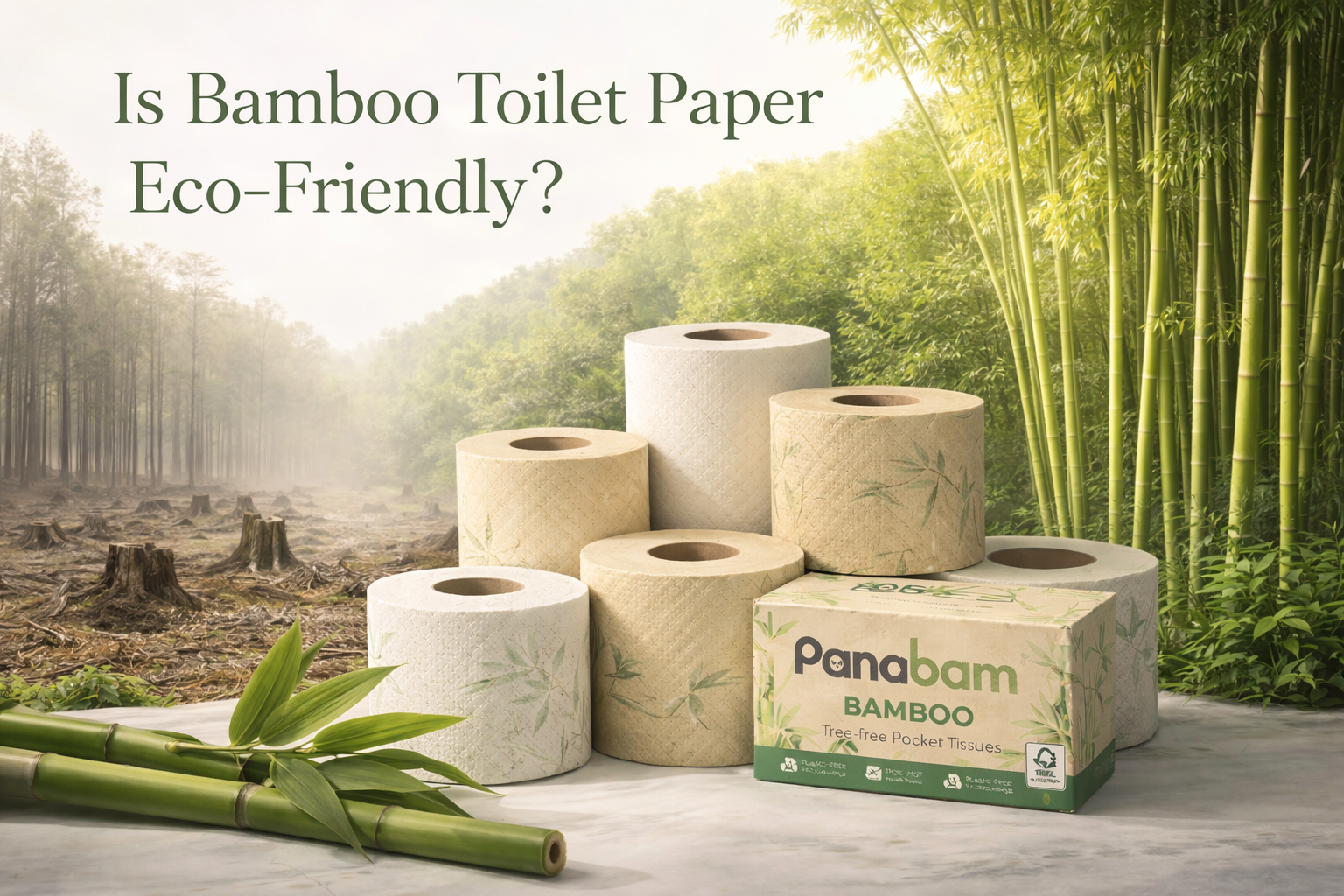
1. Introduction: Why Bamboo Toilet Paper Matters for Business
Most toilet paper still comes from virgin forest fiber. I see this as a real problem. It drives deforestation, raises carbon emissions, and creates ESG risks for businesses. Hotels, offices, retailers, and public institutions now face pressure from guests, clients, and regulators. They need restroom products that are eco-friendly, compliant, and reliable.
I started paying attention to bamboo toilet paper because it promises a tree-free solution. It sounds simple. But I learned quickly that “bamboo” alone does not guarantee eco-friendliness. Processing methods, chemicals, and supplier transparency matter just as much as the fiber itself. In this article, I explain what actually makes bamboo toilet paper eco-friendly, using data, science, and practical B2B experience.
2. What Does “Eco-Friendly Toilet Paper” Actually Mean?
2.1 Clear Criteria Beyond Marketing Claims
I do not trust green labels without proof. When I evaluate eco-friendly toilet paper, I focus on five core criteria.
First, raw material matters. Eco-friendly toilet paper must be tree-free or use low-deforestation fibers. It should avoid virgin forest pulp, especially from old-growth forests.
Second, climate impact matters. I look at total lifecycle greenhouse gas emissions, not just one stage. Lower emissions than virgin wood pulp are essential.
Third, chemistry matters. Truly eco-friendly toilet paper avoids chlorine bleaching, BPA, formaldehyde, PFAS, and unnecessary fragrances. These chemicals affect both human health and wastewater systems.
Fourth, end-of-life performance matters. The paper must be biodegradable, septic-safe, and free from microplastics.
Finally, transparency matters. FSC certification, ISO systems, and test reports tell me whether a supplier is credible or just marketing.
2.2 Full Lifecycle Perspective
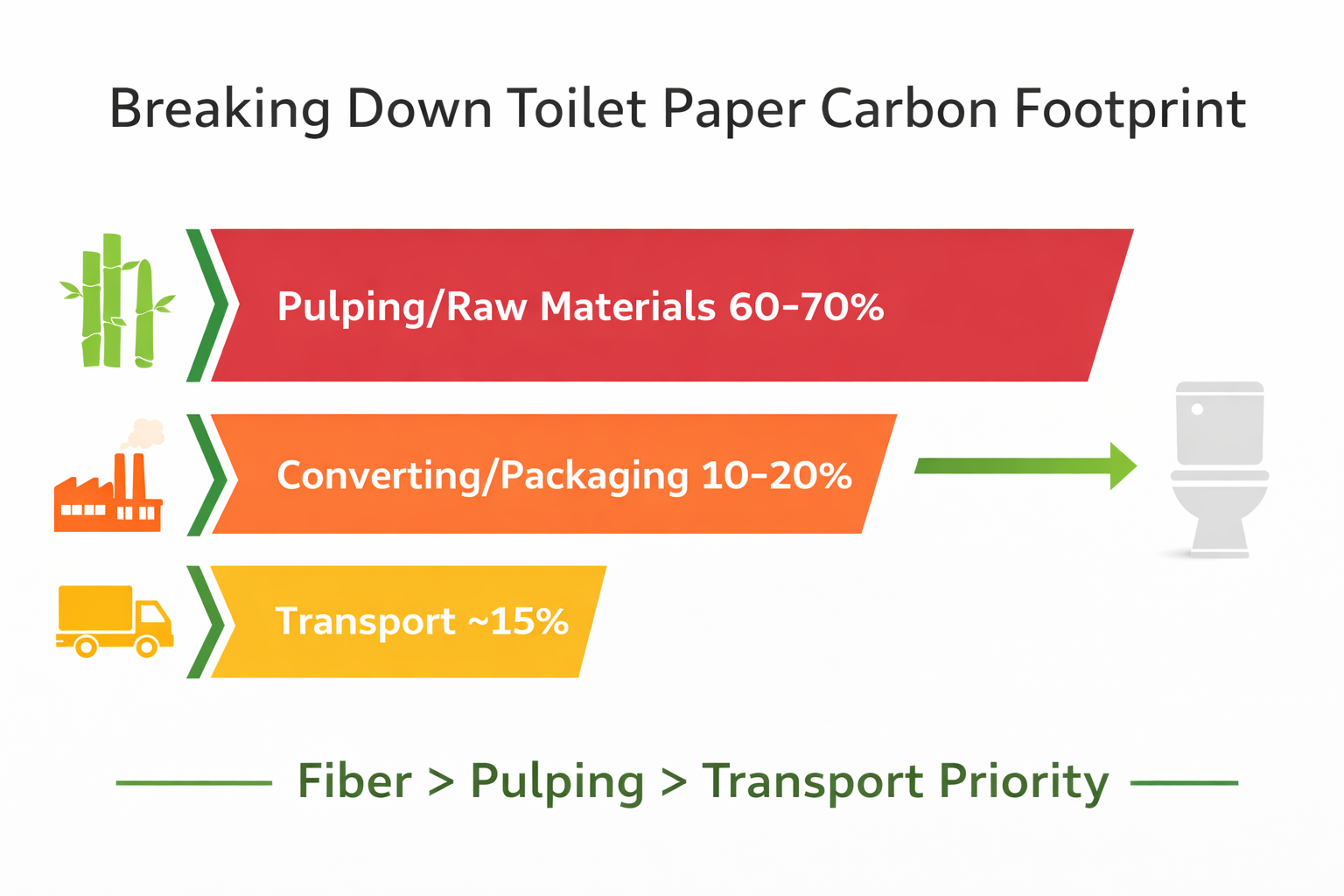
When I studied lifecycle data, I realized many buyers focus too much on shipping distance. That is a mistake.
Typical emissions breakdown looks like this:
- Pulping and raw materials: ~60–70%
- Converting and packaging: 10–20%
- Transport: ~15%
This changed how I think. Fiber choice and pulping efficiency matter far more than whether a factory is local. A modern bamboo mill can be lower carbon than a nearby but inefficient wood pulp supplier.
3. Is Bamboo as a Fiber Eco-Friendly?
3.1 Growth, Regeneration & Land Efficiency
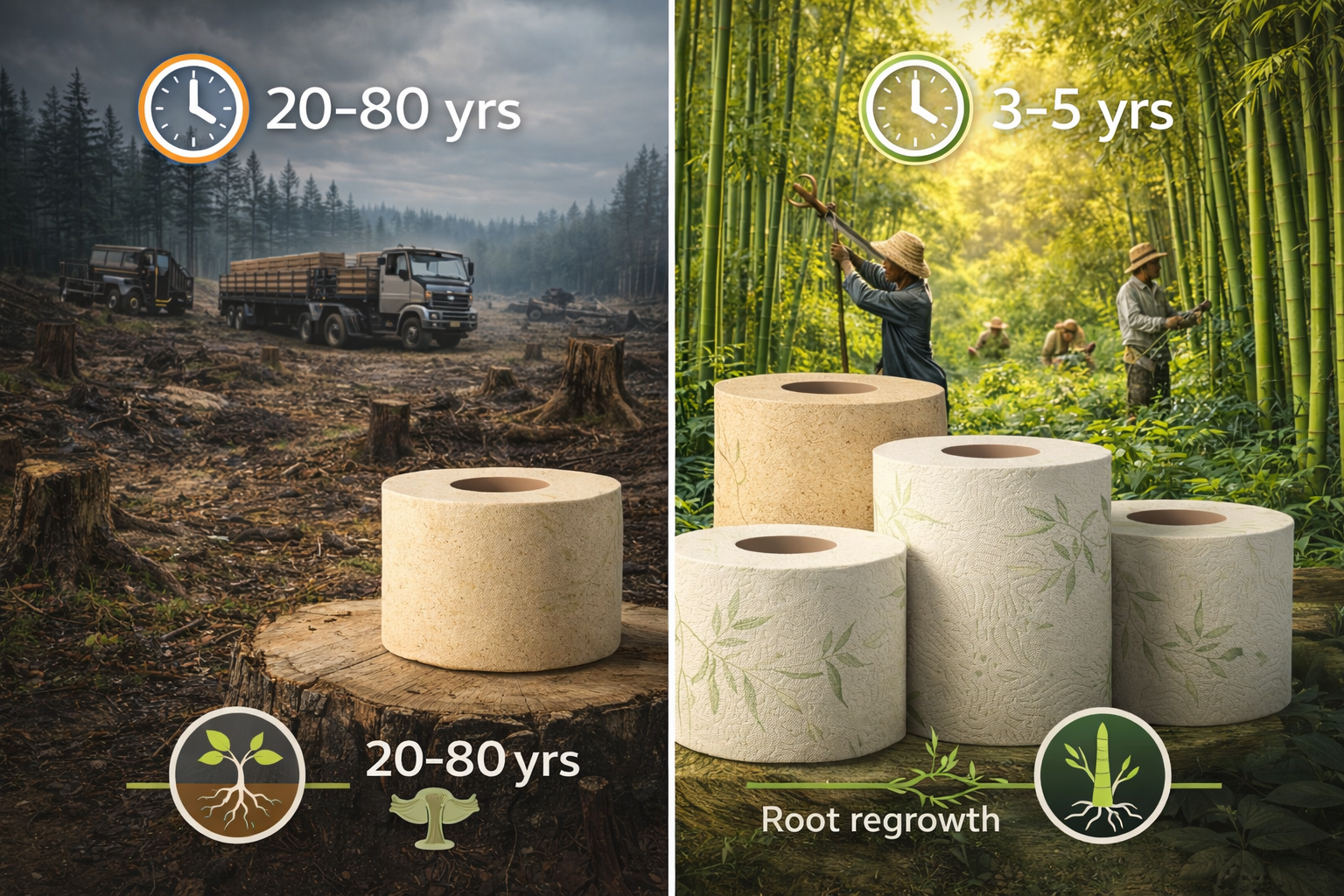 Bamboo stands out as a fiber source. It grows fast and regenerates naturally. I compared bamboo with virgin forest trees:
| Factor | Bamboo | Trees (Virgin Forest) |
|---|---|---|
| Harvest cycle | 3–5 years | 20–80+ years |
| Replanting | No (root regrowth) | Yes |
| Land productivity | High | Low |
Bamboo is grass, not a tree. It regrows from its roots after harvest. That means no clear-cutting and no decades of waiting.
3.2 Carbon Storage & Emissions
Research shows bamboo tissue can produce around 30% fewer greenhouse gas emissions than toilet paper made from 100% virgin forest fiber. Bamboo also sequesters CO₂ quickly as it grows.
However, I also learned that bamboo culms can emit CO₂ if plantations are poorly managed. Because of this, net benefit depends on land management and processing efficiency. Responsible sourcing makes the difference.
3.3 Ending “Tree-to-Toilet” Deforestation
Virgin pulp often comes from boreal forests. These forests store massive amounts of carbon and support biodiversity. Cutting them for single-use toilet paper makes little sense.
Bamboo avoids this damage when it is responsibly sourced. That is why I see bamboo as a practical way to break the “tree-to-toilet” cycle.
4. Production Process: Where Eco Impacts Occur
4.1 Bamboo → Toilet Roll Steps
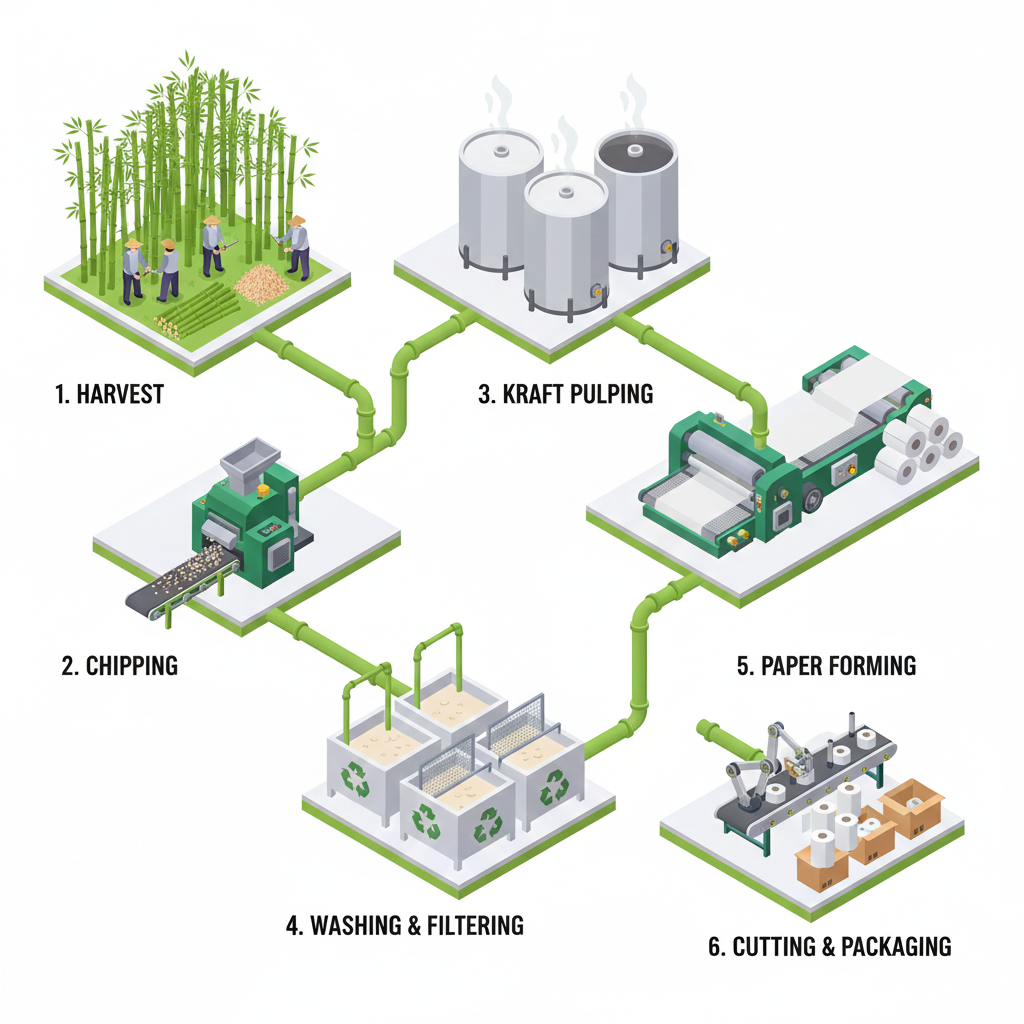
Understanding the process helped me spot real eco risks. The basic steps are:
- Harvest and chip bamboo
- Pulping through cooking and washing
- Bleaching (ECF, TCF, or unbleached)
- Converting into rolls or tissue
The pulping stage uses the most energy. This is where most emissions come from.
4.2 Chemical Safety
I always check chemical use. I avoid products that contain:
- Chlorine
- BPA
- Formaldehyde
- PFAS
- Artificial fragrances
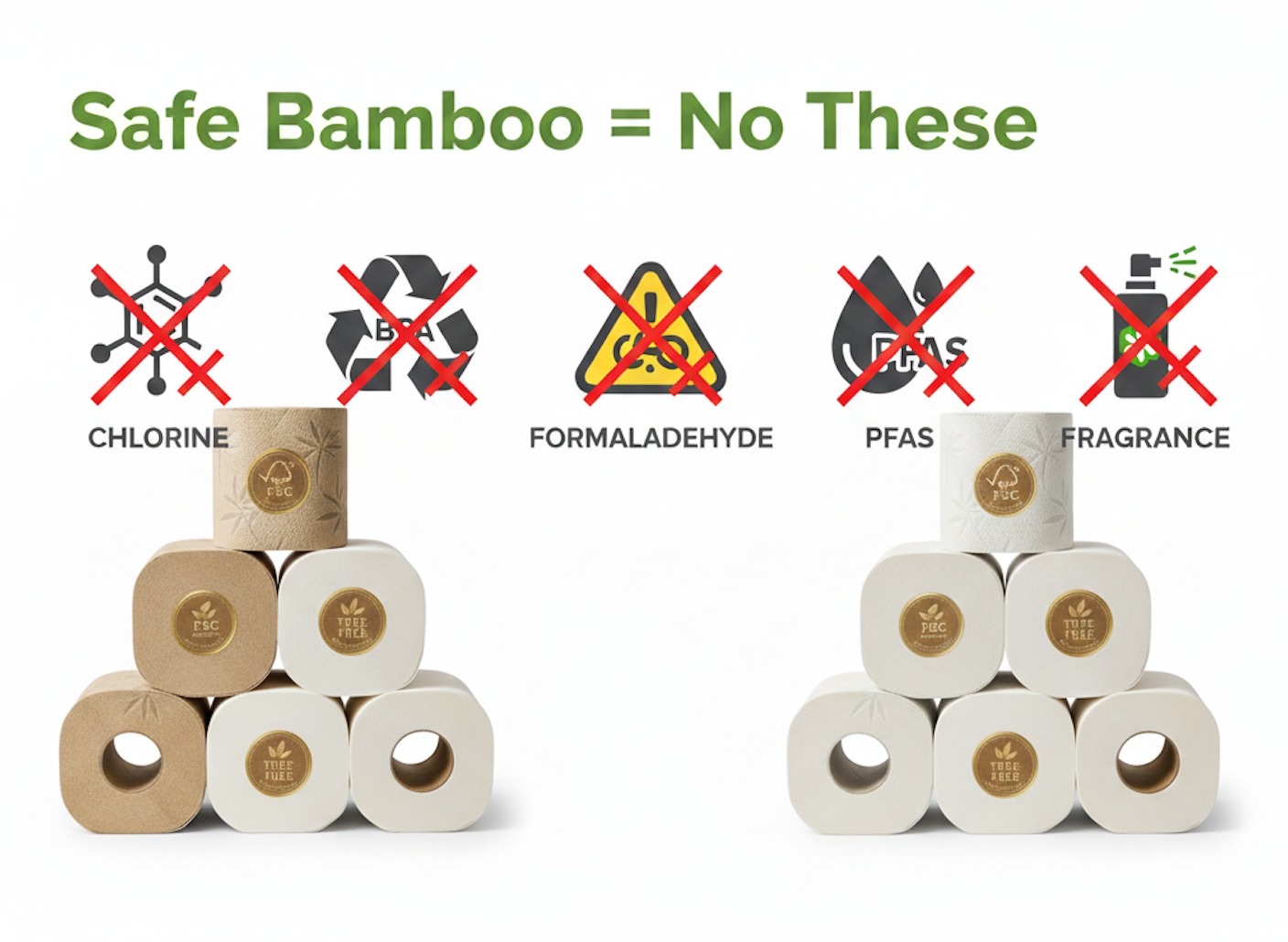
At PANABAM, I work with unbleached natural tan tissue and chemical-free options. When bleaching is needed, ECF or TCF methods reduce environmental harm.
4.3 Biodegradability & Septic Safety
Bamboo toilet paper is 100% plant-based. It dissolves naturally in water. In real use, it is safe for septic systems, RVs, and marine toilets. This matters a lot for hotels, resorts, and remote facilities.
4.4 Bidet + Bamboo: Maximum Eco Impact
Bidets use less water than producing toilet paper. When I pair a bidet with bamboo toilet paper, I reduce paper use and keep the fiber tree-free. This combination offers one of the lowest-impact restroom setups available today.
5. Health, Comfort & Performance

5.1 Strength = Fewer Sheets Used
Bamboo fibers are long and strong. This gives bamboo toilet paper high wet and dry strength. Because users need fewer sheets, overall consumption drops. Lower use means a lower eco footprint.
5.2 Softness for Premium Settings
Many people assume eco-friendly means rough. That is no longer true. Multi-ply design and embossing allow bamboo toilet paper to match premium wood pulp tissue. This is critical for hotels, offices, and wellness spaces.
5.3 Do Gynecologists Recommend Bamboo Toilet Paper?
Many gynecologists recommend toilet paper that is unscented, dye-free, and chlorine-free. Bamboo toilet paper fits these needs well. It is hypoallergenic, low-lint, and gentle on sensitive skin.
5.4 Do Plumbers Recommend Bamboo Toilet Paper?
Yes. Plumbers often complain about thick, heavily quilted brands. Excessive thickness causes clogs. Bamboo toilet paper breaks down naturally. That is why plumbers prefer it over brands like Charmin.
6. Pros & Cons: Honest Assessment
6.1 Eco Advantages
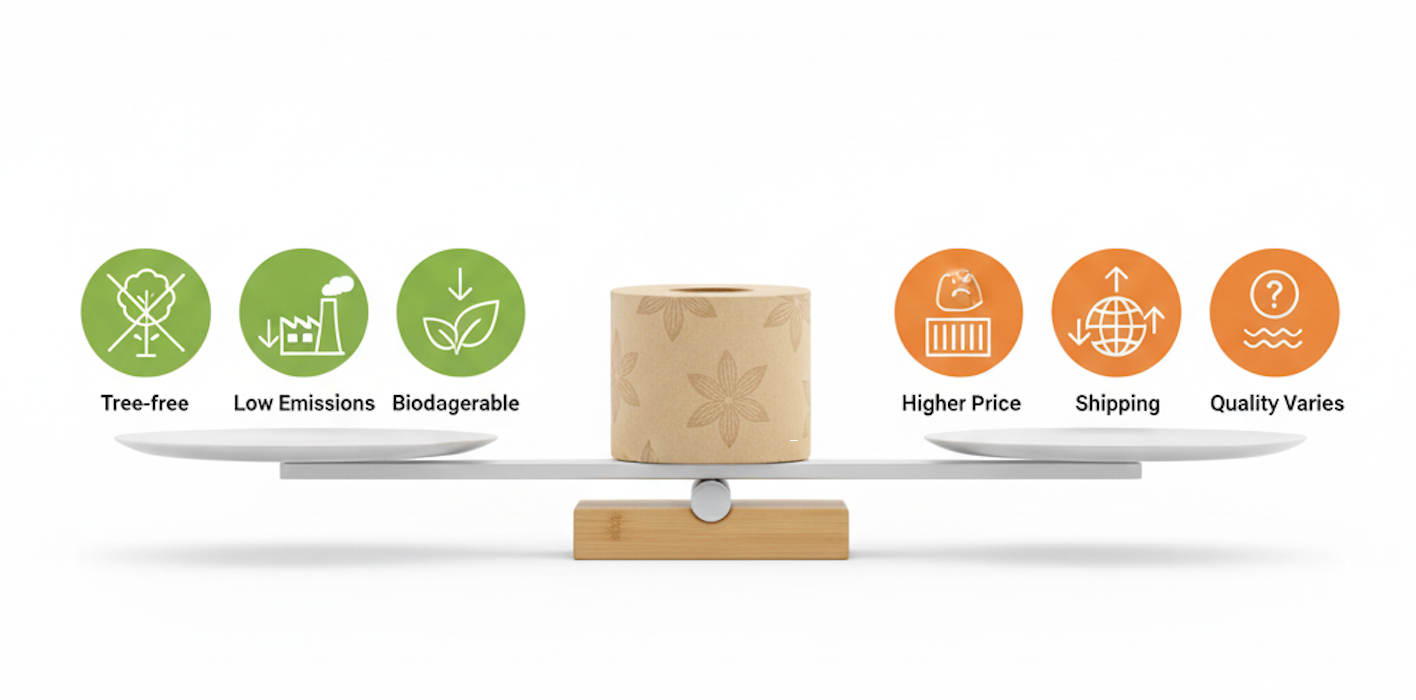
Bamboo toilet paper offers clear benefits:
- Tree-free renewable fiber
- Lower emissions than virgin forest TP
- Biodegradable and septic-safe
- Plastic-free packaging options
6.2 What Is the Downside of Bamboo Toilet Paper?
There are trade-offs. Unit price is usually higher, though strength offsets this. Brand quality varies widely. Production often happens in Asia, so shipping emissions must be managed with full containers and efficient logistics.
7. Bamboo vs Recycled vs Virgin: Carbon & Eco Comparison
7.1 Bamboo vs Virgin Wood TP
Virgin toilet paper performs worst. It destroys boreal forests and carries the highest emissions.
7.2 Bamboo vs Recycled TP
| Metric | Recycled | Bamboo |
|---|---|---|
| Tree-free | ✅ | ✅ |
| Fiber reuse | ✅ | ❌ |
| Softness | Medium | Premium |
| Guest appeal | Basic | High-end |
7.3 What Is Better: Bamboo or Recycled?
Both beat virgin. Recycled maximizes reuse. Bamboo delivers premium performance and a strong tree-free story. I often recommend using both, depending on the space.
7.4 Which Toilet Paper Has the Lowest Carbon Footprint?
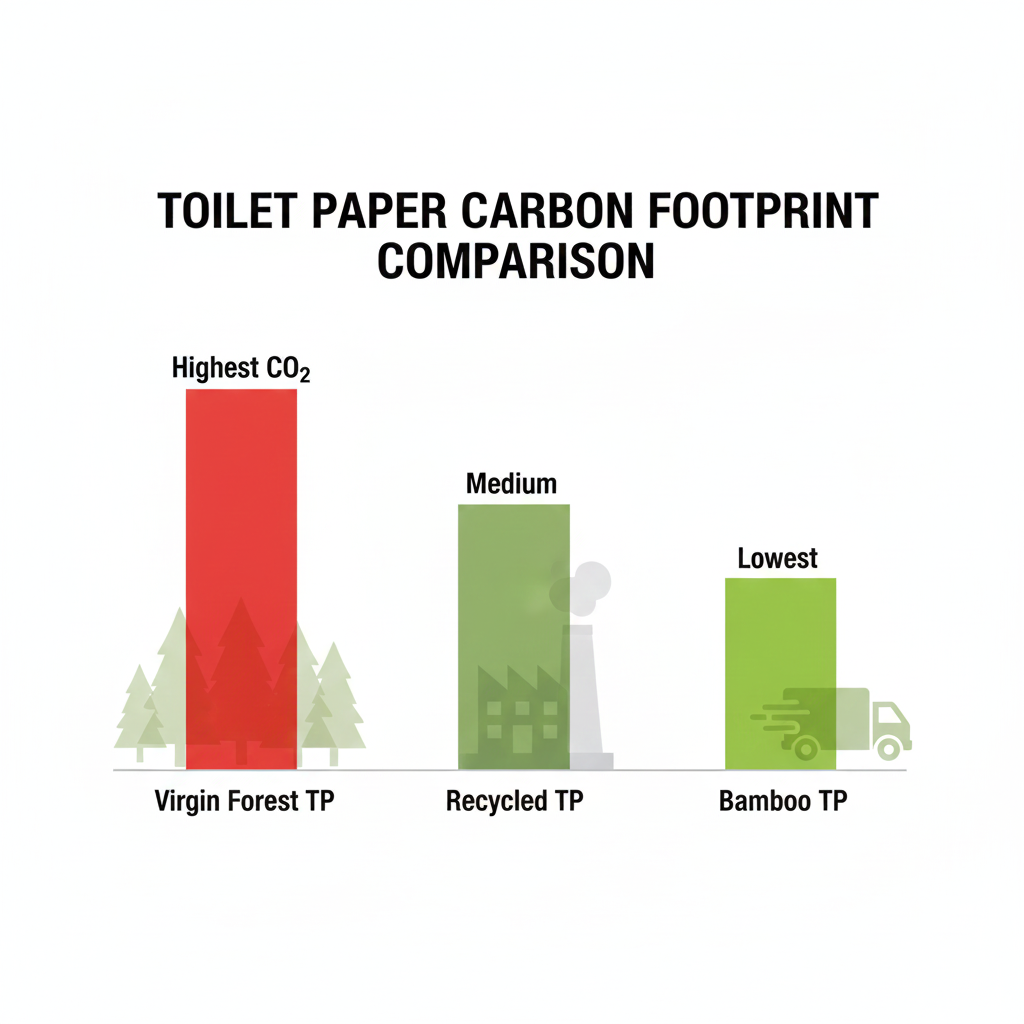 Top performers include high post-consumer recycled tissue made with clean energy and bamboo tissue produced in modern, efficient mills. Virgin forest TP ranks last.
7.5 Which Is the Most Environmentally Friendly Toilet Paper?
Leaders use 48%+ post-consumer recycled fiber or FSC-certified bamboo with low-impact chemistry. I avoid 100% virgin forest fiber products.
8. Greenwashing Risks to Avoid
I watch out for these red flags:
- “Bamboo” labels mixed with wood pulp
- Missing FSC or ISO certificates
- Vague chemical claims
- Inconsistent quality that causes overuse
PANABAM solves this with factory-direct supply, 100% bamboo pulp, and full documentation.
9. Global Toilet Practices: Context for Bamboo TP
9.1 What Do Muslims Use Instead of Toilet Paper?
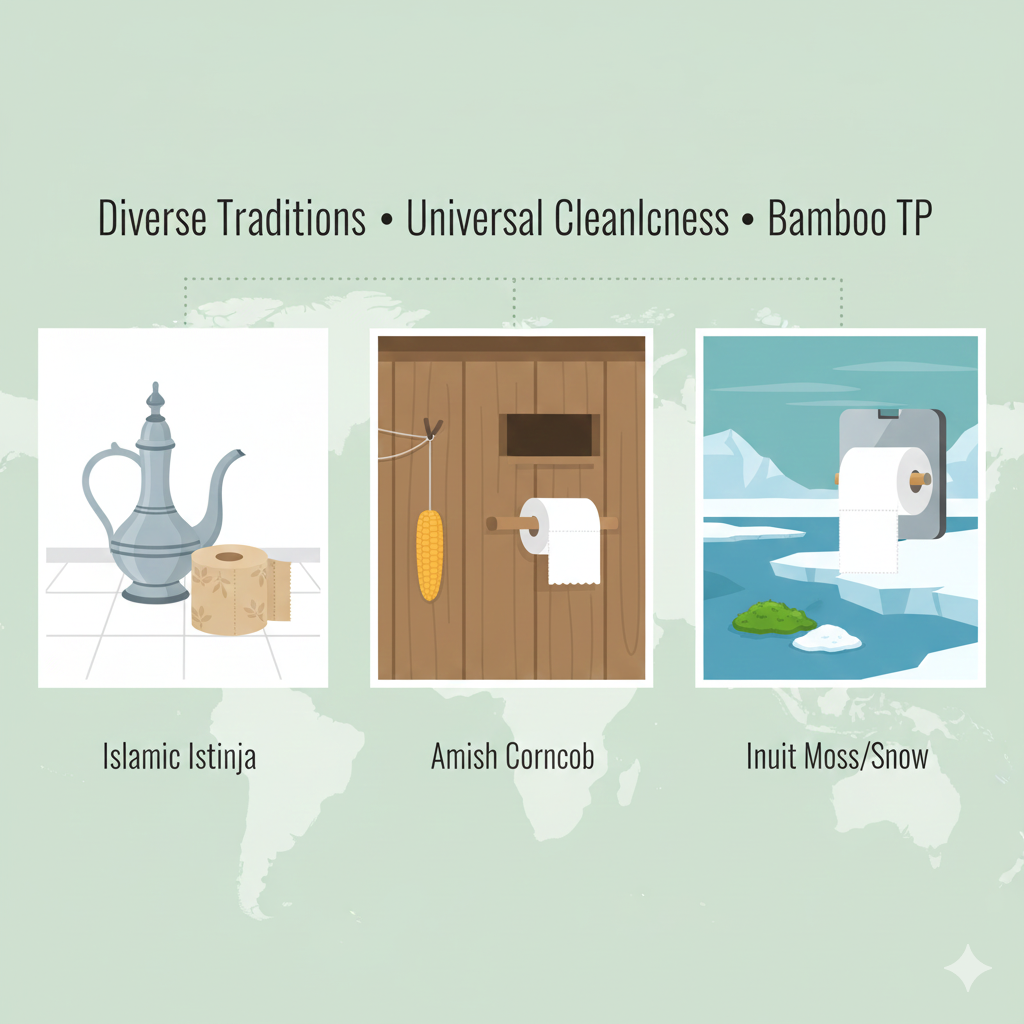
Many Muslims practice istinja, using water first. Bamboo toilet paper works well as a minimal, eco-friendly companion.
9.2 What Do Amish Use Instead of Toilet Paper?
Traditionally, corncobs were used. Today, basic toilet paper is common. Bamboo fits simple and natural preferences.
9.3 What Do Eskimos (Inuit) Use for Toilet Paper?
Traditionally, moss or snow was used. Modern Inuit communities use standard TP. Bamboo suits remote areas with septic limits.
10. PANABAM: Factory-Direct Eco Bamboo Solutions
10.1 Sichuan Bamboo Heartland
Our factory is in Chengdu, Sichuan. Local bamboo supply reduces raw material transport.
10.2 Industrial Scale
We operate 20+ automated lines with capacity for 300+ containers per month.
10.3 Full Certifications
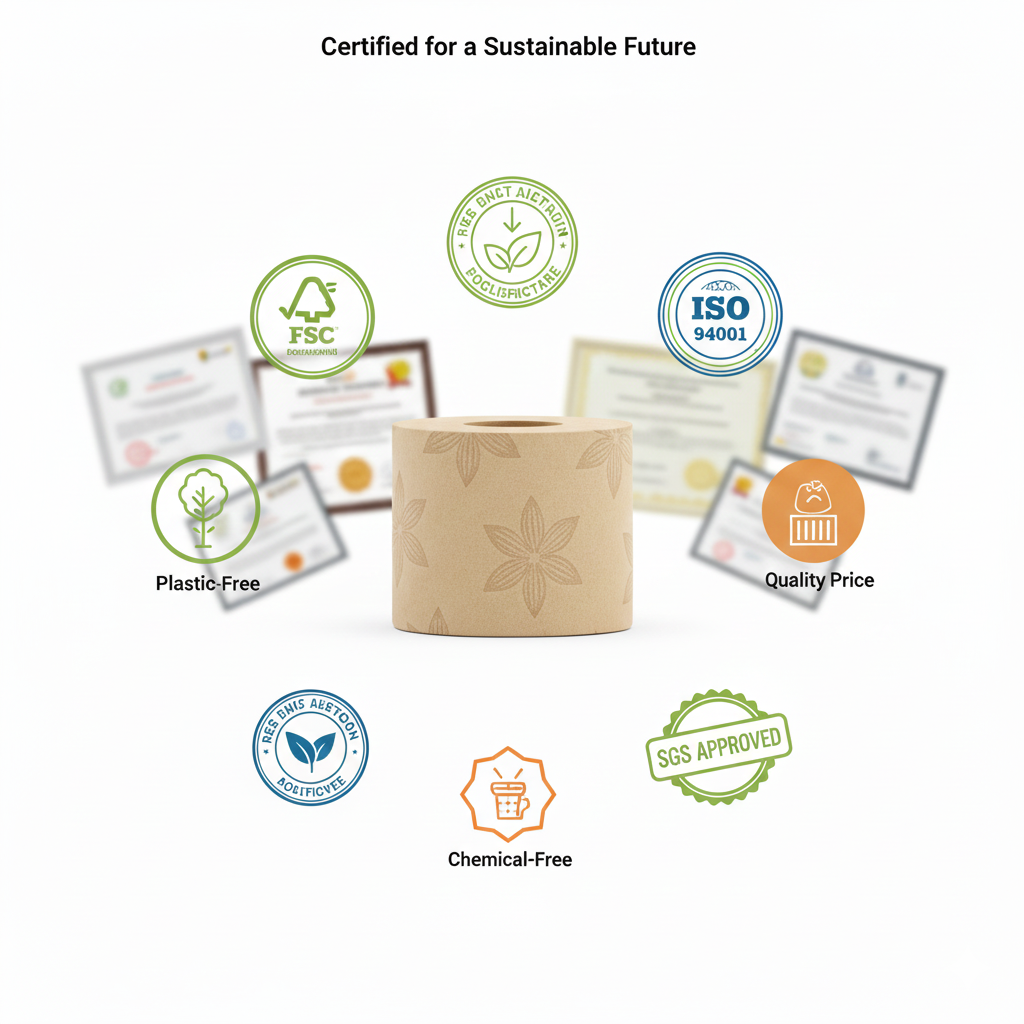
- FSC bamboo pulp
- ISO 9001 / ISO 14001
- Compostability and septic reports
- Chemical safety testing
10.4 B2B Product Range
We supply toilet paper, facial tissue, paper towels, jumbo rolls, and napkins.
10.5 OEM/ODM + Plastic-Free Packaging
We support private label brands for global retail and hospitality markets.
11. B2B Buyer’s Eco Checklist
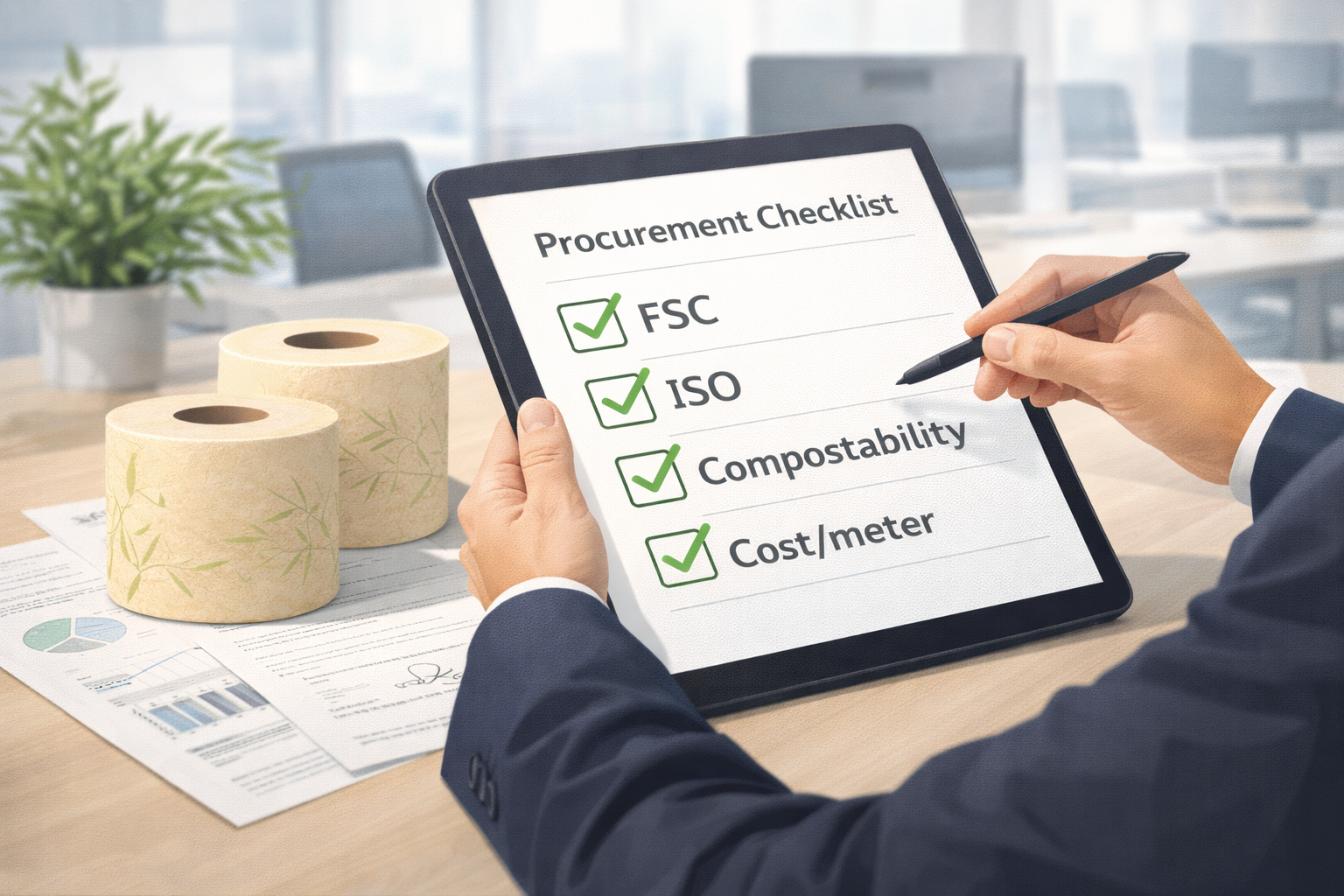
11.1 Documentation Required
- FSC certificates
- Chemical test reports
- Septic and compostability data
- ISO systems
11.2 Commercial Vetting
- Cost per meter, not per roll
- Monthly container capacity
- Stable lead times
11.3 Use Case Matching
- Hotels: premium guest rolls
- Offices: jumbo rolls for ESG reporting
- Retail: plastic-free hero SKUs
12. FAQ: All Your Bamboo Toilet Paper Questions
Is bamboo toilet paper eco-friendly?
Yes, responsibly sourced and certified bamboo beats virgin forest TP.
What is the downside of bamboo toilet paper?
Higher price, quality variation, and shipping, all manageable with the right supplier.
What is better for the environment, bamboo or recycled?
Both outperform virgin. Recycled maximizes reuse. Bamboo offers premium tree-free performance.
Do gynecologists recommend bamboo toilet paper?
Yes, when it is unscented and chlorine-free.
Which toilet paper has the lowest carbon footprint?
Efficient recycled or modern bamboo mills.
Do plumbers recommend bamboo toilet paper?
Yes, because it dissolves better than thick quilted brands.
13. Conclusion & Next Steps
Bamboo toilet paper is eco-friendly when real science, certifications, and performance back it up. For B2B buyers, PANABAM offers factory-direct solutions that protect margins and meet ESG goals.
Contact info@panabam.com for free samples, full certification packages, and custom OEM pricing.