

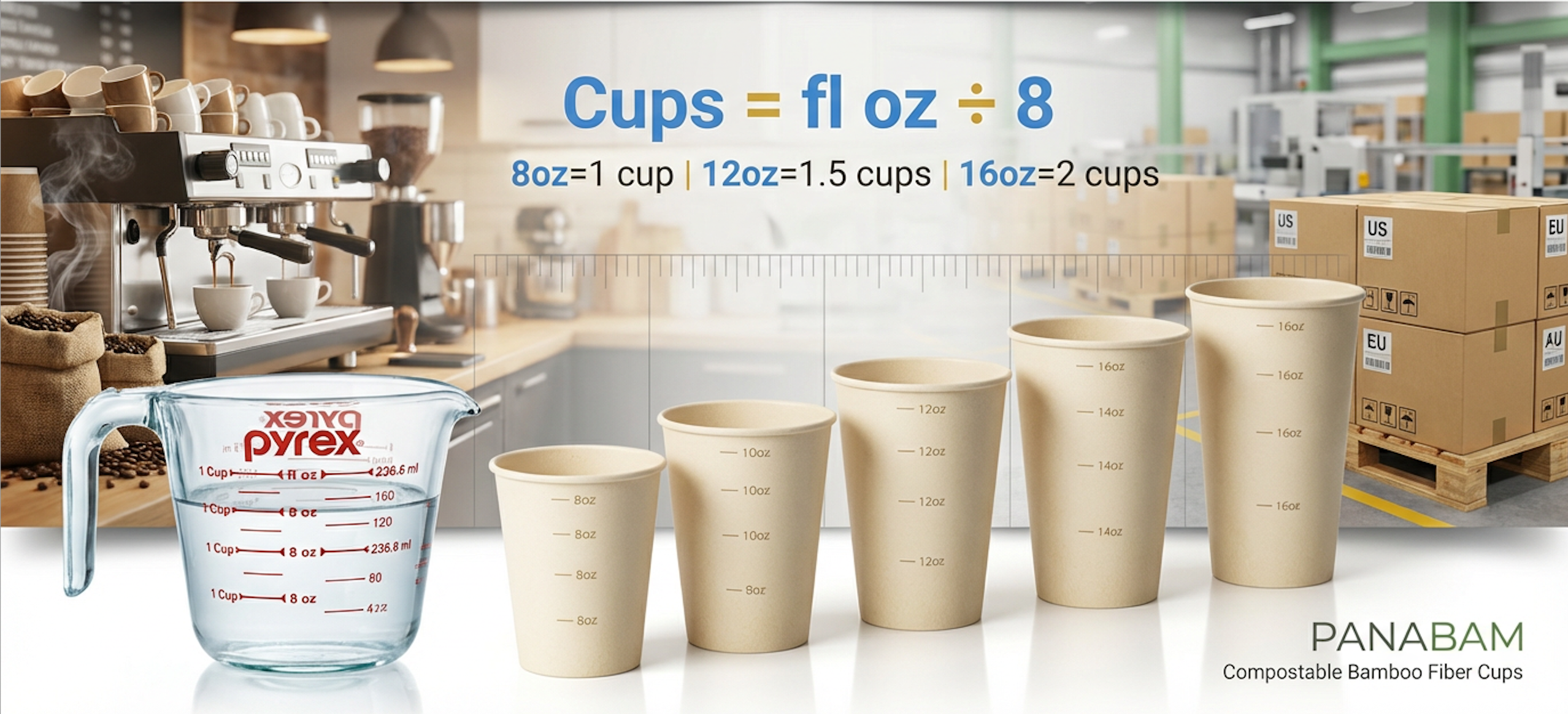
I used to lose margin because my “12 oz” cups did not match my real pour line. So I had waste, and I had complaints.
In US measures, 1 cup = 8 fl oz. So cups = fl oz ÷ 8. This guide converts 8/10/12/14/16 fl oz to cups and mL, and it adds safe-fill tips for foodservice.
So I will show the exact conversions, and I will also show how I use safe-fill to buy the right cups in bulk.
How many oz in a cup, and what is the simplest oz to cups formula?
I often see teams guess ounces in a cup during rush hours. Then they pour too much, and they lose money.
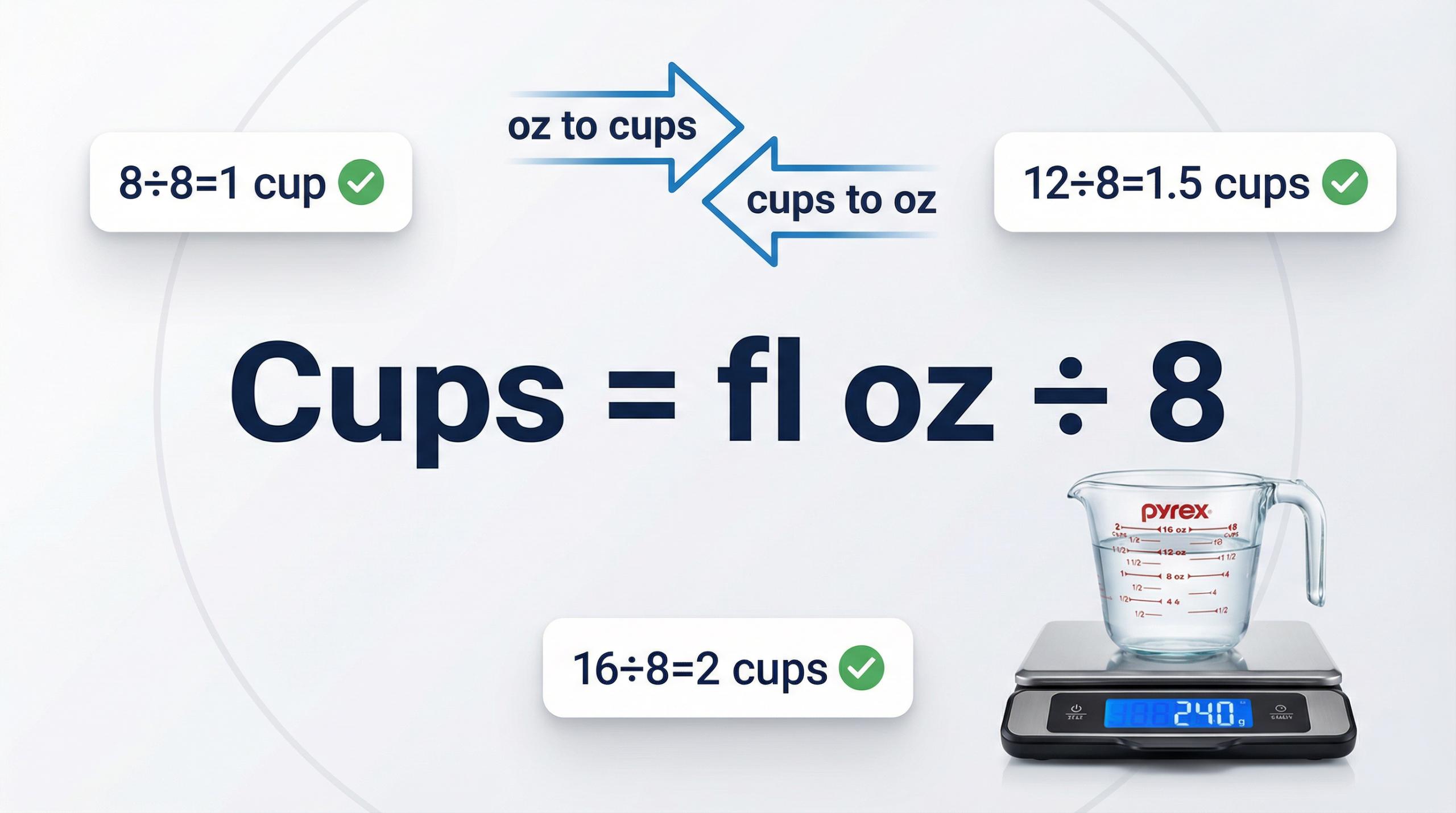
For liquids, 1 US cup equals 8 fl oz. Use cups = fl oz ÷ 8 for oz to cups, and use fl oz = cups × 8 for cup to oz conversions.
So I will keep the math simple, and I will also connect it to real B2B cup buying.
How many ounces in a cup, and how many ounces per cup?
When people ask how many oz in a cup, they also type it in many ways. They may write how many ounces in a cup, how many ounces per cup, how many oz in one cup, or how many liquid oz in a cup. I answer them with the same rule because it is stable and easy.
- Answer: 1 US cup = 8 fl oz
- This covers “oz in cup,” “oz in a cup,” and “ounces in a cup” for liquids.
oz to cups, oz to cup conversion, and cups to ounces
I teach two lines because they work in daily operations. I use basic words, and I repeat them.
| You need | Quick rule | Example |
|---|---|---|
| oz to cups / ounces to cups | cups = fl oz ÷ 8 | 12 ÷ 8 = 1.5 cups |
| cup to oz / cups to ounces | fl oz = cups × 8 | 2 × 8 = 16 fl oz |
So if a buyer asks me “oz and cups are confusing, what should I do?” I tell them to store this table in their SOP. Then every store can follow the same method.
Looking for 8–16oz eco cups, disposable biodegradable cups, compostable cups?
If you are sourcing 8–16oz eco cups, disposable biodegradable cups, or compostable cups for cafés, catering, or distribution, I can help you match size, lid fit, and safe-fill.
- 8 oz eco cups (bulk) → bamboo fiber cups
- 10 oz compostable cups → bamboo fiber cups
- 12 oz disposable biodegradable cups → bamboo fiber cups
- 14 oz eco cups (optional lids) → bamboo fiber cups
- 16 oz compostable cups (hot/cold) → bamboo fiber cups
- Request a wholesale quote → Contact Us
- Get samples → Contact Us
I always ask three things first: drink type, lid type, and monthly volume. Then I can recommend sizes with fewer mistakes.
Why oz to cups dry is a different problem
Some people search oz to cups dry or how many cups in an oz**. This is not the same as liquid math. Dry ounces are weight, and cups are volume, so density changes the result. I explain this early because buyers often copy one answer and apply it everywhere. That creates recipe drift, and it also creates cost drift.
What are the exact conversions for 8/10/12/14/16 fl oz to cups and mL?
I used to think “12 oz is always 12 oz,” but cup labels and real pour lines did not match. So my staff made inconsistent drinks.
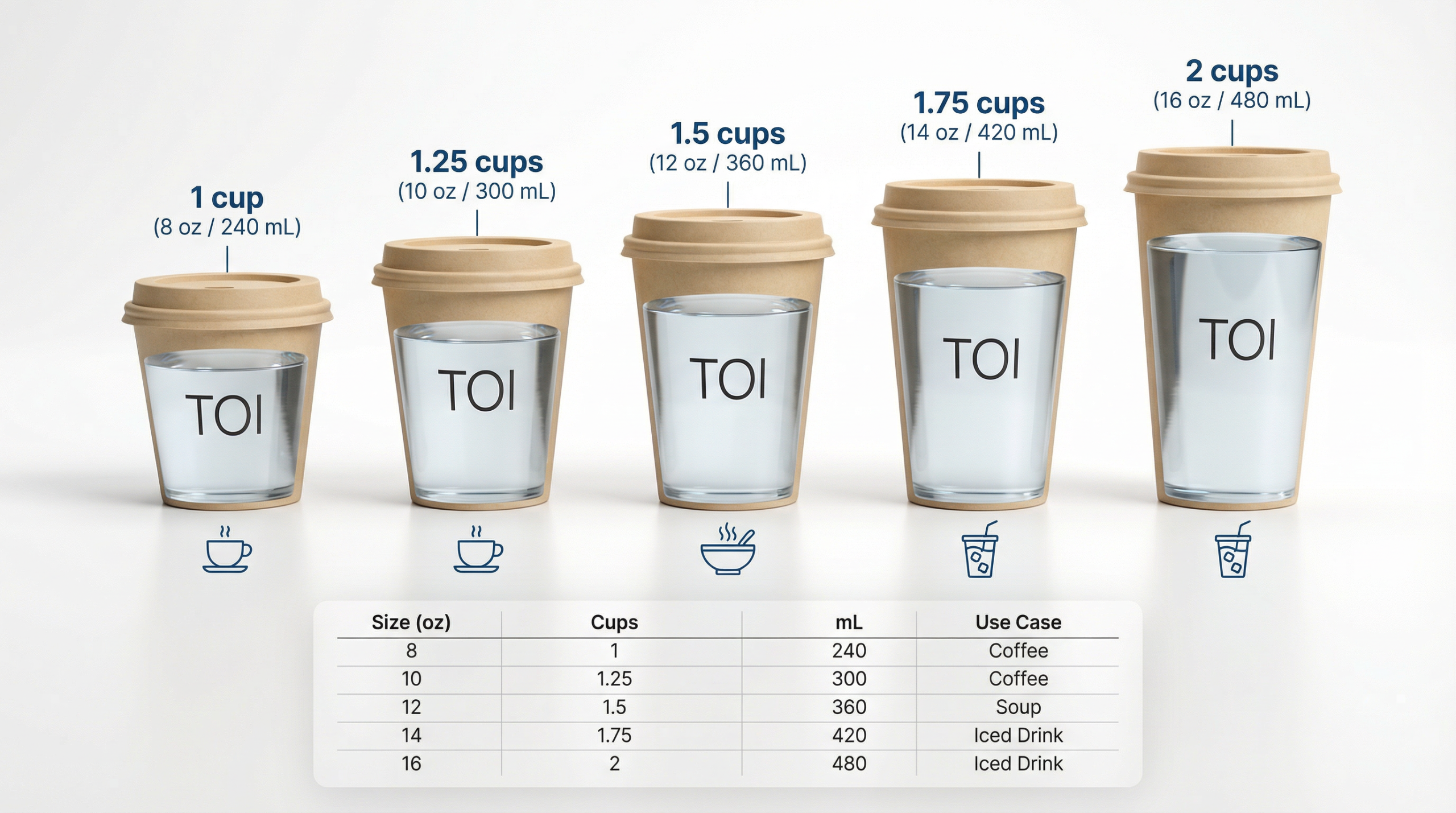
For liquids: 8 oz to cups = 1 cup, 10 oz = 1.25 cups, 12 oz to cups = 1.5 cups, 14 oz = 1.75 cups, and 16 oz to cups = 2 cups. In mL they are 236.6, 295.7, 354.9, 414.0, and 473.2.
So I will put everything in one table, and then I will break down each size with a simple “how to measure” method.
Master conversion table (8/10/12/14/16 oz to cups + mL + use cases)
| Size (US fl oz) | Cups | mL (exact) | Typical foodservice use | My safe-fill reminder |
|---|---|---|---|---|
| 8 oz | 1.00 | 236.6 | small coffee, sampling, kids drinks | leave headspace for lids |
| 10 oz | 1.25 | 295.7 | “small but premium” hot drinks | mark a pour line |
| 12 oz | 1.50 | 354.9 | standard hot coffee | foam needs headspace |
| 14 oz | 1.75 | 414.0 | large hot drinks | confirm lid lock |
| 16 oz | 2.00 | 473.2 | grande drinks, some iced drinks | ice changes liquid volume |
8 oz to cups: how many cups is 8 oz, and how do I measure it?
Many readers search 8 oz to cups because they want a fast answer for coffee, soup, or kids drinks.
- Answer: 8 fl oz = 1 cup (≈ 236.6 mL)
- How I measure it: I fill a 1-cup measuring cup to the 1-cup line. Then I pour it into the serving cup. Then I mark the safe-fill line for lids.
How much is 10 oz in cups?
This question is common in cafés because 10 oz sits between 8 oz and 12 oz.
- Answer: 10 fl oz = 1.25 cups
- How I measure it: I measure 1 cup first, then I add 1/4 cup. I keep it simple because staff need speed.
How many cups is 12 oz, and what is 12 fl oz in a cup?
Buyers also ask how many cups is 12 oz, how many cups in 12 oz, and how much is 12 oz in a cup.
- Answer: 12 fl oz in a cup = 1.5 cups (≈ 354.9 mL)
- How I measure it: I pour 1 cup, then I add 1/2 cup. Then I test the lid. If the cup is for delivery, I keep a little more headspace.
16 oz to cups: how many cups is 16 oz, and 16 oz equals how many cups?
This is one of the biggest queries: 16 oz to cups, 16oz to cups, how many cups in 16 oz, and how many cups in 16 ounces.
- Answer: 16 fl oz = 2 cups (≈ 473.2 mL)
- How I measure it: I use two full cups. Then I decide the safe-fill line based on ice, foam, and lid type.
Why I still talk about safe-fill here
The math is clean, but real service is not. A cup can be labeled “16 oz,” yet the safe-fill for delivery might be 14–15 oz because the lid needs space. So I always combine the conversion with a safe-fill test. This reduces spills, and it reduces refunds.
Why do 240 mL and 250 mL both look like “1 cup,” and how can this affect cost?
I once saw a buyer round every drink to 250 mL. Then the beverage cost went up, and nobody knew why.
A US cup is 236.6 mL (8 fl oz). 240 mL is about 1.01 US cups, and 250 mL is 1 metric cup, about 1.06 US cups. Small gaps can cause real waste at scale.
So I will explain the difference, and I will show a simple cost impact example.
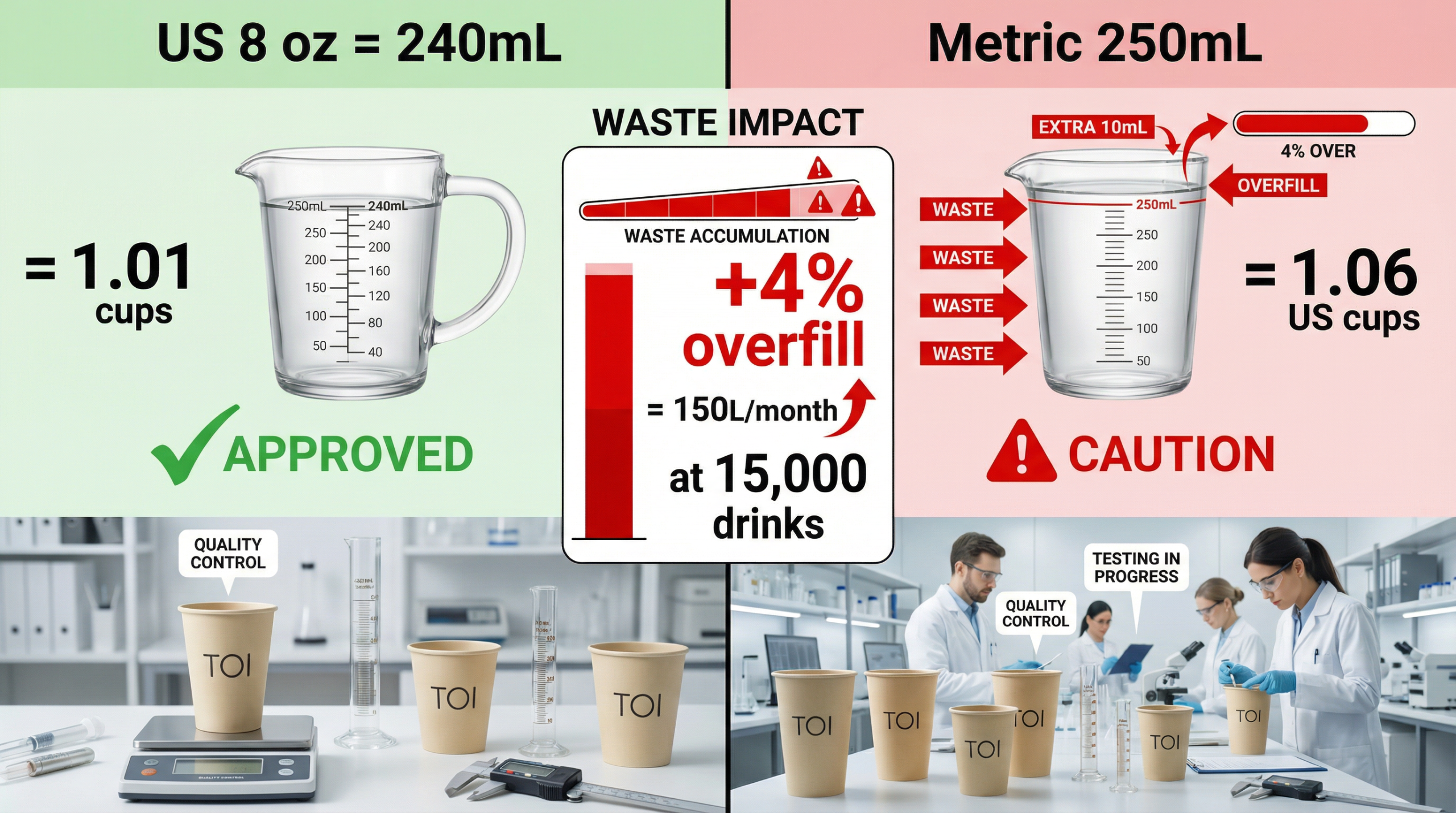
240 mL to cups vs 250 mL to cups (simple explanation)
People often say “240 mL is one cup,” and they also say “250 mL is one cup.” Both can be true, but they refer to different standards.
| Volume | In US cups (approx.) | What it usually means |
|---|---|---|
| 240 mL | ~1.01 cups | casual rounding for US cup use |
| 250 mL | ~1.06 cups | metric cup standard |
So if a team uses “250 mL = 1 cup” in a US operation, the portions can inflate without notice.
The “+4%” waste pattern I watch for
If my target is 240 mL, and my team pours 250 mL, the extra is 10 mL. That is about 4.17% more liquid (10 ÷ 240). This can look small in one drink. But it grows fast across a month.
Here is the simple logic I share with buyers:
- If a store sells 15,000 drinks per month, 10 mL extra becomes 150,000 mL.
- That is 150 liters.
- So the waste becomes real money, and it becomes real margin loss.
So I do not argue about which “cup” is correct in theory. I set one operational standard. Then I train it.
Container labeling differences (why “8 oz” is not always the same cup)
Cup labeling also causes confusion. Some suppliers show “brim-full capacity,” and some show “nominal size.” Some even use rounded mL numbers on cartons. So I ask clear questions:
- Is the stated capacity brim-full or safe-fill?
- What is the safe-fill mL with the lid on?
- Do you have a sample so I can run a water test?
My B2B takeaway
I use conversions to start the conversation. Then I use safe-fill to finish the decision. This is how I protect consistency and cost at the same time.
How does oz to cups dry work, and why does “how many cups are in an ounce” depend on ingredients?
I used to copy a dry conversion line from the internet. Then a batch failed, and my cost per batch changed.
Oz to cups dry is ingredient-specific. For liquids, 1 fl oz = 0.125 cups. But for dry goods, 1 oz by weight can take different space, so cups vary by density and packing.
So I will show a practical table, and I will also show the rule I use in food production.
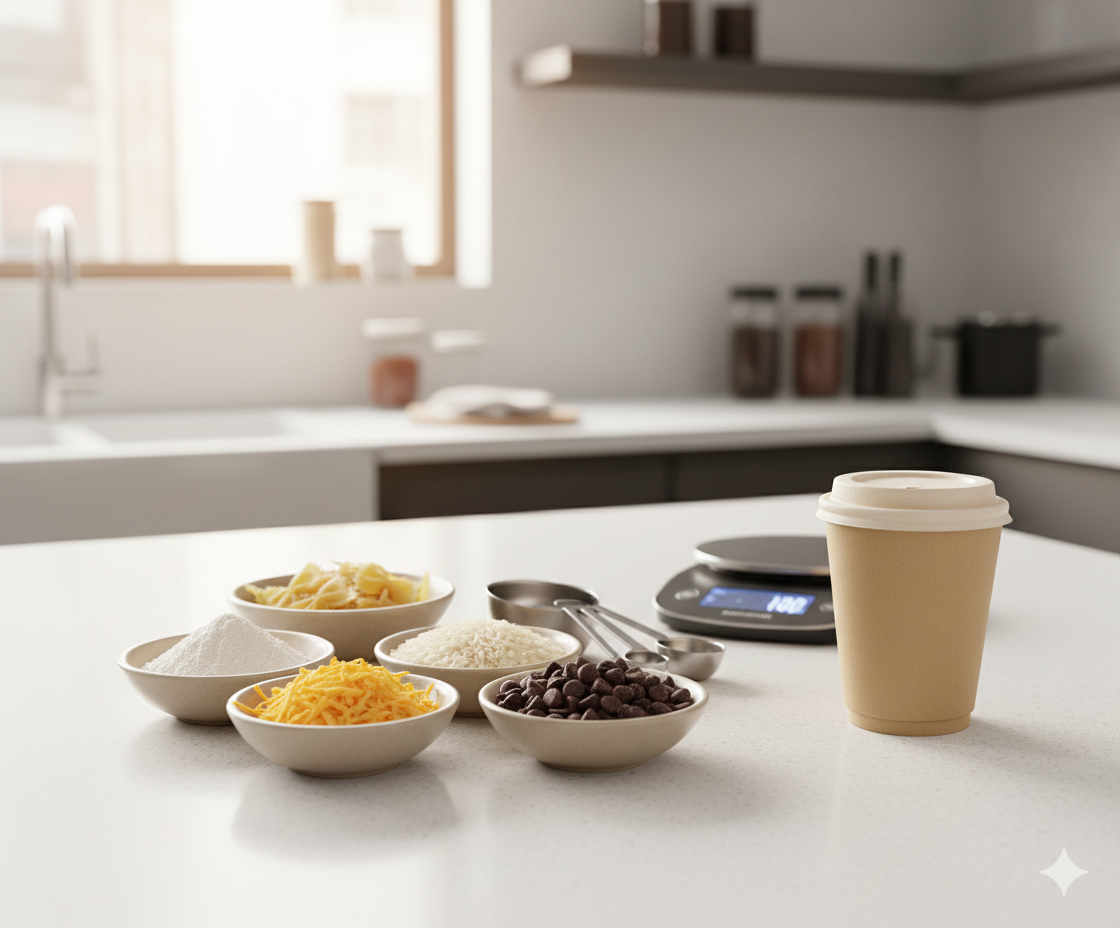
oz to cups liquid vs oz to cups dry
When someone asks how many cups are in an ounce, I answer in two parts.
- For liquids: 1 fl oz = 0.125 cups because 8 fl oz = 1 cup.
- For dry ingredients: the answer changes because the same weight can have different volume.
This is why searches like oz to cups dry, how many cups in an oz, and how many cups in an ounce can look messy online.
Dry ingredients reference table (8 oz examples)
I keep this table as a starting point. I also keep notes because packing changes results.
| Ingredient (dry) | 8 oz = ? cups | Notes I always mention |
|---|---|---|
| Flour | ~2 cups | sifted vs packed changes a lot |
| Rice (dry) | ~1.5 cups | long-grain varies by brand |
| Pasta (dry) | ~2 cups | shape changes volume |
| Shredded cheese | ~2 cups | loose vs packed changes volume |
| Chocolate chips | ~1⅓ cups | chip size changes packing |
What I do in real kitchens and factories
In B2B kitchens, I prefer weight for dry ingredients. I do this because “cups” can change by person and by humidity. So I write formulas in grams, and I keep cups only for fast reference.
Also, I remind teams that drinks are simpler. Drinks usually use fl oz to cups, so the conversion stays stable. That is why this article focuses on cup sizes and drink service.
Where this connects back to cups and packaging
This is still relevant to cup sourcing because many operators use a serving cup as a measuring tool. If the cup shape changes, the “same pour” can look different. So I keep the measurement tool separate from the serving cup. I measure with a calibrated tool, then I serve with the chosen cup, then I set a safe-fill line.
My B2B takeaway
Dry conversions are useful, but they are not universal. So I treat them as guidance, and I use scales for control.
What questions do buyers ask most about measuring, and how do I answer them without confusing the team?
I often see buyers ask simple questions, but they get complex answers online. Then they lose trust, and they stop reading.
Most measuring questions have short, stable answers: 1 cup = 8 fl oz, 12 fl oz = 1.5 cups, and 16 fl oz = 2 cups. Then safe-fill and tools decide what works in service.
So I will answer the top questions in context, and I will add B2B tips right next to the answers.
How much is 8 oz in cups in Canada, and are US/Canadian oz the same?
People ask this because they buy across borders. In daily foodservice practice, the US fluid ounce standard is used widely in Canada too. So the working conversions stay the same:
- 8 fl oz = 1 cup
- 12 fl oz = 1.5 cups
- 16 fl oz = 2 cups
The confusion usually comes from mixing fl oz (volume) with oz (weight). So I always say “fl oz” when I talk about drinks.
How much is 8 oz of water, and what does 8 oz water look like?
This question sounds basic, but it matters because it helps staff “see” the amount.
- 8 fl oz of water = 1 cup
- It looks like a liquid measuring cup filled to the 1-cup line.
If a team can picture it, they can pour it more consistently. So I use this in training.
What can I use to measure 8 oz if I do not have a scale?
If someone asks “what can I use to measure 8 oz,” I give two options:
- Use a liquid measuring cup with fl oz marks.
- Or use mL marks, because 8 fl oz ≈ 236.6 mL.
If they only have a scale, water is easy because grams and mL are close for water. So a scale can still help in a pinch.
How many 8 oz cups in a gallon?
This is a common conversion for bulk beverage planning.
- A US gallon is 128 fl oz.
- So how many 8 oz cups in a gallon? 128 ÷ 8 = 16 cups.
This helps catering teams plan for events, and it helps buyers estimate inventory.
Why these questions matter in B2B
When I talk to customers, I know price matters. But I also know waste matters. If the team pours too much, the buyer loses money. If the cup leaks, the buyer loses trust. So I give short answers, then I move to safe-fill and cup performance. This keeps the conversation clear, and it keeps decisions fast.
Which 8–16 oz compostable cups should I buy, and how do I match size with safe-fill and compliance?
Buyers often start with “I need compostable cups,” but they worry about leaks, weak walls, and higher cost than plastic. So they hesitate.
I choose cups by size accuracy, safe-fill performance, and compliance. Bamboo fiber cups can be plastic-free and PFAS-free, and they can stay rigid across -40°C to 200°C, which supports real foodservice use.
So I will show my size lineup, then I will compare materials, and then I will share a buyer checklist.
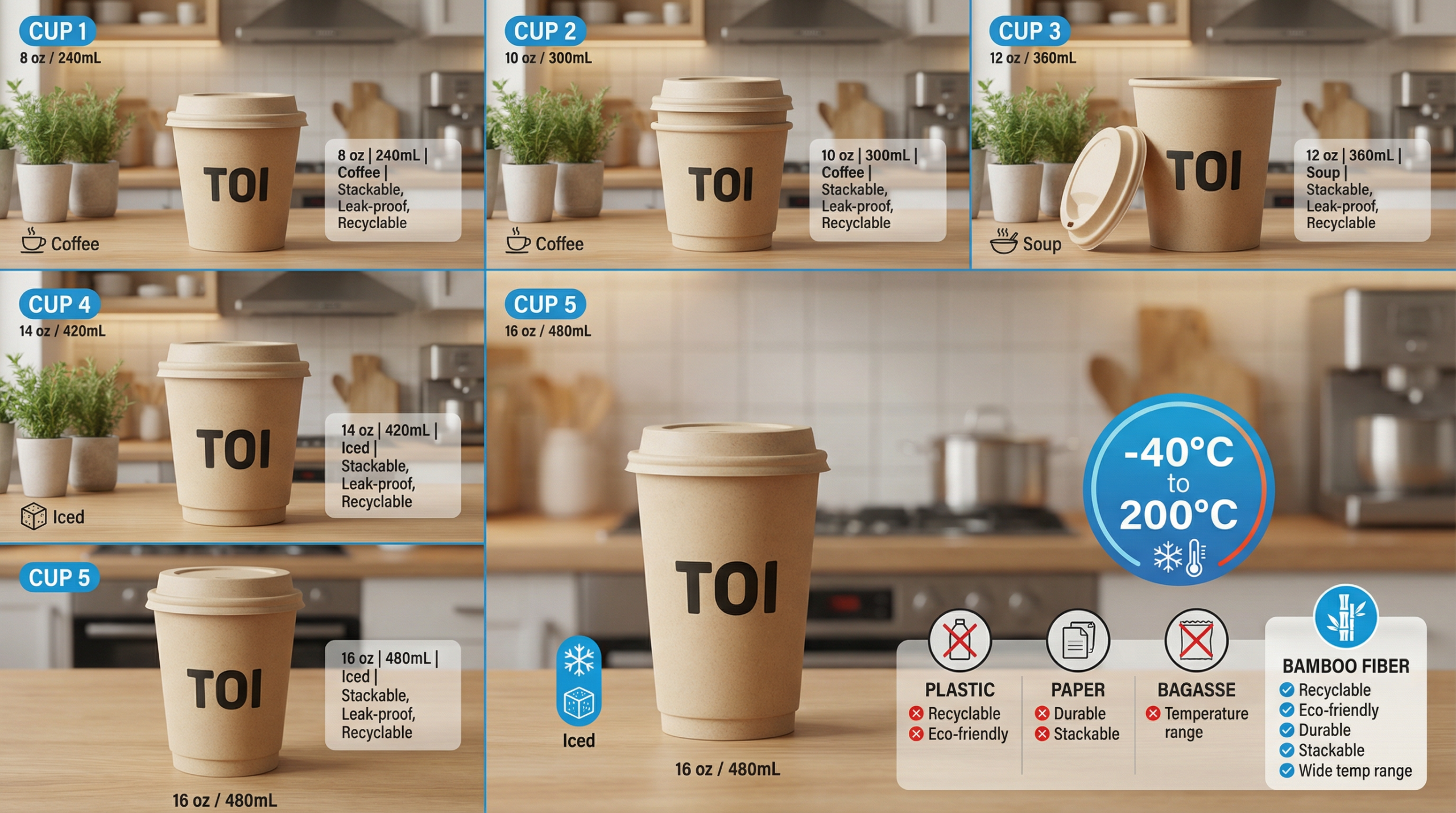
PANABAM bamboo fiber cup lineup (8/10/12/14/16 oz)
| Size | Cups | mL (exact) | Use case | Key features I highlight |
|---|---|---|---|---|
| 8oz | 1.00 | 236.6 | small coffee, sampling | heat-resistant, leak-resistant |
| 10oz | 1.25 | 295.7 | tall lattes | stackable, stable rim |
| 12oz | 1.50 | 354.9 | regular hot coffee | logo printing, strong feel |
| 14oz | 1.75 | 414.0 | large hot drinks | delivery-friendly, rigid wall |
| 16oz | 2.00 | 473.2 | grande drinks | full lid set, stable structure |
Plastic vs paper vs bagasse vs bamboo fiber (what I tell buyers)
I keep this comparison simple because buyers want fast decisions, not long theory.
| Material | What feels good | What can go wrong | What I check |
|---|---|---|---|
| Plastic | low cost, strong | bans, brand risk, waste | policy risk and customer pushback |
| Paper (often lined) | familiar, easy print | lining may block composting | “is it truly plastic-free?” |
| Bagasse | common eco option | can feel soft with hot/oily use | rigidity and coating claims |
| Bamboo fiber | natural look, strong feel | cost concern | safe-fill, rigidity, and supply stability |
B2B buyer’s checklist: sourcing oz-accurate cups
Capacity verification questions
- Is the listed capacity brim-full or safe-fill?
- What is safe-fill mL with the lid on?
- Can I test samples with my real drinks?
Certification & compliance
- Can you support FDA and LFGB food contact needs?
- Are cups plastic-free and PFAS-free?
- Can you provide test reports when needed?
Supply chain, MOQ, and customization
- What is the MOQ for stock and for custom print?
- What is the lead time for samples and mass production?
- Can you support logo printing and packaging design?
PANABAM Factory Authority (Why PANABAM Can Guarantee Stable Supply)
At PANABAM, we operate as a wholesale-only bamboo fiber tableware manufacturer based in China.
Our factory runs 5 automated production lines and has over 10 years of manufacturing experience in molded bamboo fiber pulp products.
Our annual production capacity reaches up to 500 million pieces, allowing us to support long-term, repeat orders without compromising quality or delivery timelines. We manage the full process—from bamboo fiber processing to finished foodservice packaging—so quality remains consistent across batches.
Today, PANABAM supplies customers across the United States, Australia, Canada, the United Kingdom, Japan, the Netherlands, and Germany. This global export experience enables us to meet different regulatory standards while maintaining stable lead times and reliable after-sales support for B2B partners.
My B2B takeaway
Buyers often start with price, but they stay with reliability. So I focus on safe-fill, compliance, and consistent supply.
Conclusion
I use oz-to-cups plus safe-fill to cut waste, keep menus consistent, and help buyers choose compostable cups with confidence.