

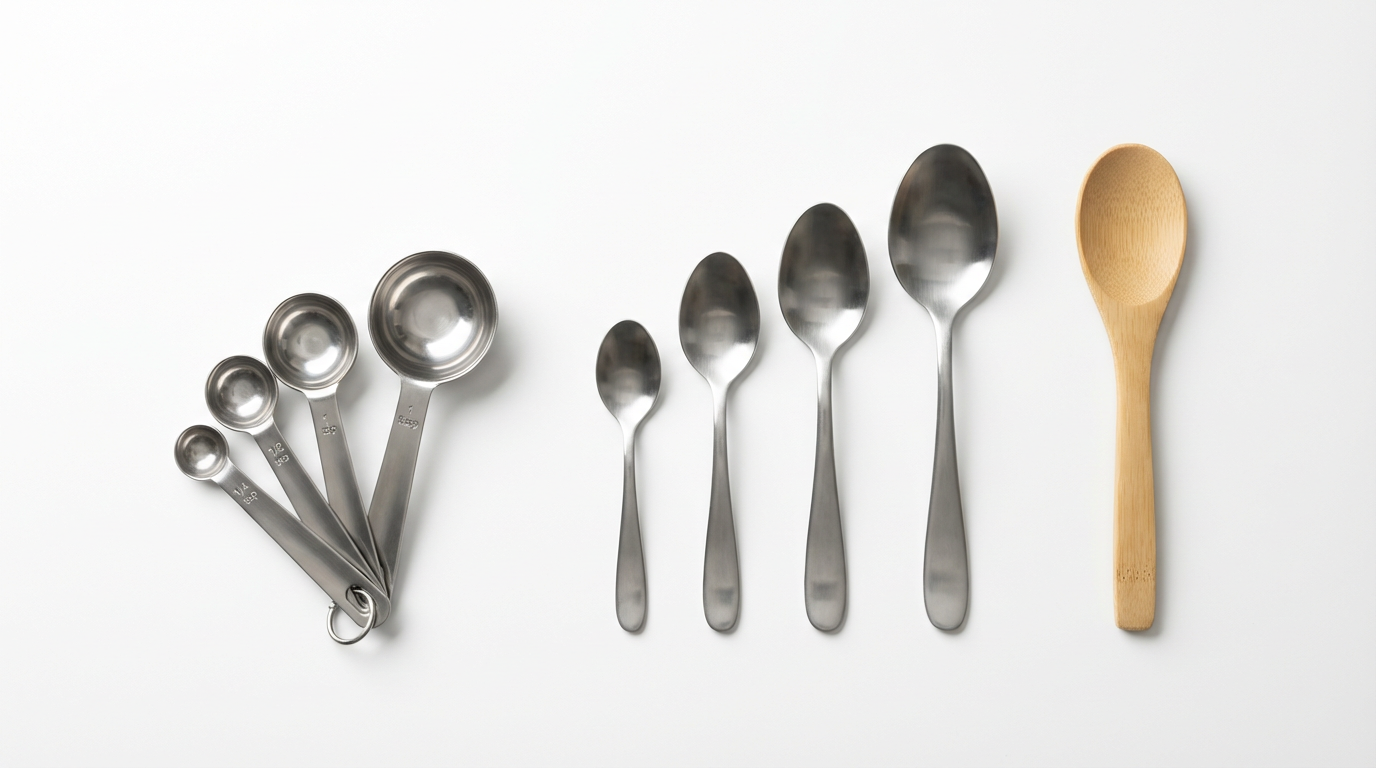
Spoon terms seem simple, but they cause mix-ups. So recipes shift and orders miss the mark. We will make spoon sizes clear.
“Spoon sizes” can mean measuring volumes (tsp/tbsp in mL) or utensil dimensions (length and bowl shape). This guide explains both and gives charts you can use right away.
So keep going, because we will answer the common questions fast, and we will also help you choose the right spoon size for real use.
Spoon sizes chart: what is the fastest way to compare tsp, tbsp, and common spoons?
People want one quick chart, but most pages split the topic. So readers jump around and still feel unsure. We will solve it here.
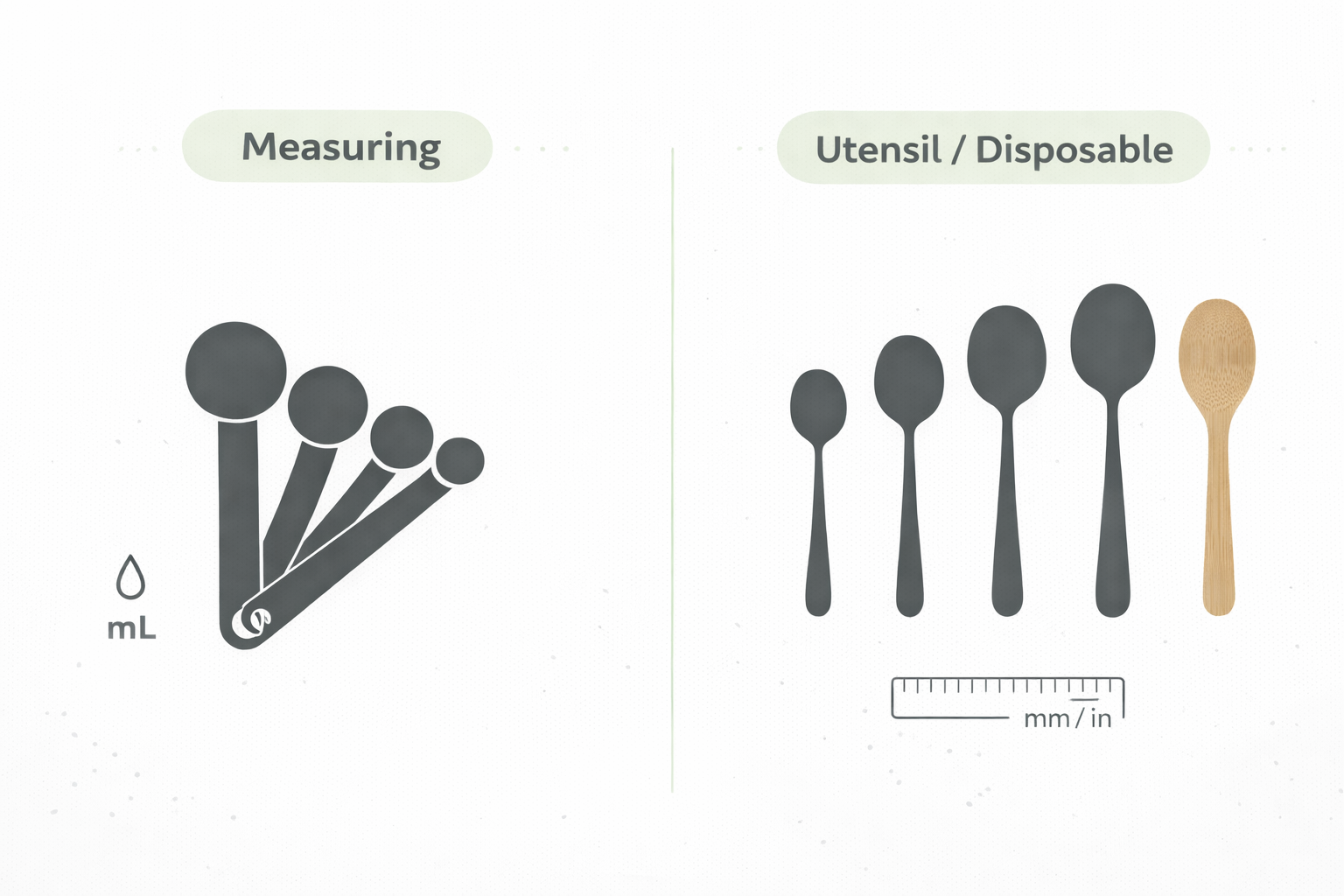
The fastest way is to separate measuring spoons (volume in mL) from eating and disposable spoons (length and bowl shape). This chart puts them in one place so you can decide in minutes.
Why one chart must cover two systems
We see one big problem again and again. People use the same word, “spoon,” but they mean two different things. Measuring spoons are calibrated tools, so they are about volume. Eating spoons are not calibrated, so they are about comfort and shape. Disposable spoons are also not calibrated, so they are about length, strength, and user feel.
So we use a two-step rule. First, we ask if the task is measuring or eating. Then we choose the right chart. This sounds basic, but it prevents real mistakes. It also prevents bad reviews in food service, because customers notice small discomfort fast.
Quick spoon sizes chart (volume + length + best use)
| Spoon type / unit | Typical volume | Typical length | Best use | What to watch |
|---|---|---|---|---|
| 1 tsp (measuring) | 5 mL | — | spices, extracts | use a real measuring set |
| 1 tbsp (measuring) | 15 mL | — | sauces, oils | about 3 tsp |
| Teaspoon (cutlery) | not fixed | 13–15 cm / 5–6 in | drinks, small bites | varies by brand |
| Dessert spoon | often ~10 mL | 15–18 cm / 6–7 in | pudding, yogurt | can overlap with “tbsp” name |
| Soup spoon (Western) | not fixed | 15–20 cm / 6–8 in | soups, stews | deeper bowl matters |
| Chinese soup spoon | often 15–30 mL | short handle | broths + solids | shape differs a lot |
| Serving spoon | not fixed | 20–25 cm / 8–10 in | buffet, catering | portion control matters |
| Disposable bamboo wooden spoon (best seller) | n/a | 170 mm / 6.69 in | most takeout meals | strong default for food service |
How we use this chart in real decisions
First, if we need accuracy, we use the measuring rows only. That is because utensil rows are not standards. Next, if we need customer comfort, we focus on length and bowl shape. Then we match the food. Soup needs a deeper bowl, and rice needs a stable scoop. After that, we match the container. Deep bowls need longer handles so hands stay clean. Finally, we match the channel. Retail needs a clean look, and takeout needs fast packing.
So this chart is not here to sound smart. It is here because it reduces confusion, and it makes decisions faster. Also, it supports common searches like “spoon sizes chart,” “measuring spoon sizes,” and “different spoon sizes,” because those searches often mix both systems in one session.
What are the sizes of spoons, and what do the names really mean?
Names sound familiar, so people assume they are correct. But names vary by place and brand, so mistakes happen. We will make the names practical.
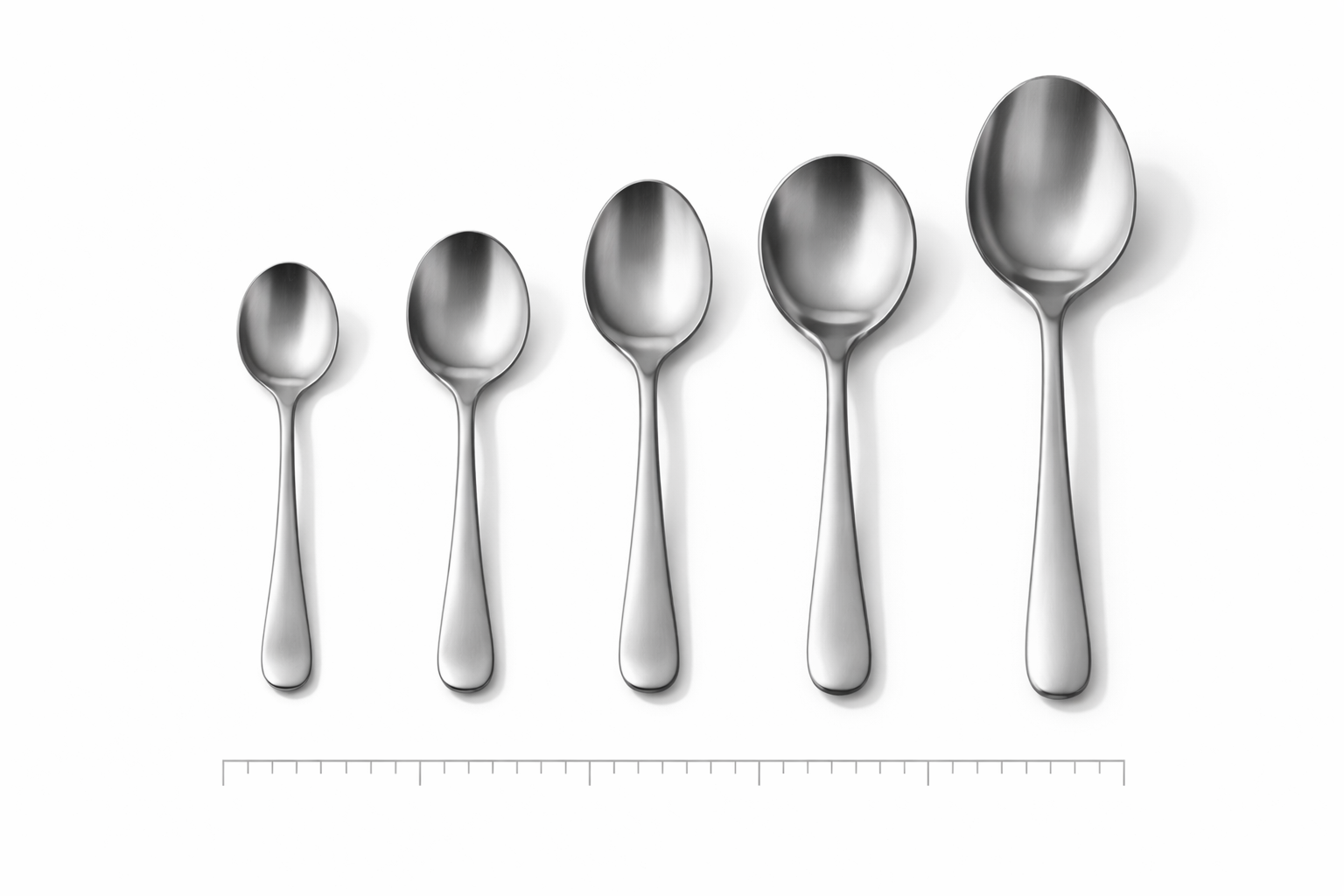
Common spoon “sizes” are categories by use: teaspoon, tablespoon, dessert spoon, soup spoon, and serving spoon. Since names vary, we should match the spoon to the job and the shape, not the label.
Why spoon names are not consistent
Spoon words are not strict standards for eating utensils. So “dessert spoon” in one market can look like “tablespoon” in another. Also, “soup spoon” can mean a deep round Western spoon, but it can also mean an Asian-style soup spoon with a short handle and wide bowl. Because of this, we treat names as a starting point, and then we confirm the physical shape.
This matters in food service because customers do not care about the name. They care about comfort. If the bowl is too shallow, soup spills. If the handle is too short, hands touch food. If the edges feel rough, people complain. So we focus on function first, and we use names second.
Spoon types and sizes in real life
| Spoon type (common name) | Typical job | What we check first | Common mismatch |
|---|---|---|---|
| Teaspoon (cutlery) | coffee, tea, small bites | small bowl + comfort | used as a measuring tsp |
| Tablespoon (cutlery) | bigger bites | bowl size + feel | confused with 1 tbsp unit |
| Dessert spoon | yogurt, pudding | smooth mouthfeel | overlaps with “tbsp” naming |
| Soup spoon | soup + stew | bowl depth | too shallow for broth |
| Serving spoon | buffet + catering | strength + length | bends under heavy food |
A job-first selection method we rely on
We use a job-first method because it reduces mistakes. First, we ask: “Is this spoon for measuring or for eating?” If it is for measuring, we use a measuring set. If it is for eating, we focus on length and bowl shape.
Next, we ask: “Is the food liquid, thick, or dry?” Soup needs depth, and thick foods need stability. Then we ask: “Is the container shallow or deep?” Deep bowls need longer handles. After that, we ask: “Is this dine-in, takeout, or retail?” Because packaging and hygiene needs change what works best.
We learned this through real checks. We once used a shallow “soup spoon” shape for deep bowls, and service slowed down because customers kept chasing broth. So we changed our standard. Now we list spoon type, length, and food scenario together. That is why we keep this guide simple, and that is why we separate measuring spoon sizes from utensil sizes.
What are the 4 sizes of measuring spoons, and what are the standard measuring spoon sizess](https://en.wikipedia.org/wiki/Measuring_spoon)?
People want fast answers, so they guess. Then recipes change, and costs rise. We will make measuring sizes easy.
A common 4-piece measuring spoon set is 1/4 tsp, 1/2 tsp, 1 tsp, and 1 tbsp. In metric, that is about 1.25 mL, 2.5 mL, 5 mL, and 15 mL.
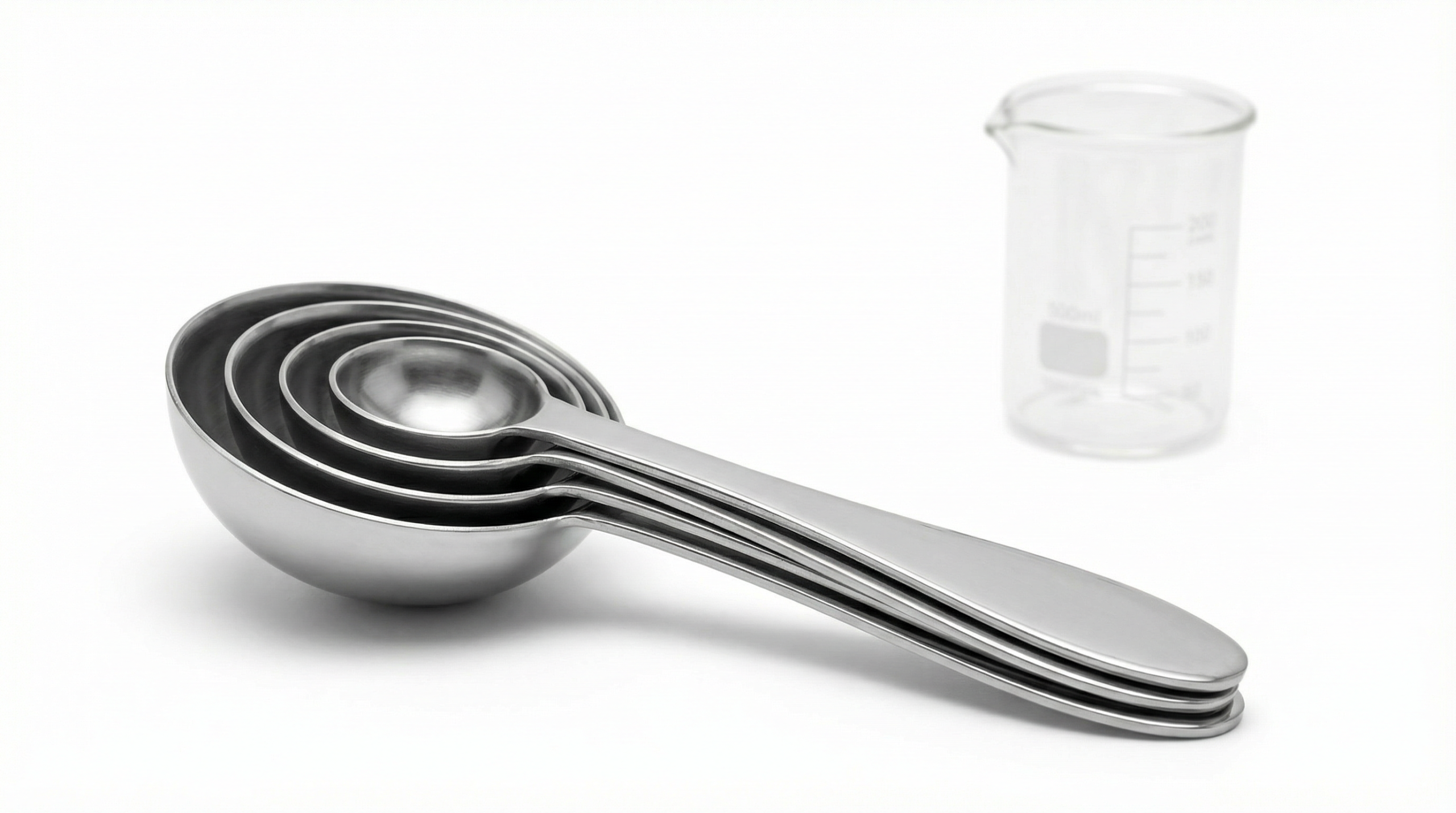
The standard four measuring spoon sizes (with mL)
| Measuring spoon | Metric volume (approx.) | Best for | Why it matters |
|---|---|---|---|
| 1/4 tsp | 1.25 mL | extracts, strong spices | tiny changes matter |
| 1/2 tsp | 2.5 mL | baking, seasoning | common in mixes |
| 1 tsp | 5 mL | sauces, baking | key daily unit |
| 1 tbsp | 15 mL | oils, dressings | big step size |
Measuring spoons vs dinner spoons
Measuring spoons are calibrated tools. Dinner spoons are not. So an eating “teaspoon” does not guarantee 5 mL. Also, how full you scoop changes the amount. Because of that, when we need repeatable results, we do not use a dinner spoon.
This is important in food business work. If a sauce is too salty, customers notice. If a spice mix shifts, the product tastes different across batches. So we standardize measuring tools first, and then we train staff with one method.
How we write it for global readers
We work with buyers and kitchens in many countries, so we show tsp/tbsp and mL together. This makes the chart easier to use across different measurement habits, and it also supports “spoon sizes in ml” searches.
We keep language simple:
- We write 1 tsp (≈ 5 mL).
- We write 1 tbsp (≈ 15 mL).
- We use “≈” or “approx.” because kitchens are not labs.
Also, if a team needs strict consistency, we tell them to use the same measuring set every day. This is because sets can differ by brand. So we focus on the tool markings first, and we focus on names second. That is also why we keep the measuring section separate from disposable spoon sizing. Mixing them creates errors, and errors create cost.
What’s the easiest way to remember tbsp vs tsp?
Many teams mix tbsp and tsp. So food tastes off, and label claims can drift. We want a simple rule.
The easiest rule is: tbsp is bigger. 1 tbsp ≈ 3 tsp, and 1 tbsp ≈ 15 mL while 1 tsp ≈ 5 mL.
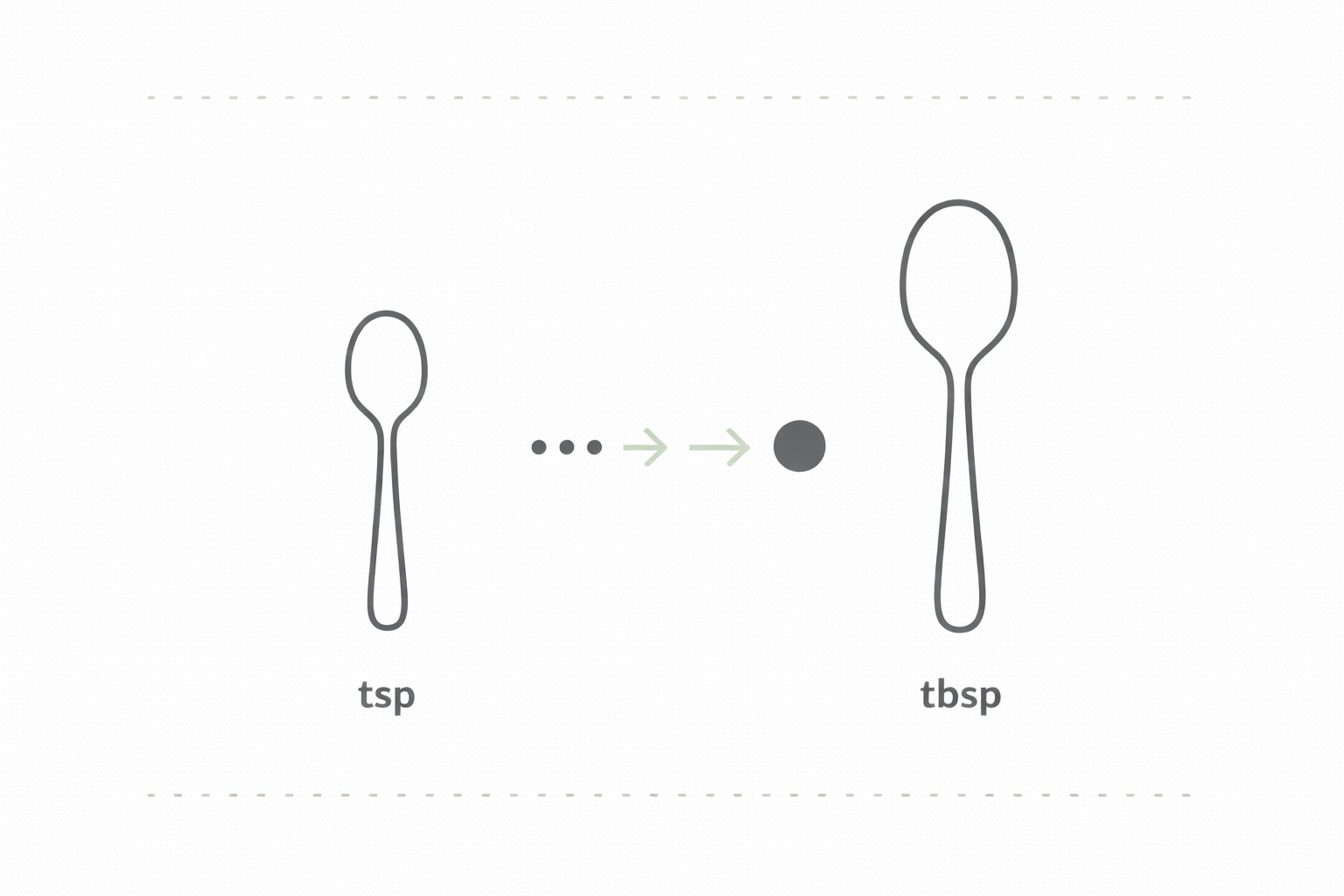
The memory rules we teach (simple on purpose)
- tsp = teaspoon = small
- tbsp = tablespoon = big
- 1 tbsp ≈ 3 tsp
- When unsure, measure
A quick conversion table (easy to copy)
| Unit | Meaning | Approx. metric | Quick relationship |
|---|---|---|---|
| 1 tsp | teaspoon | 5 mL | 3 tsp ≈ 1 tbsp |
| 1 tbsp | tablespoon | 15 mL | 1 tbsp ≈ 3 tsp |
Why we still measure, even with memory tricks
Memory tricks reduce mental load, so they help busy kitchens. But they do not control scoop level. Also, different spoons in the drawer create variation. So we add a safety net.
First, we standardize tools. We keep one measuring set in the same place. Then we use the same shapes every day. Next, we standardize language. We write tsp and tbsp clearly, and we avoid unclear phrases like “tablespoon spoon,” because that can mean a unit or a utensil.
Then we train with real examples. We show 1 tsp and 1 tbsp in the same session, because comparison teaches faster than text. Also, we label containers with both units and mL when it helps the team. This is because some people think in mL, and others think in tsp. So dual labels reduce errors, and they reduce back-and-forth questions.
In short, memory rules help, but tools protect results. That is why we always end this section with the same advice: if accuracy matters, measure it.
Which disposable spoon size should we buy for food service and takeout?
Many buyers choose by price only. So spoons feel cheap, and complaints show up. We want a practical default.
For most takeout meals, a 170 mm disposable spoon is a safe default. For soup or deep bowls, longer options like 190–210 mm often work better. We should match spoon length and bowl feel to the menu and container.
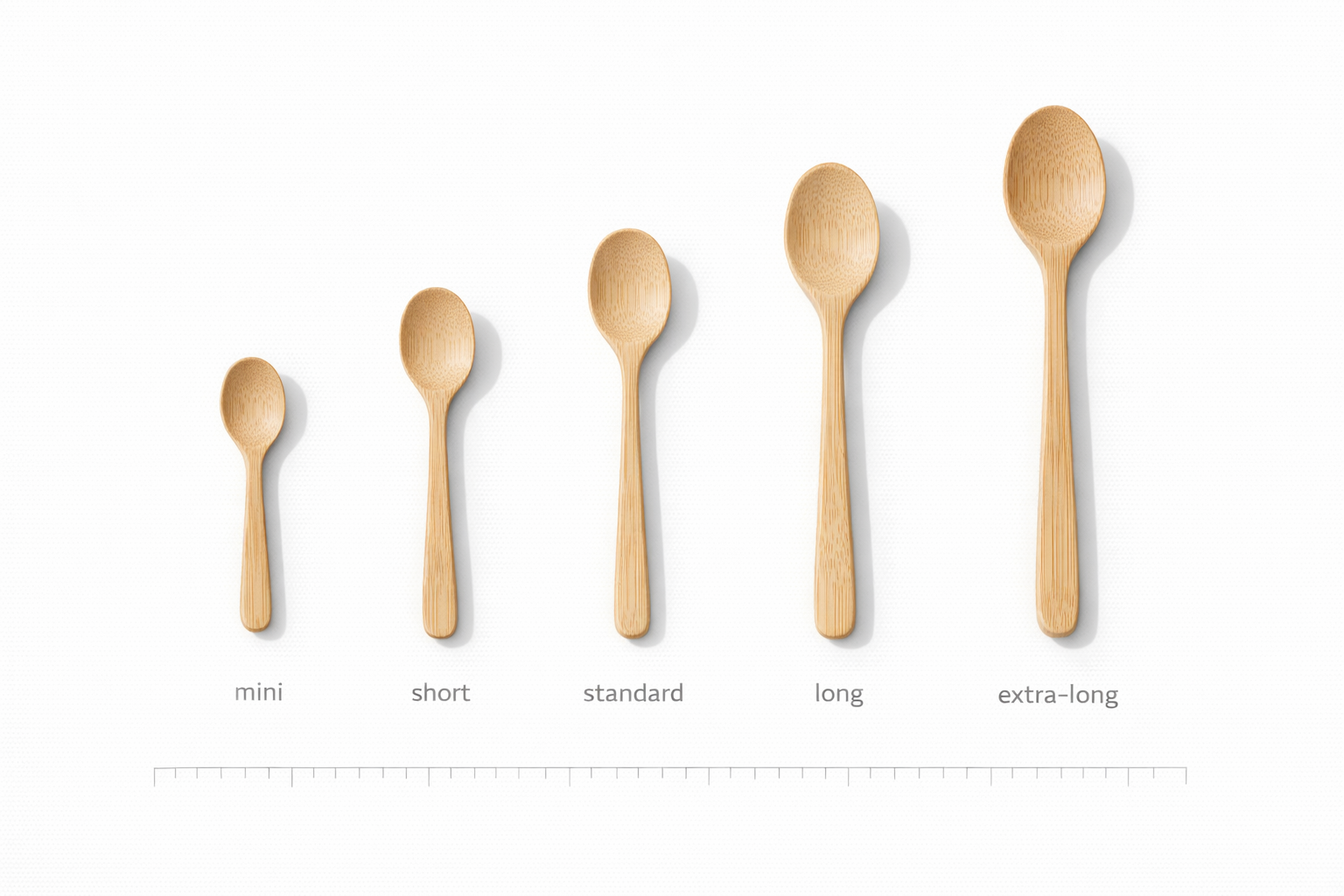
How we define disposable spoon “size”
For disposable spoons, we focus on dimensions, not tsp/tbsp. First, we use length because handle comfort drives user feel. Next, we use bowl width because it changes scooping stability. Then we add use case because soup and dessert do not need the same feel.
We also show mm and inches because buyers use different measurement habits. So dual units reduce confusion and speed up decisions. Also, we recommend testing with real bowls, because a spoon that looks right on paper can feel wrong in a deep container.
Disposable bamboo wooden spoon sizes (mm + inches)
| Type | Size (L×W) mm | Size (L×W) in | Best for |
|---|---|---|---|
| Bamboo wooden spoon (best seller, in stock) | 170×32 | 6.69×1.26 | most takeout meals, bowls, rice, salad, desserts |
| Bamboo wooden spoon | 190×32 | 7.48×1.26 | soup, porridge, larger bowls |
| Long-handle spoon | 210×32 | 8.27×1.26 | deep bowls/cups, meal kits, catering |
| Bamboo wooden spoon | 140×30 | 5.51×1.18 | desserts, yogurt cups, small meals |
| Round-head spoon | 140×36 | 5.51×1.42 | soft foods, smooth mouthfeel |
| Wide spoon | 170×35 | 6.69×1.38 | heavier foods, better scooping |
| Bamboo spork | 158×31 | 6.22×1.22 | rice + sides, one utensil sets |
| Mini spoon | 100×20 | 3.94×0.79 | sauces, tasting, samples |
Quick picks by menu (decision table)
| Use case | Our default pick | Why it works |
|---|---|---|
| Most takeout meals | 170×32 | balanced grip and scoop |
| Soup-heavy menus | 190×32 | better comfort for liquids |
| Deep bowls or cups | 210×32 | keeps hands cleaner |
| Dessert cups | 140×30 or 140×36 | better mouthfeel |
| Condiments and tasting | 100×20 | portion control |
| One utensil sets | spork 158×31 | spoon + fork function |
Packaging, cartons, and private label (B2B workflow)
We support wholesale operations, so we plan packaging with the channel in mind. We support bulk pack, individually wrapped, and retail-ready packaging. Also, packaging can be made to the buyer’s brand, so private label programs are possible.
Our standard master carton quantity is 5,000 pcs per carton. This helps warehouse planning and shipping. At the same time, we can adjust packaging details based on your requirements, because some channels need smaller inner packs.
If you want to review related cutlery pages, you can start here
So if you want the fastest path, we suggest this flow: choose 2–3 sizes, request samples, test them with your real bowls, and then confirm the default size for your main menu. After that, we can quote and plan packaging.
Are there different sizes of tablespoons, and what does “tablespoon sizes” really mean?
People search “tablespoon sizes” because they fear mismatch. Then they hesitate and delay decisions. We will make it clear.
Yes, “tablespoon” can mean a measuring unit or a utensil name. For measuring, most kitchens use [1 tbsp ≈ 15 mL](https://mediterraneantaste.com/how-many-ml-in-a-tablespoon/), and we recommend writing tbsp and mL together to avoid confusion.
Why this question keeps coming up
We see three reasons. First, “tablespoon” is used as a measuring unit and also as an eating utensil term. Second, online sources mix standards without naming them. Third, some products label volumes loosely for convenience. So readers get mixed signals, and then they doubt their tools.
So we keep a strict separation. When we talk about measuring, we write tbsp as a unit and we add mL. When we talk about utensils, we write “tablespoon (cutlery)” and we avoid mL claims. This keeps the meaning clean.
What we put on spec sheets (simple and safe)
We use one pattern because it reduces questions:
- 1 tbsp (≈ 15 mL)
- 1 tsp (≈ 5 mL)
This pattern works because it respects familiar terms, and it supports metric readers. It also helps SEO, because it naturally includes “spoon sizes in ml” without forcing it.
A short template table for teams
| Item | Unit label | Metric | Notes |
|---|---|---|---|
| Teaspoon (measuring) | 1 tsp | ≈ 5 mL | use a measuring set |
| Tablespoon (measuring) | 1 tbsp | ≈ 15 mL | show both units |
| Half tablespoon | 1/2 tbsp | ≈ 7.5 mL | useful for sauces |
| Two tablespoons | 2 tbsp | ≈ 30 mL | useful for batch prep |
Why this also helps procurement and training
In B2B, clarity reduces emails. So we show both units, and then we move to real buying needs like packaging, lead time, and supply stability. Also, when teams in different markets work together, dual units prevent internal confusion. So this section is not only “cooking advice.” It is also a communication tool that helps reduce mistakes.
Is a tsp 7g, and how do we handle “spoon sizes in grams”?
People see “tsp in grams,” so they expect one number. Then results differ, and confusion grows. We will explain it simply.
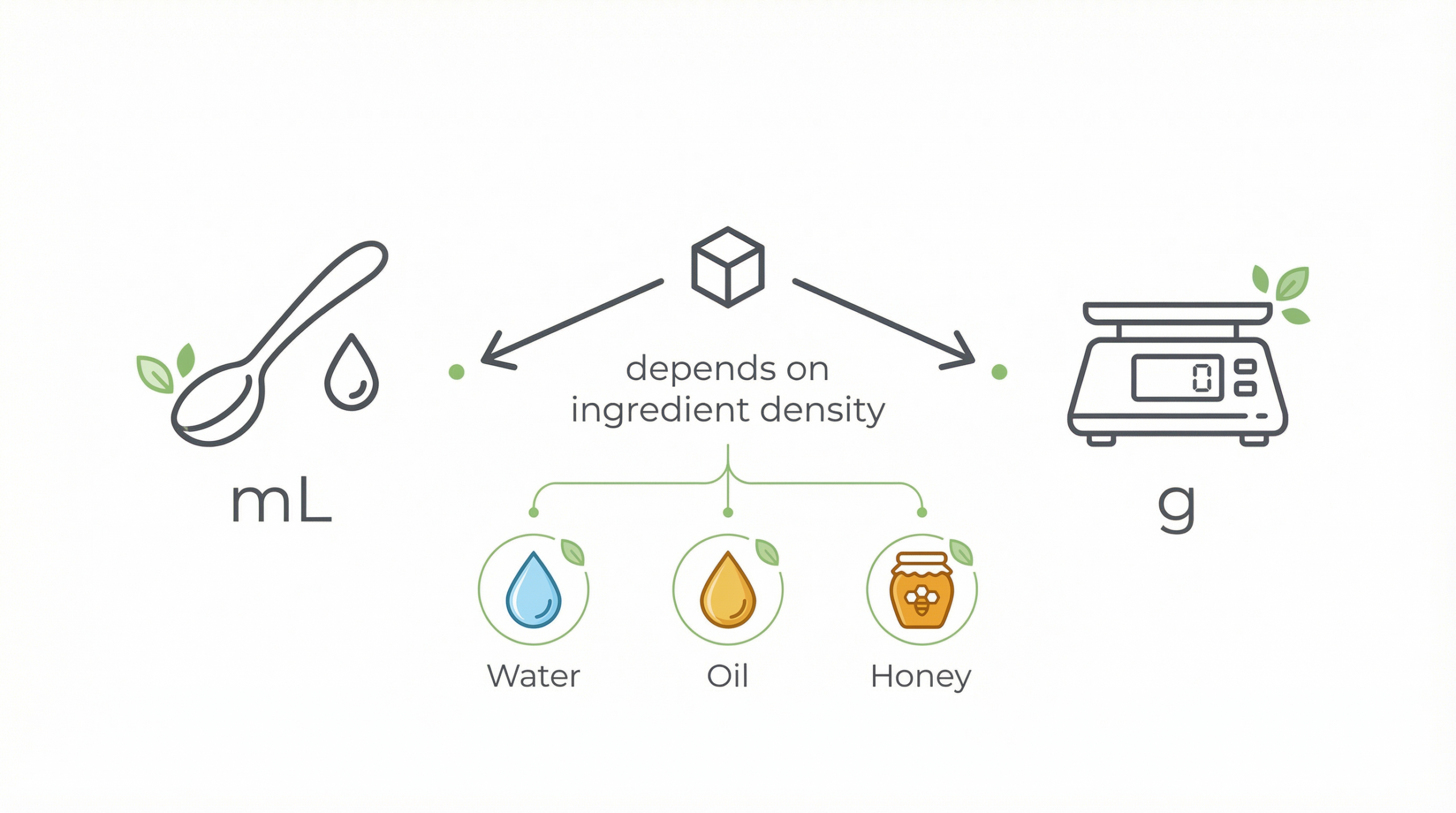
A teaspoon is a volume unit, not a weight unit. 1 tsp is about 5 mL, but grams depend on ingredient density, so tsp-to-grams is not fixed.
Why grams do not match a spoon by default
Grams measure weight. Teaspoons measure volume. So the same volume can weigh more or less depending on density. Also, packing changes weight. Flour can trap air, and sugar crystals pack differently. So “1 tsp = 7g” might be true for one ingredient in one situation, but it will fail for another ingredient.
So we do not answer “yes” or “no” without context. Instead, we ask: “7g of what ingredient?” Then we choose the right method.
The conversion method we use
We use a method that always works: 1) Confirm the volume: 1 tsp (≈ 5 mL). 2) Find density: g/mL from a reliable label or dataset. 3) Calculate: grams = mL × (g/mL).
Practical examples (for intuition)
| Ingredient | Density idea | 1 tsp (≈5 mL) becomes… | Why it changes |
|---|---|---|---|
| Water | ~1 g/mL | ~5 g | baseline reference |
| Cooking oil | <1 g/mL | <5 g | lighter than water |
| Honey | >1 g/mL | >5 g | heavier than water |
| Flour | varies | varies widely | air + packing |
| Sugar | varies | varies | crystal packing |
What we do when accuracy matters
If we need accuracy, we use a scale. If we need day-to-day consistency, we use one measuring set and one repeatable method. So we choose tools based on risk. Also, we keep “grams” content separate from disposable spoon comfort content. That keeps this guide focused, and it reduces confusion for readers who came for utensil sizes.
FAQ: Spoon sizes questions people also ask?
People want short answers, so they scan. Then they jump back to work. We want this FAQ to help fast.
This FAQ answers common “spoon sizes” questions about measuring units, mL conversions, grams, and disposable spoon sizing for food service.
What are the sizes of spoons?
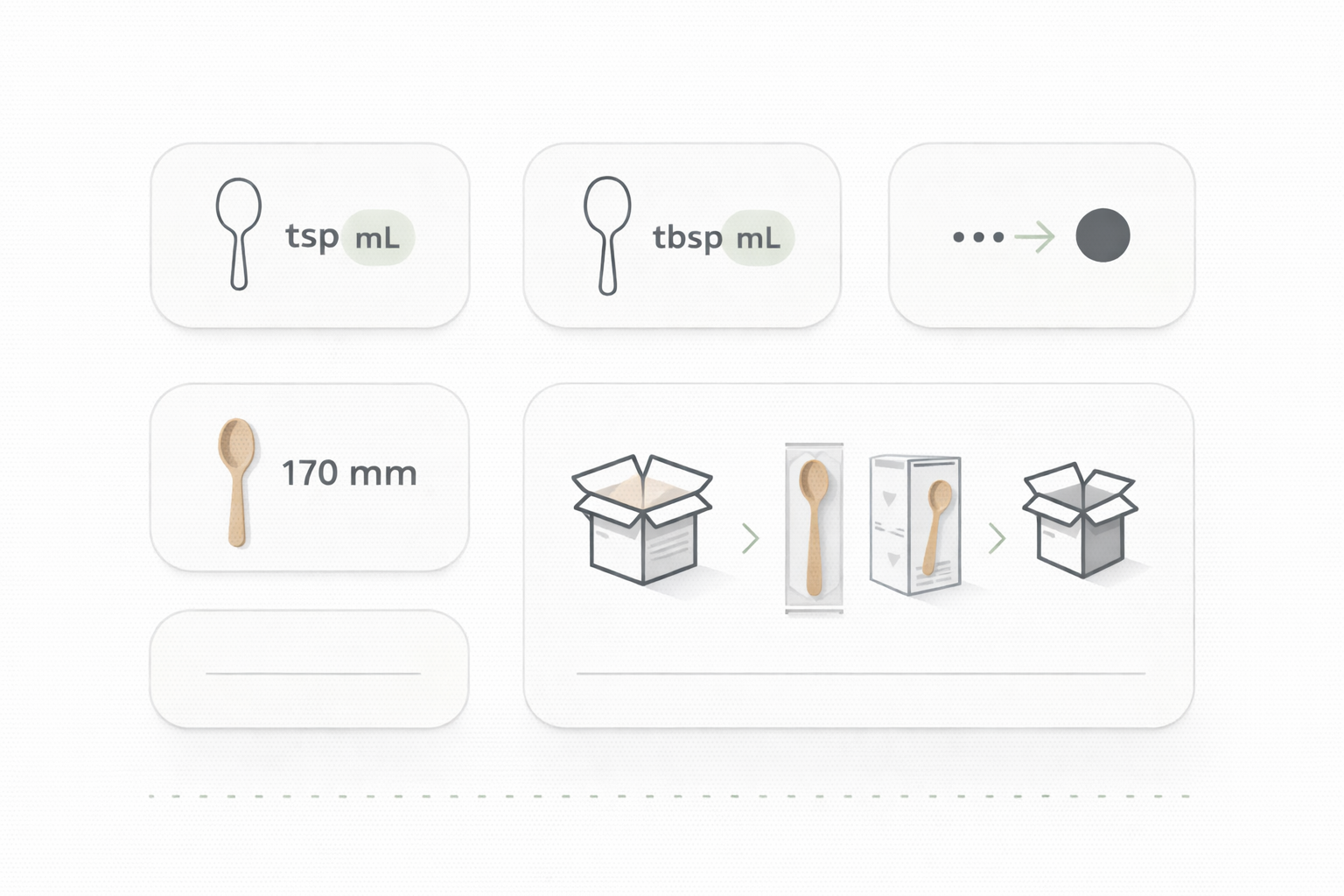
Spoon “sizes” usually mean either measuring units (tsp/tbsp in mL) or utensil dimensions (length and bowl width). So we choose the chart based on the task.
What are the 4 sizes of measuring spoons?
A common 4-piece set includes 1/4 tsp, 1/2 tsp, 1 tsp, and 1 tbsp. In metric, that is about 1.25 mL, 2.5 mL, 5 mL, and 15 mL.
What’s the easiest way to remember tbsp vs tsp?
We use: tbsp is bigger, and 1 tbsp ≈ 3 tsp. If we feel unsure, we measure instead of guessing.
Are there different sizes of tablespoons?
Yes, because “tablespoon” can mean a unit or a utensil name. For measuring, most kitchens use 1 tbsp ≈ 15 mL, so we write tbsp + mL together.
Spoon sizes in mL: what is 1 tsp and 1 tbsp?
In everyday cooking, 1 tsp ≈ 5 mL and 1 tbsp ≈ 15 mL. So we show tsp/tbsp and mL together.
Is a plastic spoon a teaspoon?
Not reliably. A disposable spoon is not a calibrated measuring tool. So we use a real measuring set for recipe accuracy.
Is a tsp 7g?
Not always. A tsp is volume, and grams depend on density. Water is about ~5 g per tsp, but many ingredients differ.
Spoon sizes in grams: how do we convert?
We use: grams = mL × (g/mL). We confirm the ingredient first, and then we use density data or a scale.
What are the 12 apostle spoons?
“12 apostle spoons” usually refers to a traditional decorative spoon set in historical contexts. It is not a measuring standard, and it is not a food service sizing topic.
What size disposable spoon is best for most takeout meals?
For most takeout meals, 170 mm is a safe default. It fits common bowls and feels comfortable. For deep bowls and soups, 190–210 mm can work better.
Do we offer bulk, individually wrapped, or retail-ready packaging?
Yes. We support bulk pack, individually wrapped, and retail-ready packaging. We also support OEM/private label packaging.
How many spoons are in a master carton?
Our standard master carton quantity is 5,000 pcs per carton.
Can we request a quote and free samples?
Yes. We can provide a quotation and free samples so you can test spoon length, bowl feel, and packaging workflow with your real bowls and menu.
Quick FAQ summary table (fast scan)
| Topic | Best quick answer |
|---|---|
| Measuring spoon sizes | 1 tsp ≈ 5 mL; 1 tbsp ≈ 15 mL |
| “4 sizes” set | 1/4 tsp, 1/2 tsp, 1 tsp, 1 tbsp |
| tbsp vs tsp memory | tbsp is bigger; 1 tbsp ≈ 3 tsp |
| tsp to grams | depends on ingredient density |
| Takeout spoon default | 170 mm is a safe start |
A simple next step
If you want a fast decision, we suggest a small test. You can request a quote and free samples, and you can tell us your menu and bowl size. Then we will recommend the best spoon length and packaging format for your workflow.
Conclusion
We separated measuring and utensil spoon sizes, shared practical charts, and helped you choose disposable bamboo wooden spoons for food service.