Technical review: PANABAM Product Manager and Quality Manager, each with 10+ years of relevant experience
Published October 14, 2026 · Last reviewed October 14, 2026
PFAS-free food packaging is packaging represented as being made without PFAS in the defined product scope. For buyers, however, the phrase is not enough by itself. A useful claim should identify which component it covers, whether PFAS are intentionally added, what supporting evidence exists and which destination-market rules apply. “PFAS-free” should not automatically be interpreted as an absolute guarantee that every possible PFAS is present at zero concentration.
The short answer
Treat PFAS-free as a claim that must be read together with its scope and evidence. Confirm the finished product body, lid, coating, print and any other component separately; ask whether PFAS are intentionally added; and review product-specific documentation against the requirements of the market where the packaging will be sold or used.
In this guide
-
Why PFAS were used in some fiber-based food packaging
-
How “PFAS-free,” “no intentionally added PFAS” and analytical results differ
-
How targeted PFAS analysis differs from fluorine screening
-
What evidence a commercial buyer should request
-
How representative evidence may support a defined product family
-
How U.S. federal, California and EU requirements differ
What Are PFAS?
PFAS stands for per- and polyfluoroalkyl substances, a large and diverse group of synthetic chemicals. Certain PFAS have been used because fluorinated chemistry can provide resistance to oil, grease and water. In food-contact applications, that function historically made some PFAS useful in grease-proof paper and paperboard packaging.
The U.S. Food and Drug Administration explains that PFAS containing carbon chains of eight or more carbons were phased out of food-contact uses, and that the remaining grease-proofing PFAS for paper and paperboard were no longer sold into the U.S. market after a voluntary phase-out announced in 2024. Read the FDA overview.
Why Were PFAS Used in Food Packaging?
Food packaging often has to manage grease, sauces and moisture. Historically, some paper- and plant-fiber packages used fluorinated grease-proofing treatments to reduce oil penetration without adding a visibly separate plastic layer. That history is why buyers now encounter PFAS questions most often around wrappers, bags, paperboard items and molded-fiber foodservice packaging.
PFAS were never the only way to design functional packaging. Fiber selection, pulp preparation, forming pressure, heat, density, geometry, surface structure and—where used—non-PFAS coatings or barriers can all affect performance. A PFAS-free claim therefore describes chemical scope; it does not by itself predict leak resistance, oil holdout, heat tolerance or storage life.
What Does “PFAS-Free” Actually Mean?
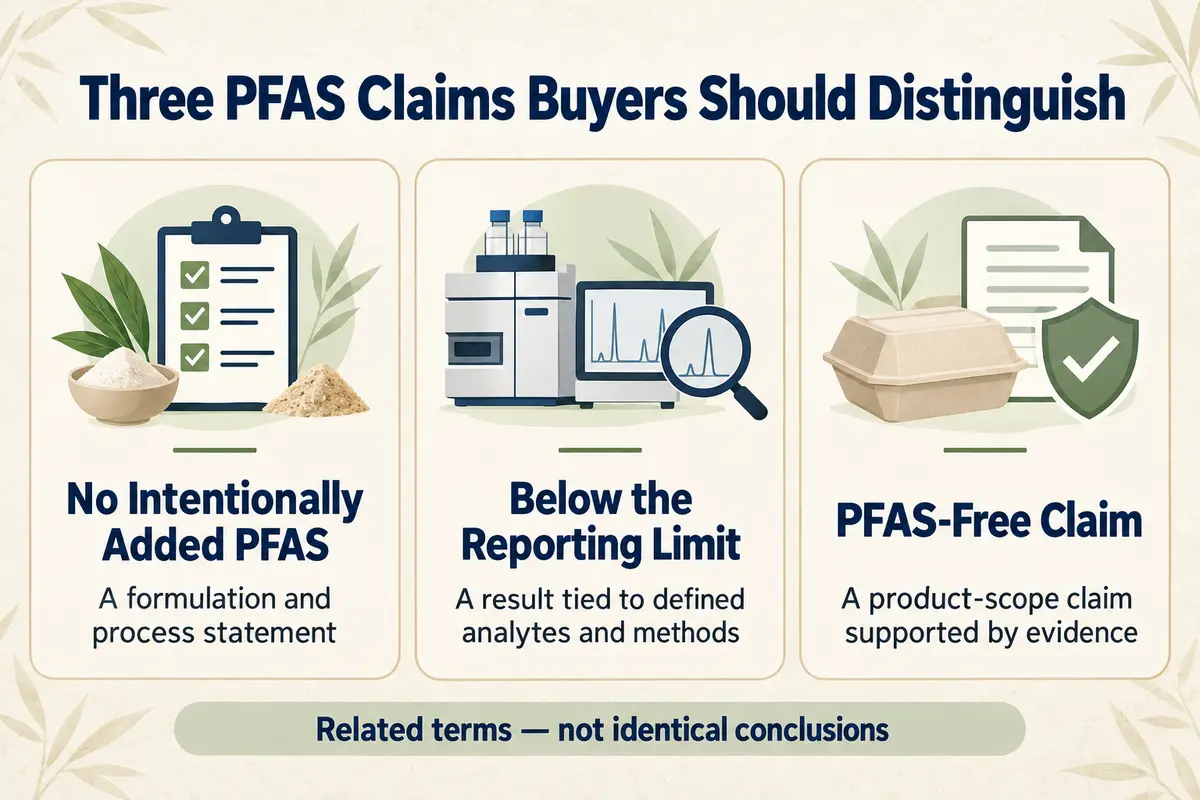
In commercial conversations, PFAS-free is used as a simple buyer-facing term, but suppliers, laboratories and regulators may support or interpret it in different ways. Procurement teams should translate the headline claim into specific questions before approving a material.
| Term | What it can communicate | What it does not automatically prove |
|---|---|---|
| PFAS-free | A supplier’s claim that the defined product or component is made without PFAS, supported by the supplier’s evidence framework. | Absolute zero for every PFAS; coverage of every lid, print, accessory, batch or market rule. |
| No intentionally added PFAS | PFAS are not deliberately introduced into the formulation or manufacturing process for the defined scope. | That sensitive analysis can never detect trace fluorine or incidental background contamination. |
| Not detected / below a reporting limit | The analytes covered by a stated analytical procedure were not reported above its applicable limit. | That unmeasured PFAS are absent, or that all other methods and regulatory thresholds would give the same conclusion. |
| Below a statutory threshold | The tested or documented product meets a particular limit under a specified rule and scope. | Compliance in every jurisdiction or proof that no PFAS were intentionally added. |
| PFOA-free | The claim addresses PFOA, one member of the broader PFAS family. | That the product is free of all other PFAS. |
Buyer rule of thumb
Do not approve a product from the phrase “PFAS-free” alone. Match the claim to a defined component, formulation statement, evidence scope, applicable market and document date.
Does PFAS-Free Mean Absolutely Zero PFAS?
An absolute-zero interpretation is usually not scientifically useful. Analytical procedures cover defined substances and have limits at which results can be reliably reported. Very sensitive techniques may also detect fluorine or PFAS traces that were not intentionally introduced. The FDA specifically notes that highly sensitive methods may detect PFAS even when they were not intentionally used in food packaging.
A responsible statement therefore avoids turning a qualified analytical result into a universal zero claim. Buyers should ask what the supplier means by PFAS-free, whether the formulation excludes intentional PFAS use, what part of the package is covered and how the claim is supported.
PFAS-Free vs. No Intentionally Added PFAS
The two phrases can appear together, but they answer different questions. “No intentionally added PFAS” describes formulation and process intent. “PFAS-free” is a broader market-facing claim that should be grounded in that formulation control and, where appropriate, analytical or documentary support. Neither phrase should be expanded beyond the product and component scope actually reviewed.
How Is Food Packaging Checked for PFAS?
There is no single analytical screen that answers every PFAS question. Two broad approaches are common in buyer and regulatory discussions: analysis for selected PFAS compounds and measurement of fluorine as a screening or threshold tool. They provide different information.
| Approach | What it tells a buyer | Important limitation |
|---|---|---|
| Targeted PFAS analysis | Looks for a defined list of individual PFAS using a stated procedure and reporting limits. | It cannot establish the absence of PFAS that are outside the target list. |
| Total organic fluorine or other fluorine screening | Measures fluorine at a broader level and may be used in some regulatory or investigative frameworks. | A fluorine result does not by itself identify which compound produced it or whether the fluorine comes from PFAS. |
| Formulation and process review | Checks whether PFAS-containing materials are deliberately used in raw materials, treatment systems or production steps. | It depends on accurate supplier declarations, change control and traceability. |
The strongest verification program combines the evidence that fits the risk: a clear formulation declaration, finished-product scope, supplier controls, relevant analytical support and destination-market review. A test result should not be detached from the sample description or treated as a permanent certificate for products that may later change.
How Buyers Can Verify PFAS-Free Food Packaging
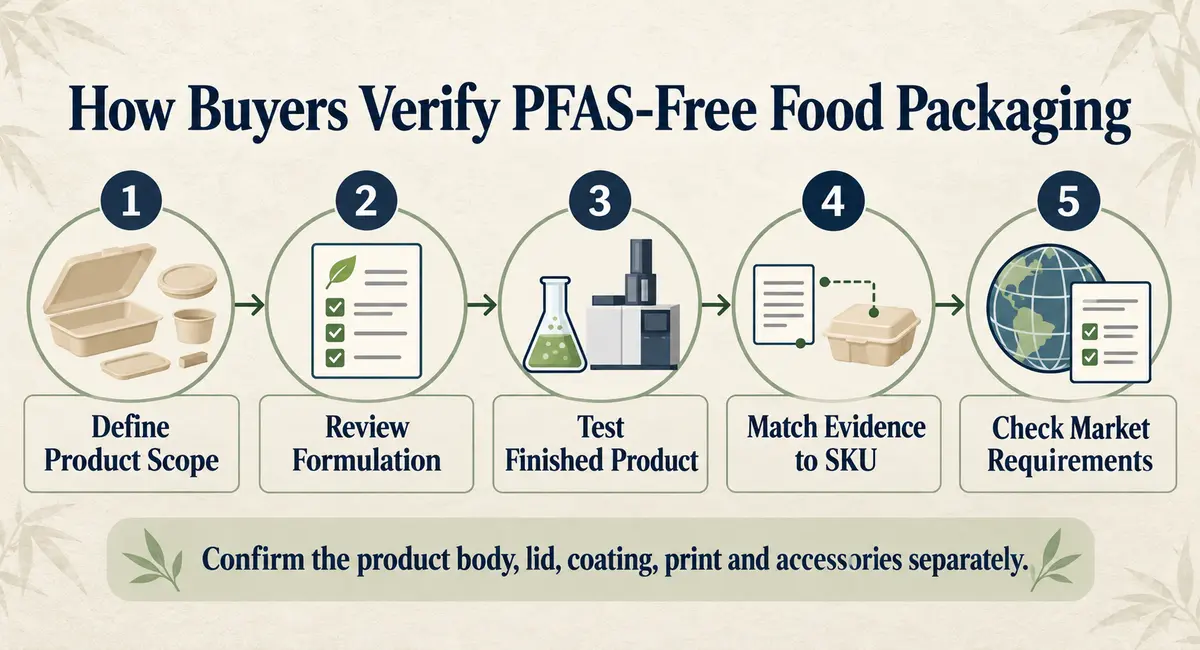
Verification is less about collecting the largest possible document file and more about building an unbroken connection from the claim to the product being purchased. The following sequence is practical for importers, distributors, foodservice brands and compliance teams.
1. Define the exact product scope
Record the item number, material, color, dimensions, compartment configuration and intended use. Separate the molded product body from a PET, RPET, PP or other lid. Treat printing, labels, inks, adhesives, coatings, laminated layers and custom decorations as separate components unless the evidence explicitly includes them.
2. Ask how the supplier defines PFAS-free
Request a written answer that distinguishes intentional formulation from analytical results. A useful response should say whether PFAS are intentionally added and describe the product family to which the statement applies. Avoid relying on vague language such as “eco-friendly,” “chemical-free” or “PFOA-free.”
3. Confirm whether the evidence relates to raw material or finished articles
Raw-material information is valuable for formulation control, while a finished-article assessment is closer to the actual item placed on the market. For a complete review, understand both the input materials and any chemicals, print, coating, adhesive or accessory introduced during manufacturing and packing.
4. Match the evidence to the product family
Ask for a product-to-evidence mapping. It should explain why the reviewed sample is representative of other sizes or shapes—for example, because they use the same fiber furnish, formulation, grease- and water-resistance system, additives, release system and manufacturing process. Where those variables differ, the evidence may not transfer.
5. Review the destination-market requirement
A buyer selling into California may need to consider a different legal definition and threshold than a buyer preparing for EU requirements. U.S. federal actions, state restrictions, EU limits and private retailer specifications should not be collapsed into one universal standard.
6. Check document control
Confirm that supporting declarations and assessments are current for the selected product. Ask what triggers re-evaluation: a fiber-source change, new chemical supplier, revised formulation, new coating, printing, different production site or material substitution. Change control is what keeps a historical document relevant.
7. Validate functional performance separately
PFAS verification does not prove that a container is suitable for a specific food, temperature, holding time or distribution route. Run fit-for-use trials with the actual food and complete packaging system, including the lid, closure and transport conditions.
Can One Representative Sample Support Multiple SKUs?
Potentially—if the product family is defined by the same relevant material and manufacturing variables. It is normal for a supplier to use a representative article to support a family of different shapes or sizes, but the rationale must be documented. The mere fact that products share a brand name is not enough.
| Representative-family condition | Why it matters |
|---|---|
| Same fiber composition | A different fiber blend may introduce different raw-material inputs. |
| Same functional chemistry | Grease resistance, wet strength, binders, coatings and release systems can change the chemical profile. |
| Same manufacturing process and site controls | A process or site change can introduce different contact materials or cross-use risks. |
| Same print and surface treatment status | Printed, colored or coated versions should not inherit evidence from an unprinted, uncoated item without review. |
| Documented change control | Evidence should be re-evaluated when relevant materials, suppliers or processes change. |
Reassessment is appropriate when a product adds a coating, switches fiber furnish, introduces printing or colorants, changes chemical inputs, moves to a different process or site, or includes a new lid or accessory. Buyers should also recheck evidence when a destination market updates its requirements.
PANABAM’s PFAS-Free Molded Bamboo-Fiber Product Scope
For PANABAM’s applicable core unprinted molded bamboo-fiber products, the complete product body is made from 100% bamboo fiber. PANABAM states that PFAS are not intentionally added and permits the buyer-facing claim PFAS-free for this defined scope. The product body does not use additives, barrier agents, wet-strength agents, binders or release agents, and it contains no PE, PLA, plastic film or wax coating.
The product-family statement is based on a shared raw-material formulation, the same fiber-forming and heat-pressing process, and the same absence of added barrier agents, wet-strength agents, binders and release agents across the applicable molded bamboo-fiber range. The evidence rationale applies while those relevant variables remain unchanged.
Scope matters
This statement covers the applicable core unprinted molded bamboo-fiber product body. A separate plastic lid, printed or colored version, composite construction, coating, custom development or future formulation change should be confirmed separately for the selected item.
PANABAM’s PFAS Test Evidence
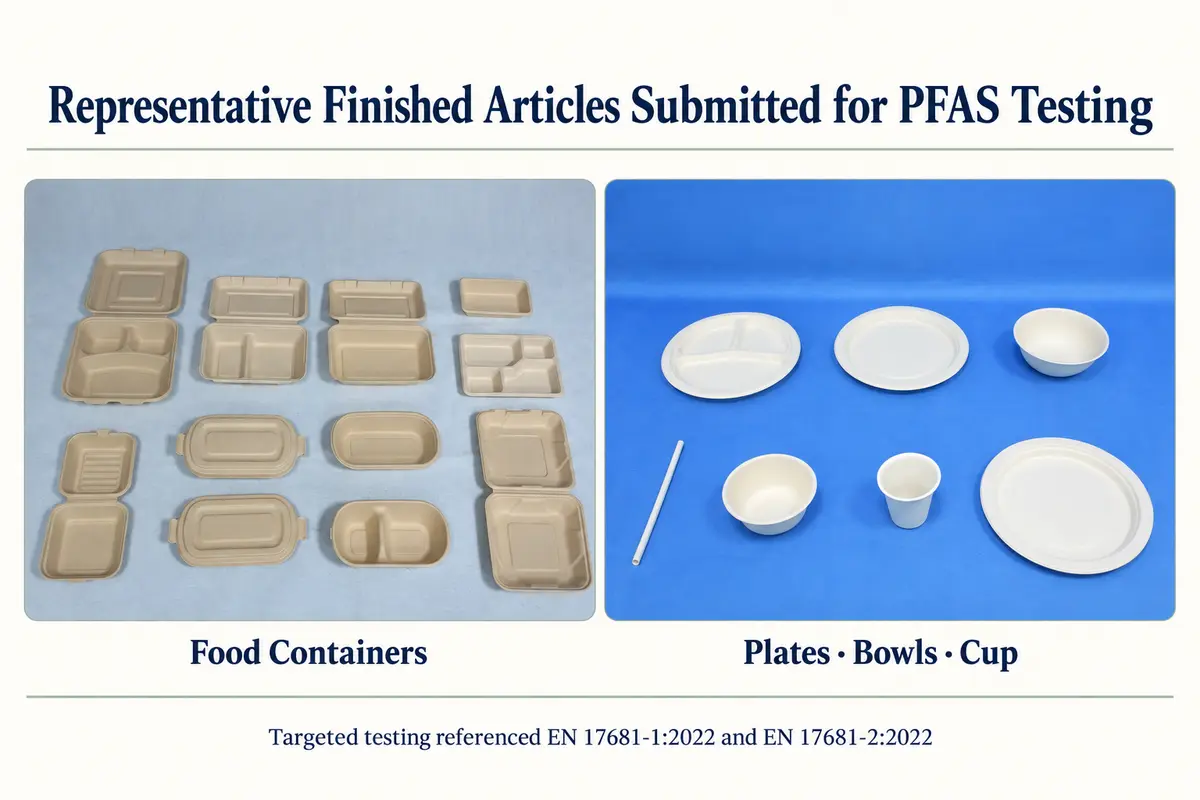
PANABAM submitted representative finished molded bamboo-fiber articles—a disposable bowl, plate and food container—for targeted PFAS testing by TÜV Rheinland/CCIC (Qingdao) Co., Ltd. The material was identified as natural bamboo. Testing referenced EN 17681-1:2022 and EN 17681-2:2022 and used CI-GC-MS, GC-MS/MS and LC-MS/MS analytical techniques.
| Evidence item | What the reviewed report states |
|---|---|
| Tested articles | Finished disposable bowl, disposable plate and disposable food container |
| Sample submission | Customer-submitted finished products |
| Material | Natural bamboo |
| Laboratory | TÜV Rheinland/CCIC (Qingdao) Co., Ltd. |
| Reference methods | EN 17681-1:2022 and EN 17681-2:2022 |
| Analytical techniques | CI-GC-MS, GC-MS/MS and LC-MS/MS |
| Targeted scope | 57 listed PFAS substances and related salts or precursors |
| Reporting limits | 0.01–0.25 mg/kg, depending on the analyte |
| Reported findings | Every listed result was below its applicable reporting limit; the report’s overall conclusion was PASS against the stated customer requirement |
“Below the reporting limit” means that a listed analyte was not reported at or above the applicable limit of that analysis. It does not mean absolute zero, does not address PFAS outside the targeted list and should not be treated as automatic proof of compliance with every current or future market rule.
The tested bowl, plate and food container are used as representative articles for PANABAM’s related core unprinted molded bamboo-fiber product families because those products share the current 100% bamboo-fiber formulation, the same absence of added barrier agents, wet-strength agents, binders and release agents, and the same relevant manufacturing process. Buyers should still request a product-to-report mapping for the selected SKU.
The representative-family rationale no longer applies automatically if a product introduces a changed formulation, coating, print, colorant, separate lid, complementary material or different relevant manufacturing process. Those variants require separate confirmation.
Buyers can review PANABAM’s disposable food containers, explore plates and trays, compare all food packaging options, or read the product-focused guide to PFAS-free disposable plates. For printed, colored, coated or custom-developed variants, review PANABAM’s OEM and private-label services and request product-specific confirmation before approving an order.
Can PFAS-Free Fiber Containers Still Resist Oil and Water?
Yes, PFAS-free molded-fiber packaging can be designed for useful oil and water resistance, but the result depends on the product’s materials, fiber network, density, forming and heat-pressing conditions, surface structure and geometry. The PFAS claim and the performance claim require separate support.
For selected PANABAM unprinted molded bamboo-fiber product bodies, the following company-confirmed maximum use conditions may apply. Availability and suitability must be confirmed for the individual SKU, food type and complete packaging configuration. These conditions do not automatically apply to separate lids, printed products or complementary materials.
| Use condition | Maximum company-confirmed condition for selected applicable SKUs |
|---|---|
| Microwave | Up to 1000 W for up to 60 minutes |
| Oven | Up to 200°C for up to 60 minutes |
| Freezer | Down to −50°C for up to 60 hours |
| Hot and oily food contact | Up to 100°C for up to 24 hours |
These conditions describe controlled product capability, not a universal shelf-life promise. Buyers should test the actual food, fill temperature, oil and water content, holding time, closure, transport, microwave or oven profile and storage environment.
PFAS Food-Packaging Rules: United States, California and European Union
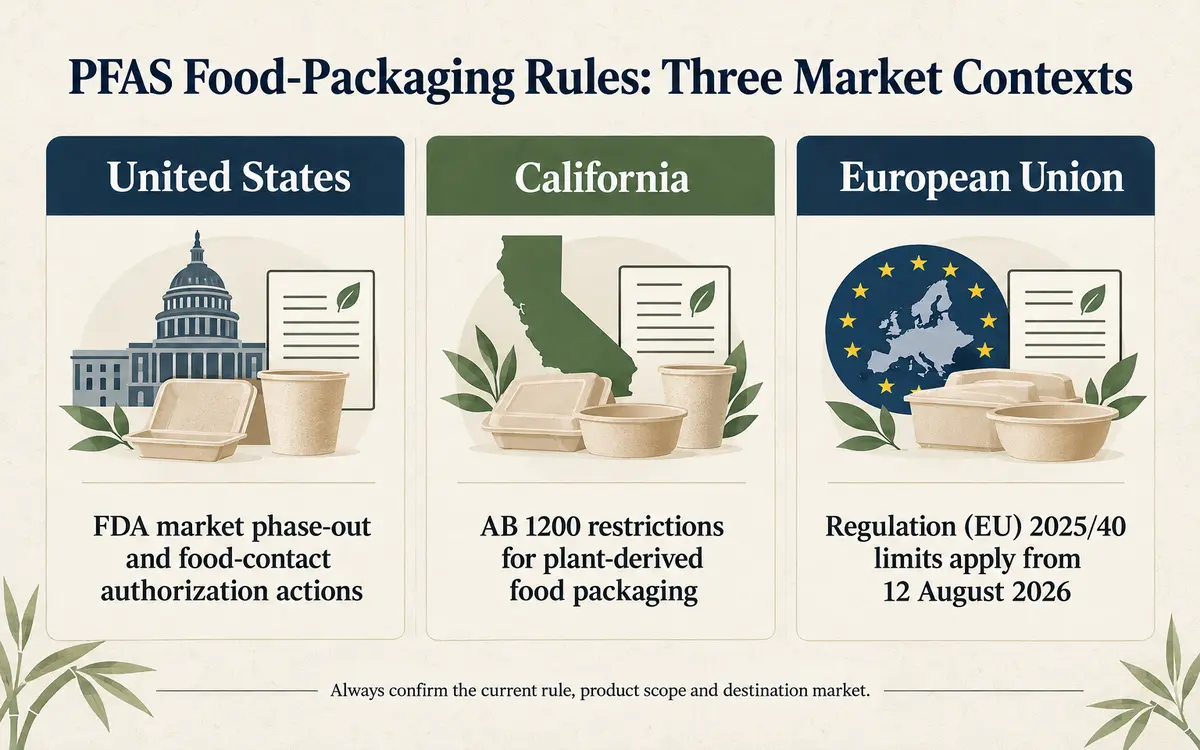
PFAS requirements are changing, but there is no single worldwide rule. The summary below is a procurement orientation, not legal advice. Always check the current primary text and the specific product, component, transaction date and destination market.
United States: federal FDA context
The FDA states that grease-proofing substances containing certain PFAS for paper and paperboard food packaging were no longer being sold into the U.S. market following a voluntary phase-out. In January 2025, the FDA determined that 35 related food-contact notifications were no longer effective because their intended uses had been abandoned. The action concerned specified authorizations; it should not be paraphrased as a global ban on every PFAS in every type of food packaging.
FDA: authorized uses of PFAS in food-contact applications • FDA: 35 food-contact notifications no longer effective
California: AB 1200
California’s AB 1200 restrictions apply to food packaging made substantially from paper, paperboard or other plant-derived materials. From January 1, 2023, the law prohibits intentionally added PFAS and sets a threshold of 100 parts per million measured as total organic fluorine. This state rule has its own definitions and scope; buyers should not assume it is identical to federal policy or rules for other materials.
California DTSC: food packaging containing PFAS • California DTSC PFAS food-packaging FAQ
European Union: Packaging and Packaging Waste Regulation
Article 5(5) of Regulation (EU) 2025/40 applies PFAS concentration limits to food-contact packaging placed on the market from August 12, 2026. The regulation sets limits of 25 ppb for any targeted PFAS measured with targeted analysis (polymeric PFAS excluded), 250 ppb for the sum of targeted PFAS measured as the sum of targeted analysis—where applicable with prior degradation of precursors (polymeric PFAS excluded)—and 50 ppm for PFAS including polymeric PFAS. Where total fluorine exceeds 50 mg/kg, the manufacturer, importer or downstream user must provide proof of fluorine measured as either PFAS or non-PFAS content on request for technical documentation.
The regulation also anticipates Commission monitoring guidance. Because targeted methods, precursor treatment and fluorine measurements answer different questions, buyers should align the evidence plan with the current EU text and any applicable implementation guidance rather than assuming that one historical report resolves every limit.
EUR-Lex: Regulation (EU) 2025/40 • European Commission guidance published in 2026
PFAS-Free Is Not the Same as Plastic-Free, Uncoated or Compostable
Sustainability and food-contact claims overlap in buyer conversations, but they are not interchangeable. Each should be supported on its own terms.
| Claim | Primary question answered | Not established by the claim alone |
|---|---|---|
| PFAS-free | Does the defined product scope exclude PFAS under the supplier’s evidence framework? | Plastic-free status, compostability, food-contact compliance or use performance. |
| Plastic-free | Does the defined item exclude plastic components or layers? | Absence of PFAS or compostability. |
| Uncoated | Is there no applied coating on the defined surface or product? | Absence of process chemicals, PFAS or all polymeric substances. |
| Compostable | Can the item meet a stated compostability standard under specified conditions? | PFAS-free status, recyclability or suitability for every local waste system. |
| Food-contact compliant | Does the product meet the stated food-contact requirements for its scope and conditions? | PFAS-free status in every market or fitness for every food and temperature. |
B2B Buyer Checklist
Use this checklist before approving a PFAS-free food-packaging supplier or item:
-
Identify the exact SKU, material, color, size and manufacturing site.
-
Separate the product body from the lid, print, label, adhesive, coating and accessory components.
-
Request the supplier’s written definition of PFAS-free and a no-intentionally-added-PFAS statement for the defined scope.
-
Confirm whether supporting information relates to raw material, a finished article or both.
-
Ask which product family is covered and why any representative sample is technically applicable to other SKUs.
-
Check whether fiber composition, functional chemistry, manufacturing process and surface treatment are shared across that family.
-
Review the current requirements for the destination market and any retailer or customer specification.
-
Confirm document dates, revision control, traceability and the changes that trigger reassessment.
-
Evaluate food-contact documentation separately from PFAS support; one does not replace the other.
-
Validate oil, water, heat, freezer, lid and transport performance with the actual food and use conditions.
Frequently Asked Questions
Does PFAS-free mean no PFAS can ever be detected?
Not necessarily. A meaningful analytical statement is tied to a defined procedure, analyte scope and reporting capability. Trace findings may also occur without intentional use. Ask for the supplier’s definition, product scope and evidence framework rather than assuming an unlimited absolute-zero guarantee.
Is no intentionally added PFAS the same as “not detected”?
No. “No intentionally added PFAS” is a formulation and process statement. “Not detected” is an analytical result for the substances and reporting limits covered by a particular procedure. The two can support each other, but they are not synonyms.
Does plastic-free automatically mean PFAS-free?
No. Plastic-free addresses plastic materials or components within a defined scope. PFAS-free addresses a different chemical family. A fiber package can be plastic-free yet still require separate PFAS verification.
Does compostable packaging automatically mean PFAS-free?
No. Compostability testing evaluates disintegration, biodegradation and related criteria under a stated standard. It is not a substitute for formulation review or PFAS-related evidence.
Can one supporting document cover several sizes and shapes?
It may support a defined product family when the relevant fiber composition, functional chemistry, process, site controls and surface treatment are the same. The supplier should provide a documented rationale and identify any excluded variants.
Can PFAS-free molded-fiber containers hold hot or oily food?
They can when designed and validated for that use. PFAS-free status alone does not establish performance. For applicable PANABAM core unprinted molded bamboo-fiber product bodies, hot and oily food contact is confirmed up to 100°C for up to 24 hours; buyers should still validate the selected SKU, food and full package.
What information should I send a packaging supplier?
Provide the food type, oil and water content, fill temperature, holding time, storage temperature, microwave or oven use, lid and sealing requirements, transport conditions, order volume and destination market. This lets the supplier recommend a product and documentation package that match the application.
Buyer Evidence Decision Table
Use this table to translate a purchasing requirement into the evidence or confirmation that should be reviewed. The exact document set depends on the selected product and destination market.
| Buyer needs to confirm | Evidence or confirmation to request |
|---|---|
| No intentionally added PFAS | A formulation or supplier declaration for the defined product scope |
| A claim about specified PFAS analytical findings | Finished-product documentation identifying the sample scope, targeted analytes, reference methods and reporting limits |
| U.S. market suitability | Applicable food-contact documentation plus confirmation of relevant federal, state and customer requirements |
| California requirements | Confirmation of intentional-use status and the applicable total-organic-fluorine requirement for the plant-fiber package |
| European Union requirements | Product-scope mapping against the applicable PFAS limits and technical-documentation requirements |
| Oil and water resistance | Product-specific use conditions and fit-for-use testing with the buyer’s actual food and complete package |
| One document supporting multiple SKUs | A written equivalence rationale covering material, formulation, process, print and surface-treatment status |
Technical Review
This guide was technically reviewed by PANABAM’s Product Manager and Quality Manager. Each has more than 10 years of experience in molded-fiber food packaging, covering product development, material formulation, quality control, food-contact testing and export-project documentation. The review covered product scope, manufacturing statements, use-condition boundaries and the practical documentation questions commonly raised in B2B purchasing.
Regulations and product documents may change. PANABAM should review this page whenever a relevant regulation, formulation, process, component, performance condition or supporting document changes.
Request Product-Specific PFAS Information
Looking for PFAS-free molded bamboo-fiber food packaging? Tell PANABAM which product, food application, temperature range, holding time, lid, order quantity and destination market you are evaluating. The team can confirm the applicable product scope, recommend samples and discuss supporting documentation for the selected item.
Request PFAS-Free Product Information
Editorial Sources
Primary sources used for regulatory and technical statements:
-
U.S. FDA — Authorized Uses of PFAS in Food Contact Applications
-
U.S. FDA — 35 PFAS-Related Food Contact Notifications No Longer Effective
-
EUR-Lex — Regulation (EU) 2025/40 on Packaging and Packaging Waste
Editorial note: Regulations and product specifications can change. Review the current primary sources and product-specific documents before publication and before making a commercial compliance decision.