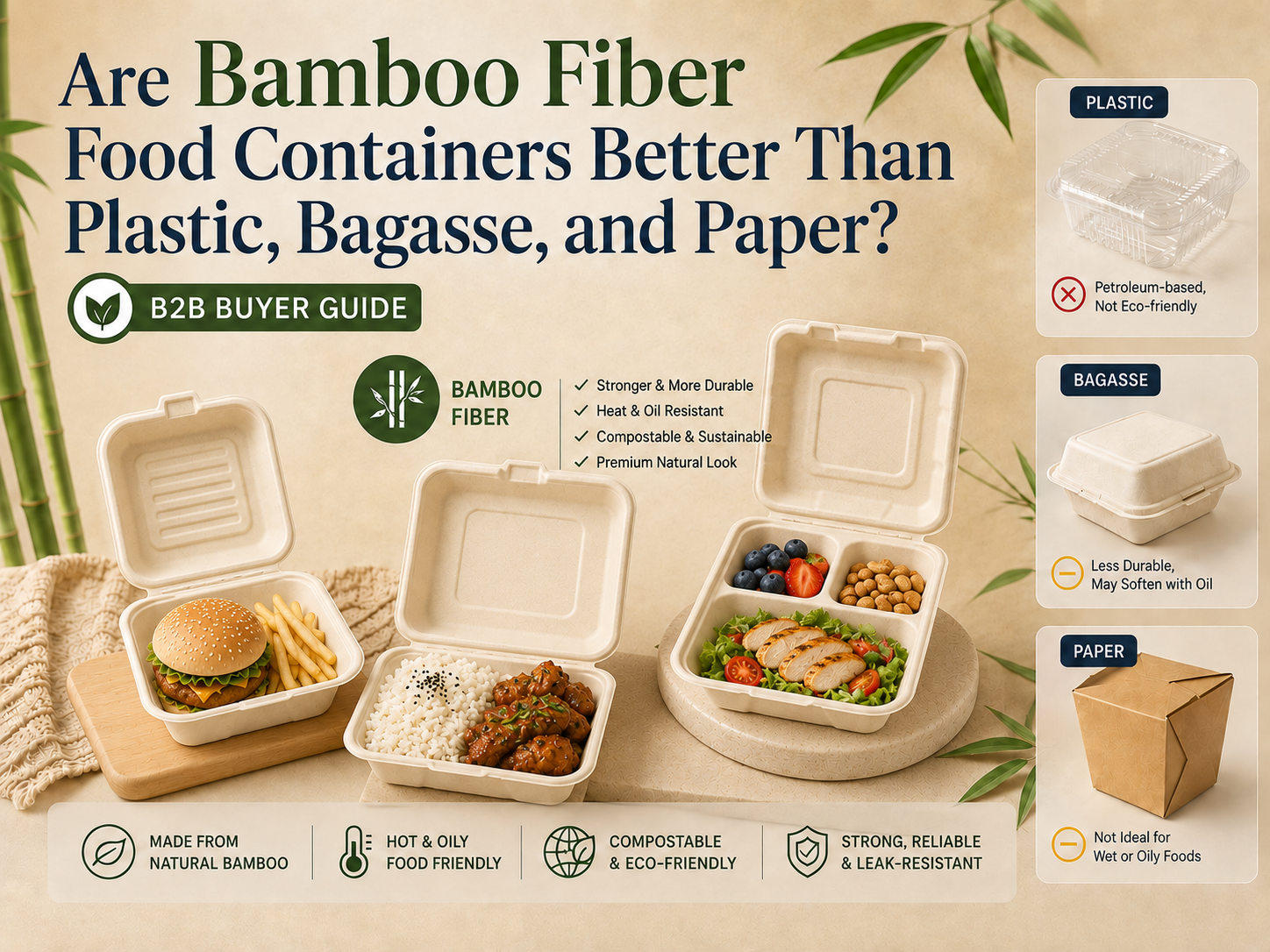
Foodservice buyers face rising plastic restrictions, inconsistent molded-pulp performance, and higher sustainable-packaging costs. Choosing only by unit price can create greater operational risks.
Bamboo fiber food containers can provide high rigidity, resistance to hot and oily foods, natural presentation, and plastic-free positioning when product performance and compliance are properly verified.
This guide compares materials, explains PANABAM’s 100% bamboo-pulp process, and identifies the factors professional buyers should verify before placing wholesale orders.
What Are Bamboo Fiber Food Containers Made Of?
Products marketed as bamboo packaging may have different compositions. Without a clear material declaration, buyers may unknowingly source blended pulp, plastic-lined, or chemically treated products.
PANABAM bamboo fiber food containers are molded from 100% bamboo pulp without added binders, plastic resin, PLA lining, wax coating, bleach, or intentionally added PFAS.
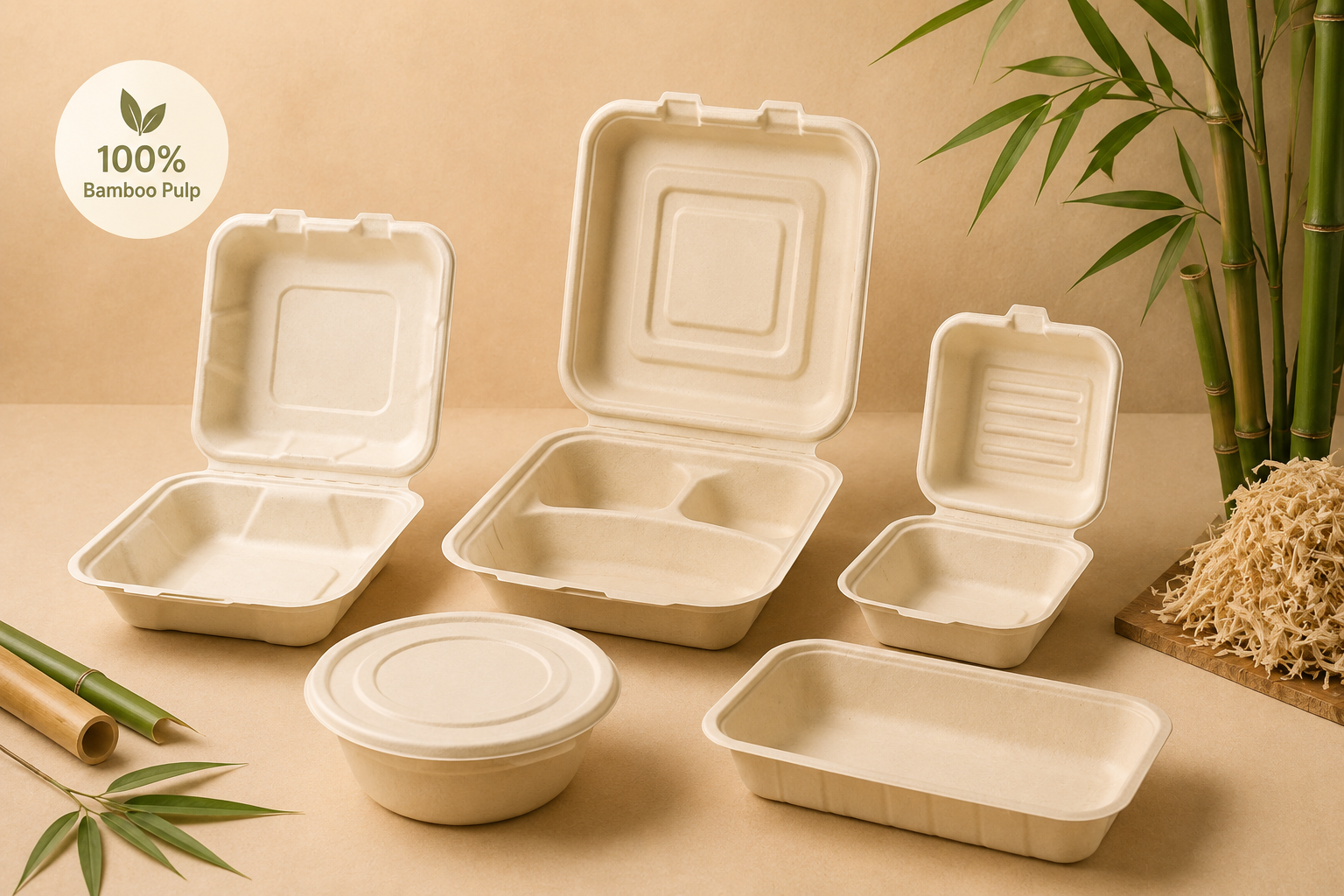
PANABAM food containers begin with bamboo fiber pulp rather than bamboo powder mixed with plastic resin or paperboard covered by a polymer barrier.
The finished structure is created through pulp preparation, vacuum wet forming, and high-temperature hot-press molding. Its strength comes from the compact molded-fiber structure and controlled production process rather than added adhesives or synthetic binders.
Buyers can review available bamboo fiber food packaging before comparing individual product formats and applications.
What Should Buyers Verify About the Material?
A natural-looking container is not necessarily made entirely from bamboo pulp. The base, lid, coating, printing, label, and inner packaging should be evaluated separately.
| Verification Point | Why It Matters | Recommended Buyer Action |
|---|---|---|
| Primary raw material | Confirms the structural material | Request a written material declaration |
| Bamboo-pulp percentage | Distinguishes pure bamboo pulp from blended pulp | Confirm whether the base is 100% bamboo pulp |
| Added binders | Affects material and disposal claims | Confirm that no additional binder is used |
| Plastic content | Affects plastic-free positioning | Confirm that no PP, PE, PET, or plastic resin is added |
| PLA content | Affects plastic-free and compostability claims | Confirm that no PLA lining is used |
| Surface coating | May affect food-contact and disposal claims | Confirm that no wax or plastic coating is applied |
| PFAS status | Relevant to grease-resistant packaging | Request product-specific test results |
| Bleaching | Affects color and chemical expectations | Confirm whether the product is unbleached |
| Food-contact testing | Supports market access | Review reports matching the ordered SKU |
Why Can Similar Bamboo Containers Perform Differently?
Two products made from bamboo pulp can still differ in strength, rigidity, surface quality, and resistance to hot or oily food.
Performance is affected by:
- Bamboo-pulp quality
- Fiber length and distribution
- Pulp concentration
- Product thickness
- Mold construction
- Vacuum-forming consistency
- Hot-pressing temperature
- Pressing duration
- Moisture control
- Trimming accuracy
- Finished-product inspection
The material name alone cannot replace application testing and product-specific quality control.
How Are PANABAM Bamboo Fiber Food Containers Manufactured?
Poorly controlled molding can cause weak edges, deformation, uneven thickness, or inconsistent stacking. Stable processing is essential for commercial foodservice performance.
PANABAM uses vacuum wet forming and hot-press thermoforming at approximately 200°C to compact 100% bamboo pulp into rigid food containers without added synthetic binders.
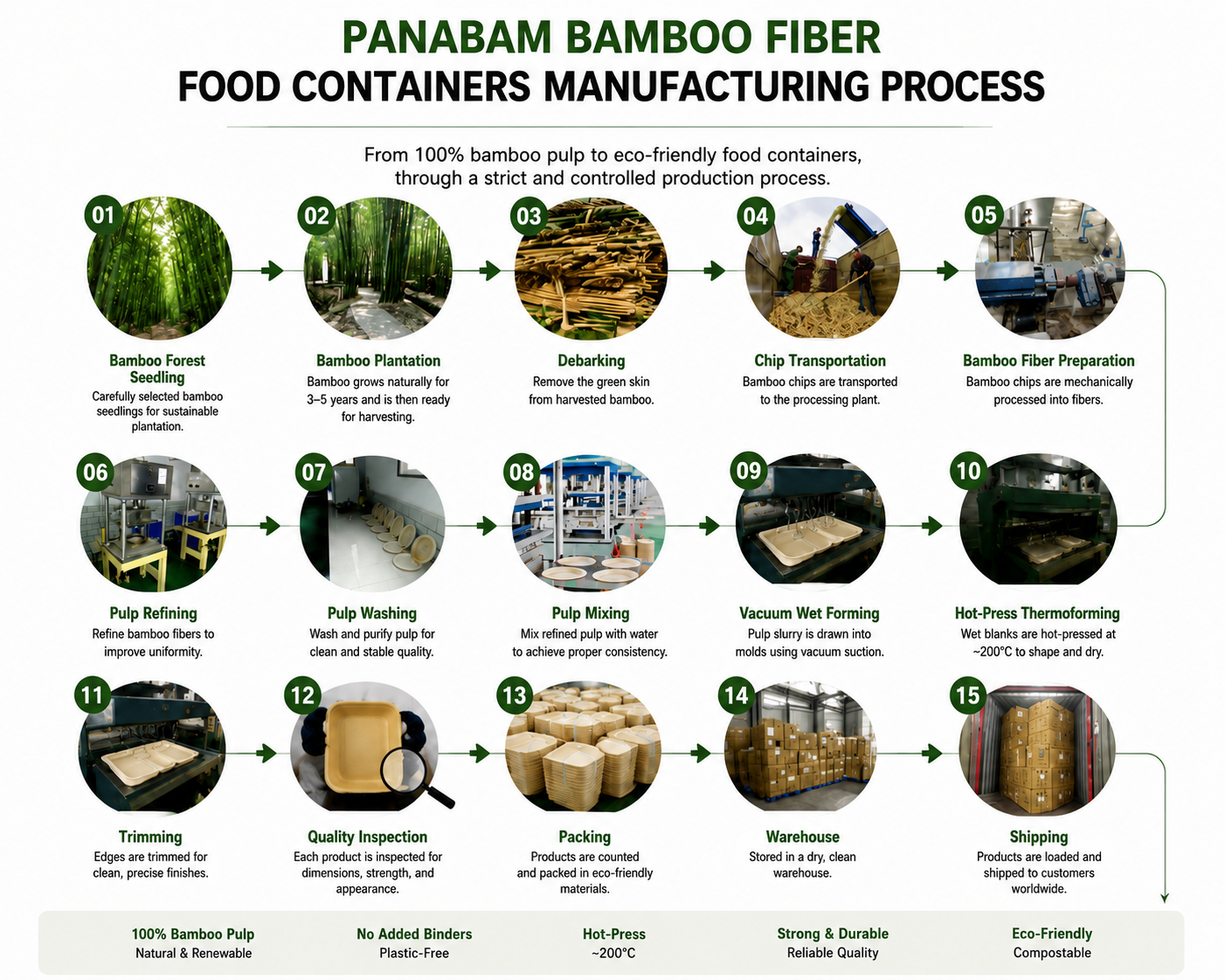
The process converts prepared bamboo pulp into a wet blank and then into a finished container through controlled heat and pressure.
What Are the Main Production Steps?
- Bamboo fiber pulp preparation
- Incoming raw-material inspection
- Pulping
- Pulp preparation
- Vacuum wet forming
- Wet-blank formation
- Hot-press thermoforming at approximately 200°C
- Trimming and shaping
- Finished-product quality inspection
- Packing
- Finished-product warehousing
During vacuum forming, suspended bamboo fibers are drawn onto the forming mold to create the preliminary wet shape.
The wet blank is transferred to heated molds and pressed at approximately 200°C. Heat and pressure remove moisture, compact the fibers, stabilize the shape, and create the finished surface.
Why Does the 200°C Molding Temperature Matter?
The molding temperature is a manufacturing parameter rather than a consumer-use instruction.
Controlled hot pressing helps:
- Remove moisture from the wet blank
- Compact the bamboo fibers
- Improve rigidity
- Create consistent wall thickness
- Stabilize the molded shape
- Produce a smoother surface
- Improve stacking consistency
However, molding a container at 200°C does not by itself prove every end-use claim. Oven, microwave, freezer, and food-contact performance should still be verified under defined conditions.
Where Should Quality Control Occur?
Quality control should not be limited to a final visual inspection.
| Production Stage | Recommended Control |
|---|---|
| Incoming bamboo pulp | Material identity, color, cleanliness, and moisture |
| Pulp preparation | Pulp concentration and fiber distribution |
| Vacuum forming | Wet-blank completeness and thickness |
| Hot pressing | Temperature, pressure, cycle time, and surface formation |
| Trimming | Edge accuracy and closure alignment |
| Finished-product inspection | Dimensions, weight, appearance, strength, and stacking |
| Packing | Count accuracy, carton strength, and transit protection |
| Warehousing | Dry, clean, and non-humid storage conditions |
Can Bamboo Fiber Containers Handle Hot, Oily, and Saucy Foods?
Weak molded-pulp containers may soften, bend, or leak during delivery. Food type, temperature, oil content, and holding time must be matched to the correct structure.
Properly designed bamboo fiber containers can hold many hot, oily, moist, and saucy foods, but buyers should test the specific model with their actual menu and delivery conditions.
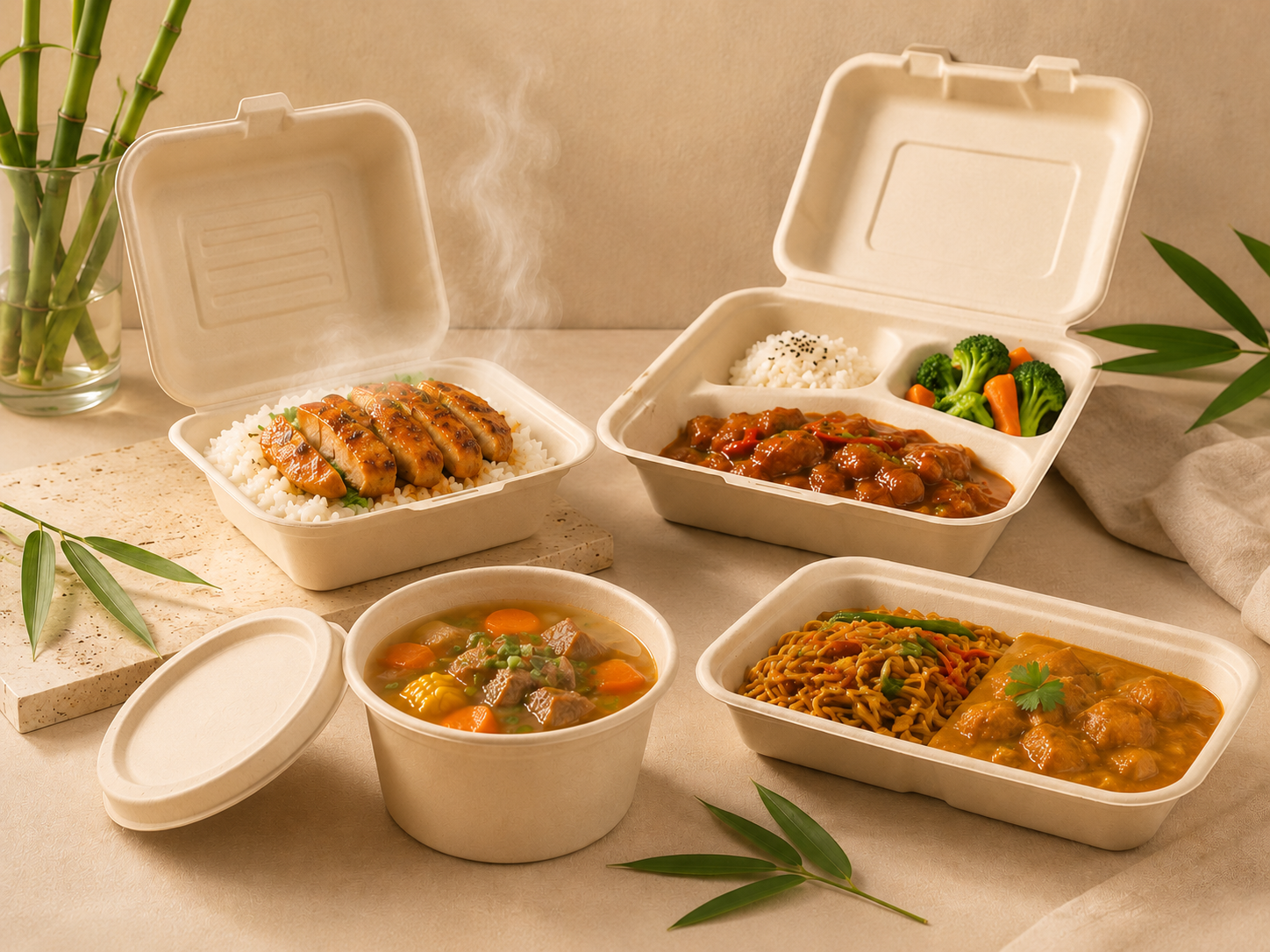
PANABAM bamboo fiber tableware is designed to provide rigidity and resistance to oil, water, and moisture without a plastic or PLA lining.
Its commercial suitability still depends on the complete application:
- Food temperature
- Oil and sauce content
- Portion weight
- Container depth
- Compartment design
- Lid fit
- Holding time
- Delivery distance
- Stacking pressure
- Reheating method
Panabam’s guide to bamboo fiber food containers for hot, oily, and saucy foods explains these application factors in more detail.
Which Container Format Matches Each Food Application?
| Food Application | Suggested Format | Main Selection Requirement |
|---|---|---|
| Rice meals | Two- or three-compartment container | Separation and load-bearing strength |
| Burgers | Hinged clamshell | Secure closure and appropriate ventilation |
| Fried food | Clamshell or tray | Grease resistance and steam management |
| Curry | Deep container with a secure lid | Leak resistance and sufficient depth |
| Saucy noodles | Deep takeaway container | Moisture resistance and closure |
| Salads | Bowl or container with a matching lid | Presentation and lid fit |
| Meal preparation | Stackable compartment box | Portion control and storage efficiency |
| Catering meals | Plates, bowls, trays, and cutlery sets | Consistent appearance and bulk packing |
| Bakery and desserts | Tray, clamshell, or wooden box | Crush protection and presentation |
For premium bakery, bento, and display-oriented products, buyers can also explore wooden food packaging.
What Should Buyers Test Before Approving a Container?
Sample testing should reproduce actual use rather than an ideal laboratory display.
Buyers should evaluate:
- Filled-product weight
- Actual food recipe
- Serving temperature
- Oil and sauce level
- Holding duration
- Refrigerator or freezer storage
- Microwave reheating
- Oven heating when required
- Transport vibration
- Vertical stacking
- Lid security
- Condensation
- Leakage
- Deformation after use
A product that performs well with dry rice may not behave identically with curry, soup, or fried food sealed while steaming.
Are PANABAM Bamboo Fiber Containers Microwave, Freezer, and Oven Safe?
Vague temperature claims can create product failures or liability. Professional buyers need both a temperature limit and a permitted duration.
PANABAM bamboo fiber tableware withstands temperatures down to -50°C and can be used in a conventional oven at up to 200°C for one hour.
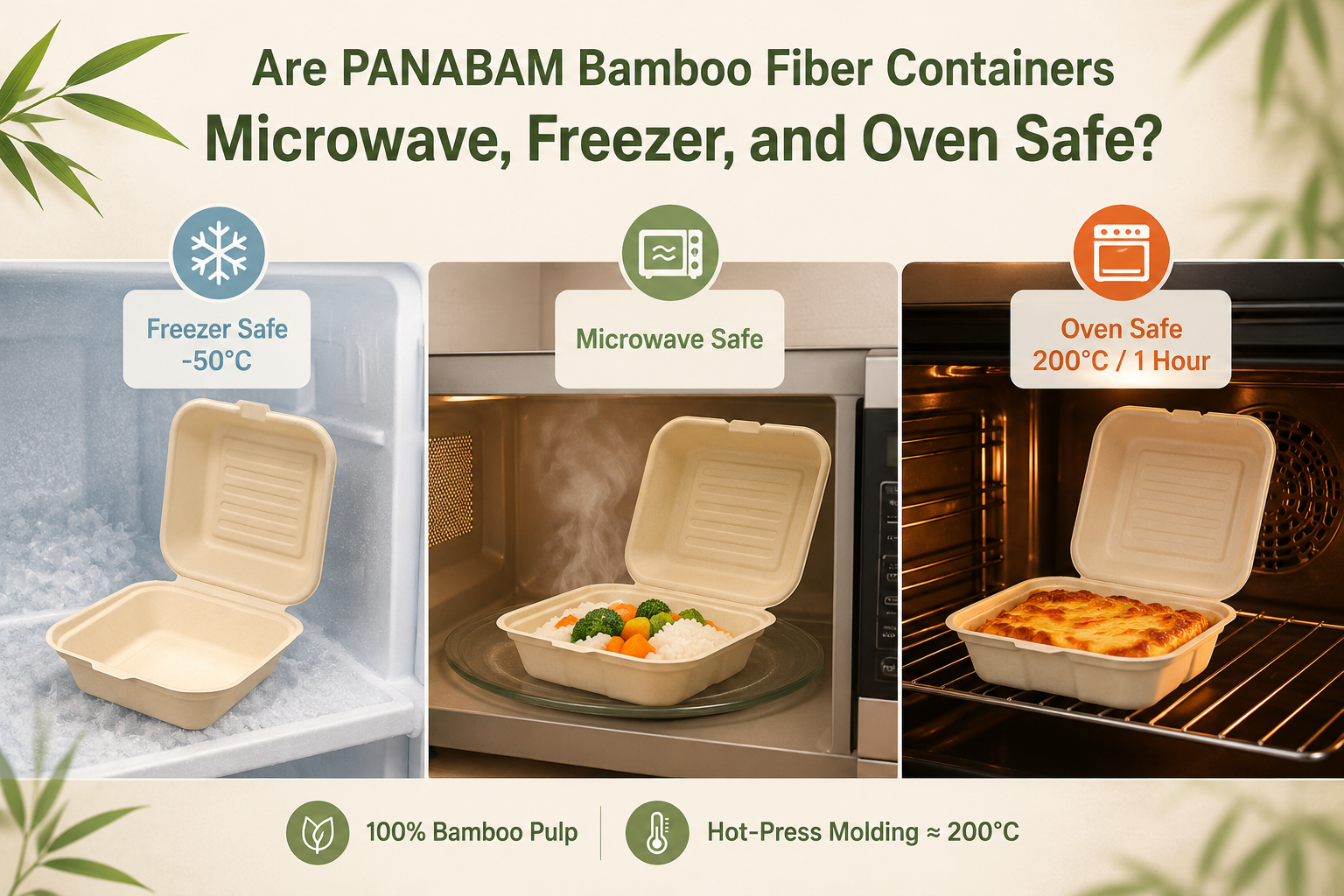
The confirmed temperature information is:
- Minimum temperature: -50°C
- Maximum conventional oven temperature: 200°C
- Maximum oven duration: one hour at 200°C
- Hot-press molding temperature: approximately 200°C
These parameters support applications involving frozen storage, hot-food service, microwave reheating, and selected oven-heating requirements.
Are Manufacturing Temperature and End-Use Temperature the Same?
No. They describe different stages.
The 200°C molding temperature refers to the manufacturing process used to dry, compact, and shape the bamboo pulp.
The 200°C for one hour specification refers to the stated maximum conventional oven-use condition for the finished tableware.
Buyers should not assume that a product can remain at 200°C indefinitely simply because it was molded at that temperature.
Which Temperature Details Should Buyers Confirm?
| Performance Item | PANABAM Product Information | Buyer Verification |
|---|---|---|
| Minimum temperature | Down to -50°C | Test with actual frozen food and storage duration |
| Maximum oven temperature | Up to 200°C | Confirm the exact product model |
| Maximum oven duration | One hour at 200°C | Do not exceed the stated duration |
| Molding temperature | Approximately 200°C | Treat as production-process information |
| Microwave use | Suitable for relevant applications | Test with actual food, power, and heating time |
| Freezer use | Suitable down to -50°C | Consider food expansion and storage duration |
| Lid use | Depends on lid material | Remove lids not approved for heating |
What About Matching Lids?
A bamboo-pulp base and its lid may have different temperature limits.
Matching options may include:
- Fiber lids
- RPET lids
- PP lids
- Other product-specific lid formats
RPET, PP, or other plastic lids should not be placed in a conventional oven unless the lid manufacturer has expressly approved that use.
Selected products and lid formats can be reviewed through Panabam’s plant fiber food containers range.
How Do Bamboo Fiber Containers Compare With Plastic, Bagasse, and Paper?
Unit price alone hides deformation, double-stacking, leakage, compliance exposure, and branding value. A cheaper package may create greater downstream costs.
Plastic is usually cheapest, bagasse is widely available, paper offers strong printability, and bamboo fiber can provide greater rigidity, heat performance, and premium natural presentation.
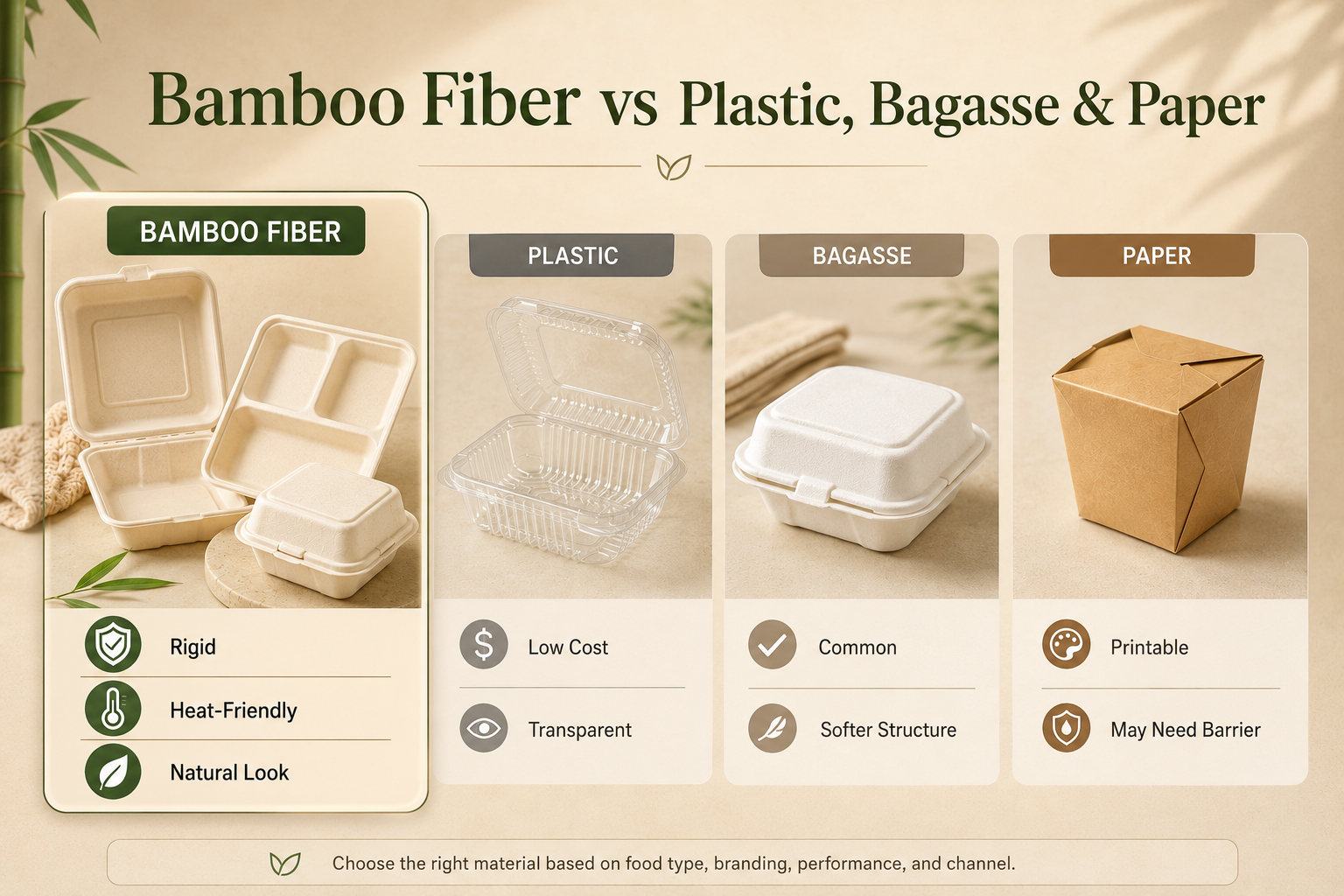
No material is best for every food, price point, or sales channel.
Plastic can remain practical where transparency, moisture barriers, and very low unit cost dominate. Bagasse is common in basic high-volume foodservice. Paperboard provides excellent printing but may require a functional barrier.
Bamboo fiber becomes more compelling where buyers require:
- Strong molded-pulp structure
- Natural premium appearance
- Plastic-free positioning
- Hot and oily food performance
- Freezer and oven compatibility
- Product differentiation
- Private-label presentation
A broader selection of disposable food containers and clamshells is available for comparison.
Which Material Performs Best in Commercial Use?
| Factor | Bamboo Fiber | Bagasse | Paper | Plastic |
|---|---|---|---|---|
| Typical source | Bamboo pulp | Sugarcane residue | Wood pulp or paperboard | Petroleum-based polymer |
| Rigidity | Generally high | Moderate and product-dependent | Varies by construction | Generally high |
| Hot and oily food | Suitable when properly designed | Product-dependent | Often needs a barrier | Usually suitable |
| Oven suitability | Up to specified conditions for suitable products | Product-dependent | Highly product-dependent | Usually unsuitable unless specially designed |
| Freezer suitability | Suitable to specified conditions | Product-dependent | Product-dependent | Usually suitable |
| Natural appearance | Premium earthy texture | Basic molded-pulp appearance | Printable surface | Conventional appearance |
| Transparency | No | No | No | Available |
| Plastic-free potential | Yes | Yes if uncoated | Depends on barrier | No |
| Brand differentiation | Strong | Moderate | Strong through printing | Limited for eco-positioning |
| Typical unit cost | Higher | Moderate | Moderate | Usually lower |
How Is Bamboo Fiber Different From Bagasse?
Bagasse is the fibrous residue remaining after sugarcane juice extraction. It is a useful molded-pulp raw material and can be economical for high-volume products.
Bamboo pulp is produced from bamboo fibers and can provide strong tensile performance and structural rigidity when correctly processed.
However, the raw-material name is not enough to judge the final product. Buyers should compare:
- Thickness
- Finished weight
- Fiber distribution
- Mold design
- Edge strength
- Closure fit
- Resistance to hot oil
- Water resistance
- Holding time
- Quality consistency
How Is Bamboo Fiber Different From Paper Packaging?
Paper food packaging often uses folded paperboard rather than three-dimensional wet molding.
Paperboard offers:
- Excellent printable surfaces
- Efficient flat storage
- Lightweight construction
- Familiar converting technology
However, containers for moist or oily food may require:
- Plastic film
- PLA lining
- Wax
- Water-based barriers
- Other functional coatings
Buyers should therefore evaluate the complete paper structure rather than assuming that all paper packaging is plastic-free or compostable.
When Is Bamboo Fiber the Better Commercial Choice?
Bamboo fiber may create more value when the buyer supplies:
- Premium takeaway brands
- Eco-conscious restaurants
- Hotels and resorts
- Airlines and cruise services
- Retail private-label programs
- Catering and events
- Schools and institutional dining
- Plastic-restricted markets
- Food products requiring stronger molded containers
It may not be the most economical option for very light, dry, short-contact foods where rigidity, oven performance, and premium presentation provide limited value.
Is Bamboo Fiber Packaging Worth the Higher Purchase Price?
Higher prices create immediate resistance for buyers replacing plastic. Yet low-cost packaging can increase failures, complaints, waste, and regulatory transition costs.
Bamboo fiber packaging may justify its price when it improves strength, reduces double-stacking, supports plastic-reduction goals, and creates stronger premium or sustainable brand positioning.
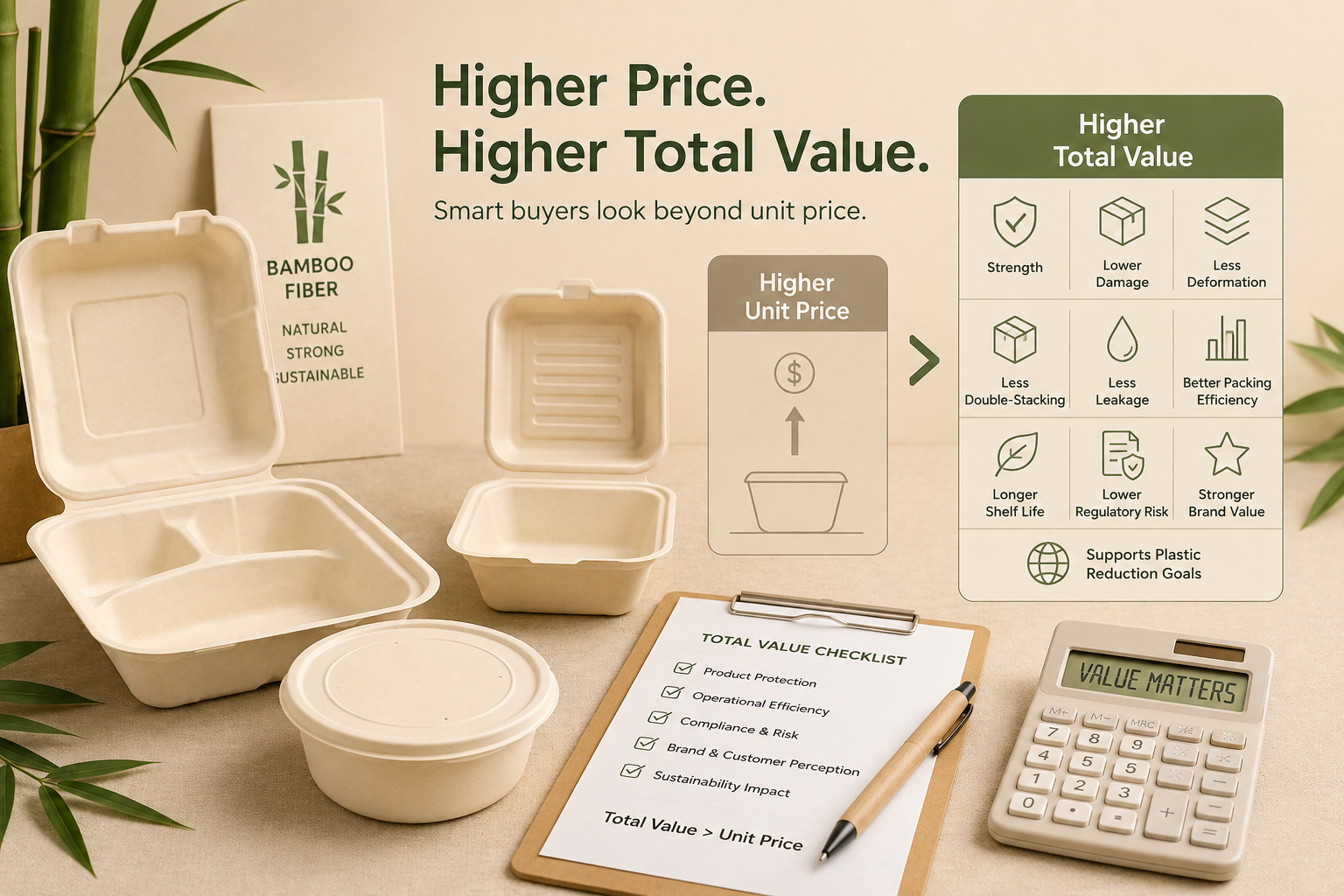
The appropriate comparison is not limited to the purchase price per piece.
Professional buyers should calculate total commercial value, including:
- Delivered cost
- Product damage
- Deformation rates
- Double-stacking
- Leakage
- Food loss
- Customer complaints
- Packing efficiency
- Storage life
- Regulatory risk
- Brand value
- Sales-channel requirements
What Is the Total Cost of Ownership?
| Cost Area | Low-Cost Packaging Risk | Potential Bamboo Fiber Value |
|---|---|---|
| Container usage | Multiple pieces may be stacked for strength | Higher rigidity may reduce double-use |
| Leakage | Food loss, refunds, and complaints | Better structure may reduce failure |
| Deformation | Poor presentation and difficult delivery | Stable shape can support transport |
| Regulatory changes | Emergency redesign or material replacement | Plastic-free positioning may reduce transition risk |
| Brand presentation | Commodity appearance | Natural texture can support premium positioning |
| Customer experience | Bending, leakage, or weak hand feel | Stronger packaging can improve perceived quality |
| Supply continuity | Unstable low-cost supply | Scalable manufacturing can improve planning |
| Waste responsibility | Greater disposal and reputation pressure | Natural-fiber packaging supports sustainability goals |
When Does the Higher Price Make Sense?
The premium is easier to justify when packaging helps a buyer:
- Enter a plastic-restricted market
- Meet retailer or customer sustainability requirements
- Reduce double-stacking
- Lower leakage or deformation rates
- Improve food presentation
- Build a premium brand position
- Support higher retail or menu pricing
- Avoid repeated packaging redesigns
- Supply institutional or corporate sustainability programs
- Differentiate from low-cost commodity packaging
The better purchasing question is not simply:
How much does each container cost?
It is:
What risks, failures, and commercial value should be included in the total packaging cost?
Are PANABAM Bamboo Fiber Containers Biodegradable and Compostable?
Environmental claims are often oversimplified. “Natural,” “biodegradable,” and “compostable” do not automatically mean the same thing.
PANABAM containers use 100% bamboo pulp without plastic, PLA lining, wax coating, or added binders, allowing the natural-fiber structure to decompose under suitable biological conditions.
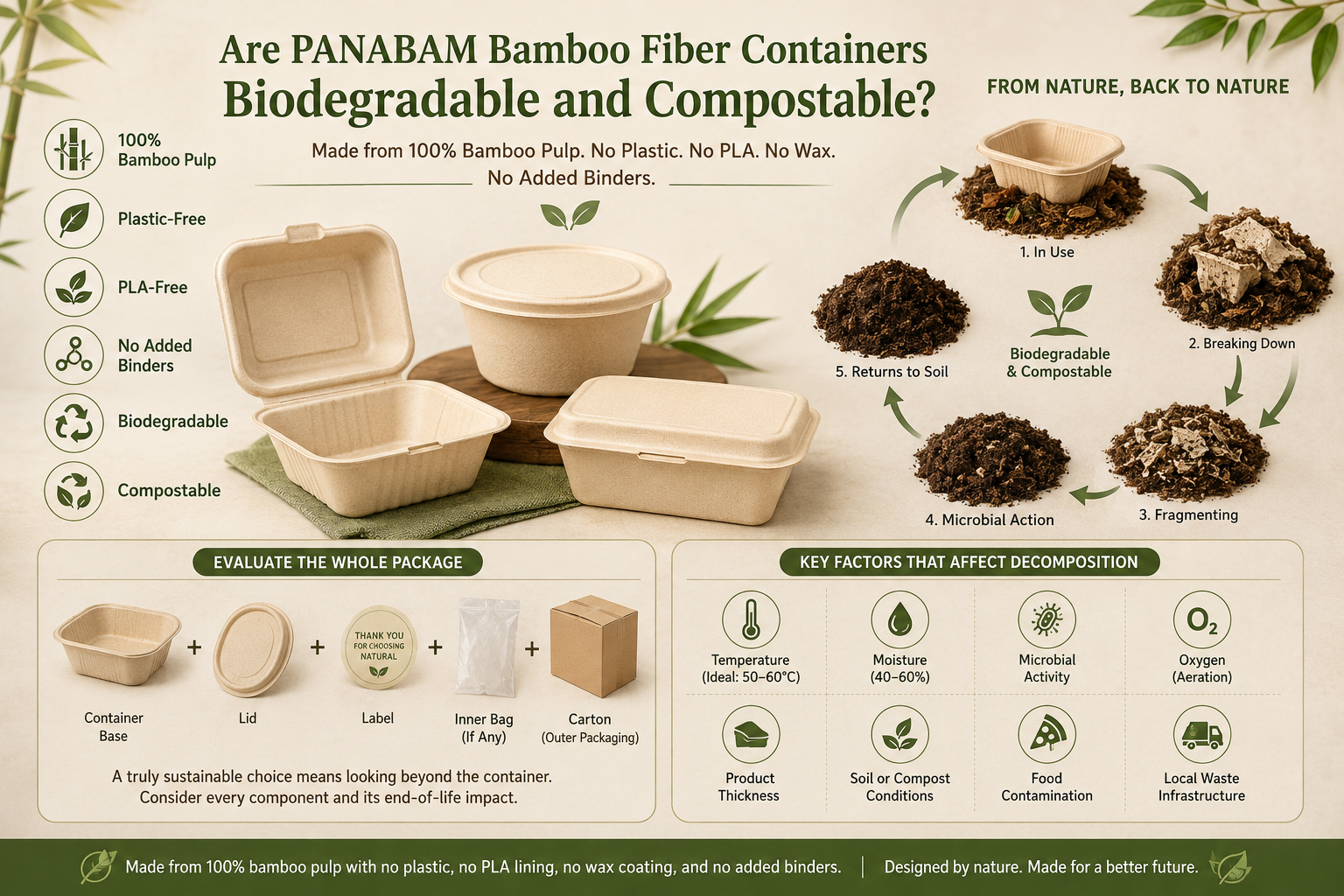
Actual decomposition depends on:
- Temperature
- Moisture
- Microbial activity
- Oxygen
- Product thickness
- Soil or compost conditions
- Food contamination
- Local waste infrastructure
Indicative decomposition time should be presented with the applicable conditions rather than as a universal guarantee.
How Should Environmental Claims Be Evaluated?
| Claim | General Meaning | Buyer Verification |
|---|---|---|
| 100% bamboo pulp | Bamboo pulp is the sole structural material | Request a material declaration |
| Plastic-free | No conventional plastic is intentionally added | Evaluate the base, lid, label, and coating |
| PLA-free | No PLA film or lining is used | Request written confirmation |
| PFAS-free | No intentionally added PFAS treatment | Request product-specific testing |
| Biodegradable | Can biologically break down under suitable conditions | Ask for conditions and supporting evidence |
| Compostable | Can decompose in an appropriate composting environment | Clarify the applicable composting conditions |
| No microplastic residue | No conventional plastic should remain after decomposition | Verify every packaging component |
Why Must Buyers Evaluate the Whole Package?
A 100% bamboo-pulp container paired with a plastic lid is not a completely plastic-free packaging system.
The complete assessment should include:
- Base container
- Lid
- Paper sleeve
- Adhesive
- Label
- Printing ink
- Inner bag
- Retail carton
- Shipping carton
Environmental claims used in retail packaging or marketing should describe the specific component accurately.
Are Bamboo Fiber Food Containers Safe and Compliant?
A container may look sustainable while lacking appropriate food-contact evidence. Unsupported claims expose buyers to customs delays, retailer rejection, or recalls.
Food-contact suitability depends on material composition, production controls, food type, temperature, exposure duration, and destination-market requirements. Product-specific reports should be reviewed before ordering.
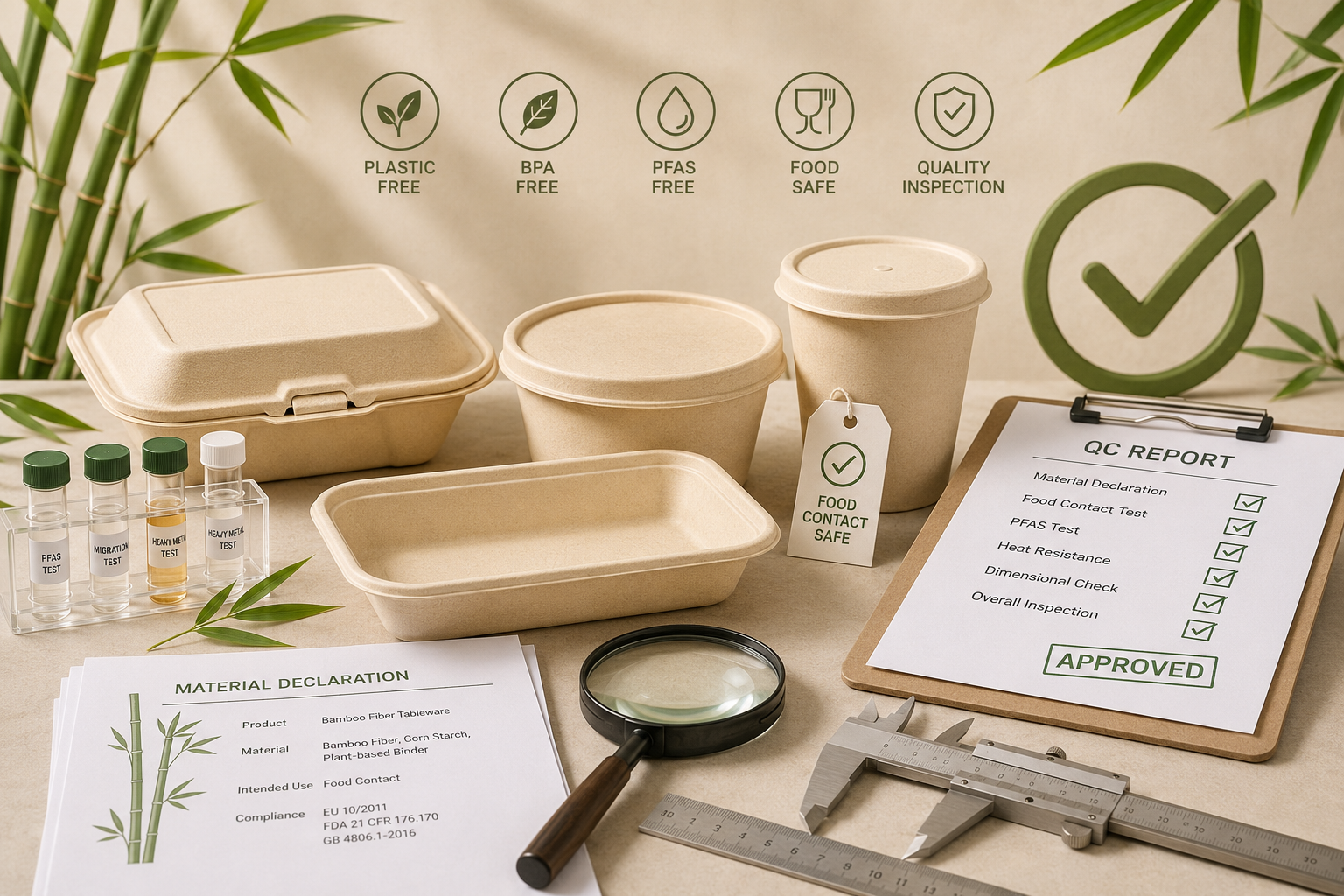
PANABAM bamboo fiber products are described as free from:
- Added plastic
- PP
- BPA
- PLA lining
- Wax coating
- Bleach
- Intentionally added PFAS
- Added synthetic binders
These characteristics support plastic-free natural-fiber positioning, but they do not eliminate the need for market-specific documentation.
Which Documents Should Buyers Review?
| Document or Test | Purpose | Buyer Check |
|---|---|---|
| Material declaration | Confirms 100% bamboo-pulp composition | Match it to the ordered product |
| Food-contact test report | Evaluates applicable safety requirements | Confirm standard, SKU, date, and laboratory |
| PFAS test report | Supports PFAS-free claims | Review method and detection limits |
| Heat-resistance test | Evaluates use at defined temperatures | Verify temperature and duration |
| Oven test | Supports the 200°C for one-hour condition | Confirm the exact product model |
| Freezer test | Supports use down to -50°C | Verify duration and actual application |
| Microwave test | Evaluates reheating performance | Review power, time, and food load |
| Biodegradation or compostability evidence | Supports disposal claims | Review the test environment |
| Quality inspection report | Confirms dimensions and visual quality | Link it to the shipment or batch |
How Should “FDA” and “LFGB” Be Discussed?
These terms should be used precisely.
Buyers should verify:
- Which regulation or standard was tested
- Which product was sampled
- Which food simulants were used
- Test temperature
- Exposure duration
- Laboratory identity
- Report validity
- Whether the current order matches the tested material and construction
Generic certificates should not be assumed to cover every product, color, size, lid, or customized formulation.
How Can Buyers Choose a Reliable Bamboo Fiber Tableware Supplier?
A low quotation may hide unstable production, inconsistent pulp, inadequate cartons, delayed shipments, or reports unrelated to the ordered SKU.
A reliable supplier should demonstrate production capacity, quality controls, product-specific testing, export experience, customization capability, responsive communication, and realistic delivery planning.
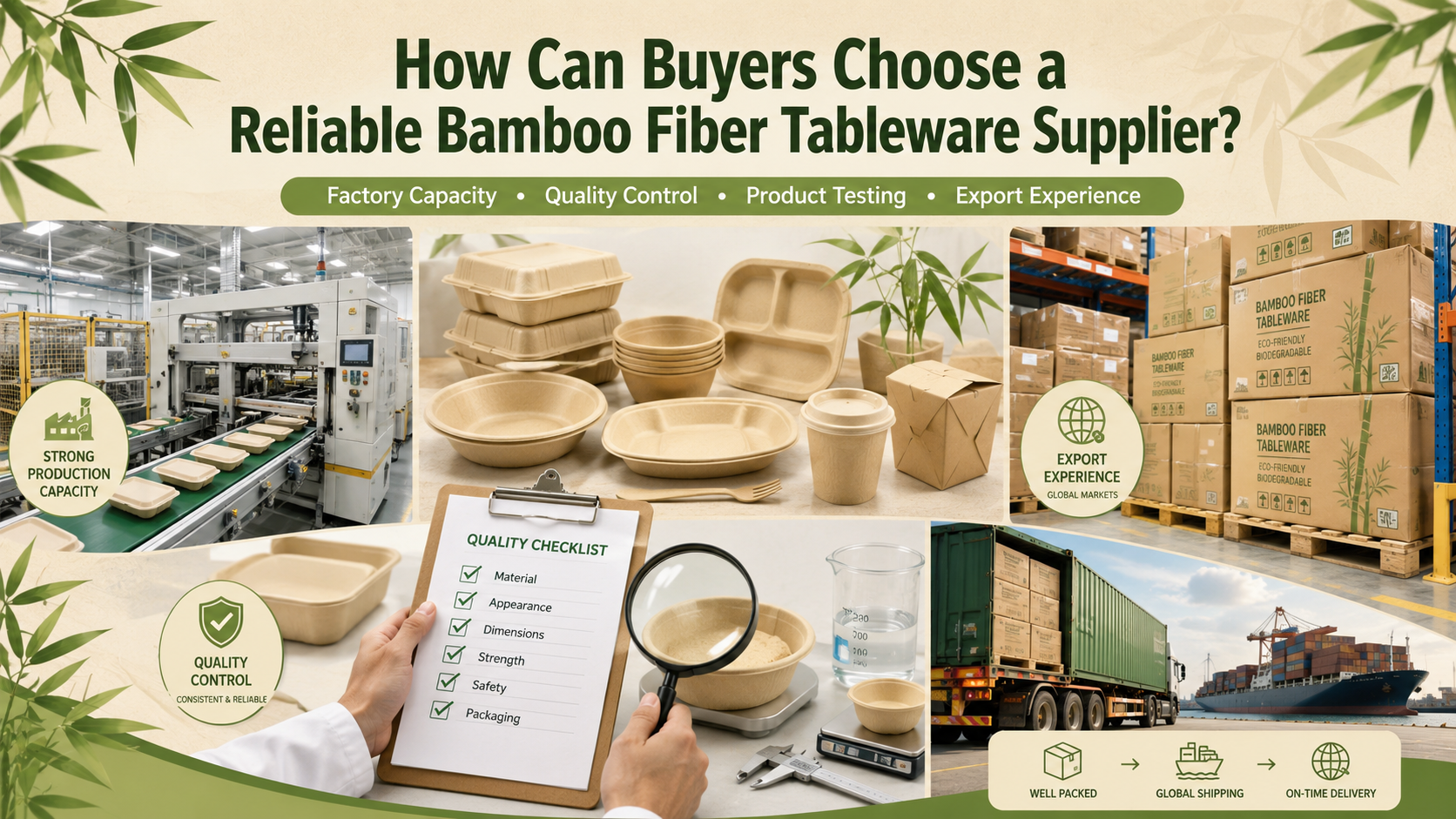
Factory size alone does not guarantee dependable supply.
Buyers should examine how the supplier manages:
- Raw-material sourcing
- Incoming inspection
- Pulp preparation
- Vacuum forming
- Hot-press conditions
- Trimming
- Dimensional tolerances
- Visual defects
- Batch consistency
- Packing protection
- Warehouse conditions
- Export documentation
- Shipment coordination
- Corrective action
What Should Supplier Due Diligence Include?
| Evaluation Area | Questions to Ask | Warning Sign |
|---|---|---|
| Manufacturer status | Are you the factory or a trading company? | Unclear production location |
| Material | Is the base made from 100% bamboo pulp? | Vague blended-material descriptions |
| Added materials | Are binders, plastic, PLA, wax, bleach, or PFAS used? | Refusal to provide a declaration |
| Production capacity | How many lines operate and what is the realistic output? | Unsupported capacity claims |
| Quality control | Which inspections occur during production? | Inspection only after completion |
| Testing | Do reports match specific SKUs? | One generic report for all products |
| Temperature performance | Which products meet -50°C and 200°C for one hour? | Claims without test conditions |
| Customization | What are the MOQ, tooling, printing, and lead-time requirements? | Unrealistically low custom MOQ |
| Export experience | Which destination markets are regularly served? | Little understanding of market requirements |
| Packing | How are products protected during transportation? | Weak cartons and no loading plan |
| Communication | Who manages sampling, production, and shipment updates? | Slow or inconsistent follow-up |
What Manufacturing Experience Does PANABAM Provide?
PANABAM is a China-based B2B manufacturer of disposable bamboo fiber pulp tableware and foodservice packaging.
The business reports:
- More than ten years of manufacturing experience
- Five production lines
- Annual output capacity of approximately 500 million pieces
- Bamboo cultivation and bamboo-fiber processing capabilities
- Molded-pulp equipment and technology development experience
- Product research and development
- Quality-control and export support
- Supply experience in the United States, Australia, Canada, the United Kingdom, Japan, the Netherlands, and Germany
Buyers requiring customized packaging can review PANABAM’s OEM and private-label food packaging services.
What Should Buyers Confirm Before Placing a Wholesale Order?
Purchasing disputes often begin because specifications were assumed rather than documented. Photos alone cannot define material, performance, packing, compliance, or tolerances.
Before ordering, confirm the SKU, dimensions, weight, 100% bamboo-pulp composition, temperature limits, lid fit, packing method, testing, MOQ, delivery terms, and approval process.
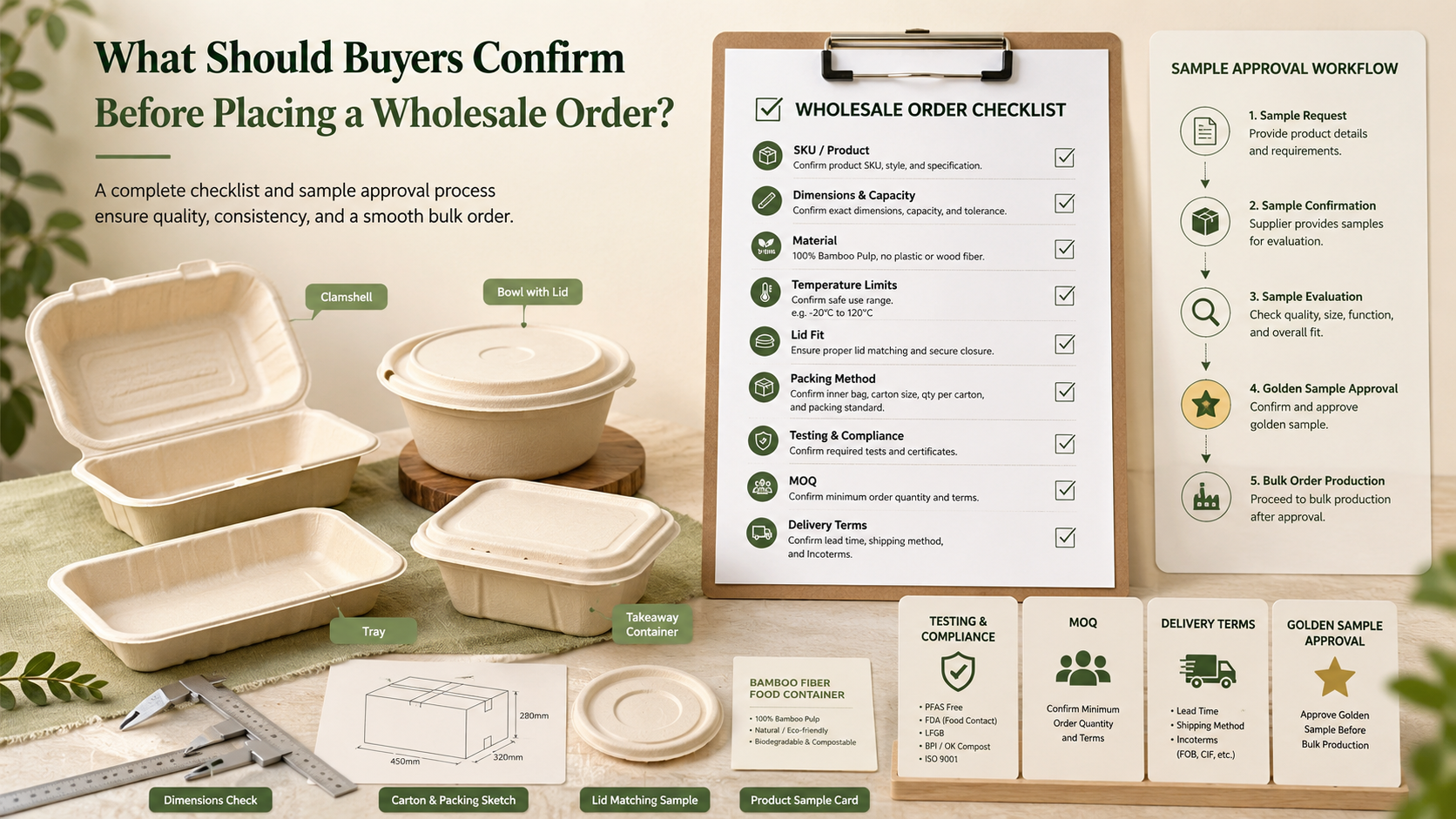
A professional sourcing process should include:
- Application and market definition
- Product recommendation
- Technical-data review
- Sample evaluation
- Material confirmation
- Food-contact document review
- Packaging approval
- Golden-sample approval
- Production inspection
- Shipment-document review
What Belongs in the Purchase Specification?
| Specification Item | Example Details |
|---|---|
| Product identification | Model number and approved reference photo |
| Dimensions | Length, width, height, capacity, and compartment layout |
| Material | 100% bamboo pulp |
| Added materials | No added binder, plastic resin, PLA lining, or wax coating |
| PFAS status | No intentionally added PFAS, supported by relevant testing |
| Minimum temperature | Down to -50°C |
| Oven performance | Up to 200°C for one hour |
| Manufacturing temperature | Hot-press thermoforming at approximately 200°C |
| Microwave use | Define power, duration, food load, and product model |
| Oil and water performance | Define food type, temperature, and holding time |
| Load-bearing requirement | Define portion weight and stacking conditions |
| Color and appearance | Natural or white color and accepted visual tolerances |
| Lid matching | Fiber, RPET, PP, or no lid |
| Packaging | Units per bag, bags per carton, and carton dimensions |
| Customization | Logo, sleeve, label, retail pack, and carton printing |
| Quality tolerances | Weight, dimensions, closure, defects, and inspection level |
| Storage | Dry, clean, and non-humid conditions |
| Commercial terms | MOQ, lead time, payment terms, Incoterm, and destination |
Why Is Sample Testing Essential?
Buyers should test samples with the actual:
- Food recipe
- Portion size
- Heating equipment
- Oven temperature
- Heating duration
- Microwave power
- Freezing temperature
- Storage duration
- Holding time
- Delivery route
- Stacking method
- Lid combination
A generic supplier demonstration cannot reproduce every buyer’s operating conditions.
For samples, product selection, and wholesale quotations, buyers can contact PANABAM.
Frequently Asked Questions
Are bamboo fiber food containers better than plastic containers?
Bamboo fiber containers provide a renewable, plastic-free alternative with strong rigidity and natural appearance. Plastic remains cheaper and offers advantages in transparency and moisture barriers.
Are bamboo fiber containers better than bagasse containers?
Bamboo fiber containers generally offer higher rigidity and premium appearance. However, performance depends on product structure, manufacturing process, and application requirements.
Are bamboo fiber containers compostable?
100% bamboo pulp containers can biodegrade under suitable biological conditions. Buyers should verify the exact product composition and applicable composting environment.
Can bamboo fiber containers hold hot and oily food?
Yes. Properly manufactured bamboo fiber containers can handle many hot, oily, and saucy foods when tested for specific applications.
Are bamboo fiber food containers microwave and oven safe?
Some bamboo fiber containers are suitable for microwave reheating and specific oven applications. Buyers should confirm temperature limits and duration with suppliers.
Conclusion
Verified bamboo pulp composition, strong performance, temperature resistance, compliance support, and reliable manufacturing determine whether bamboo packaging justifies its premium.