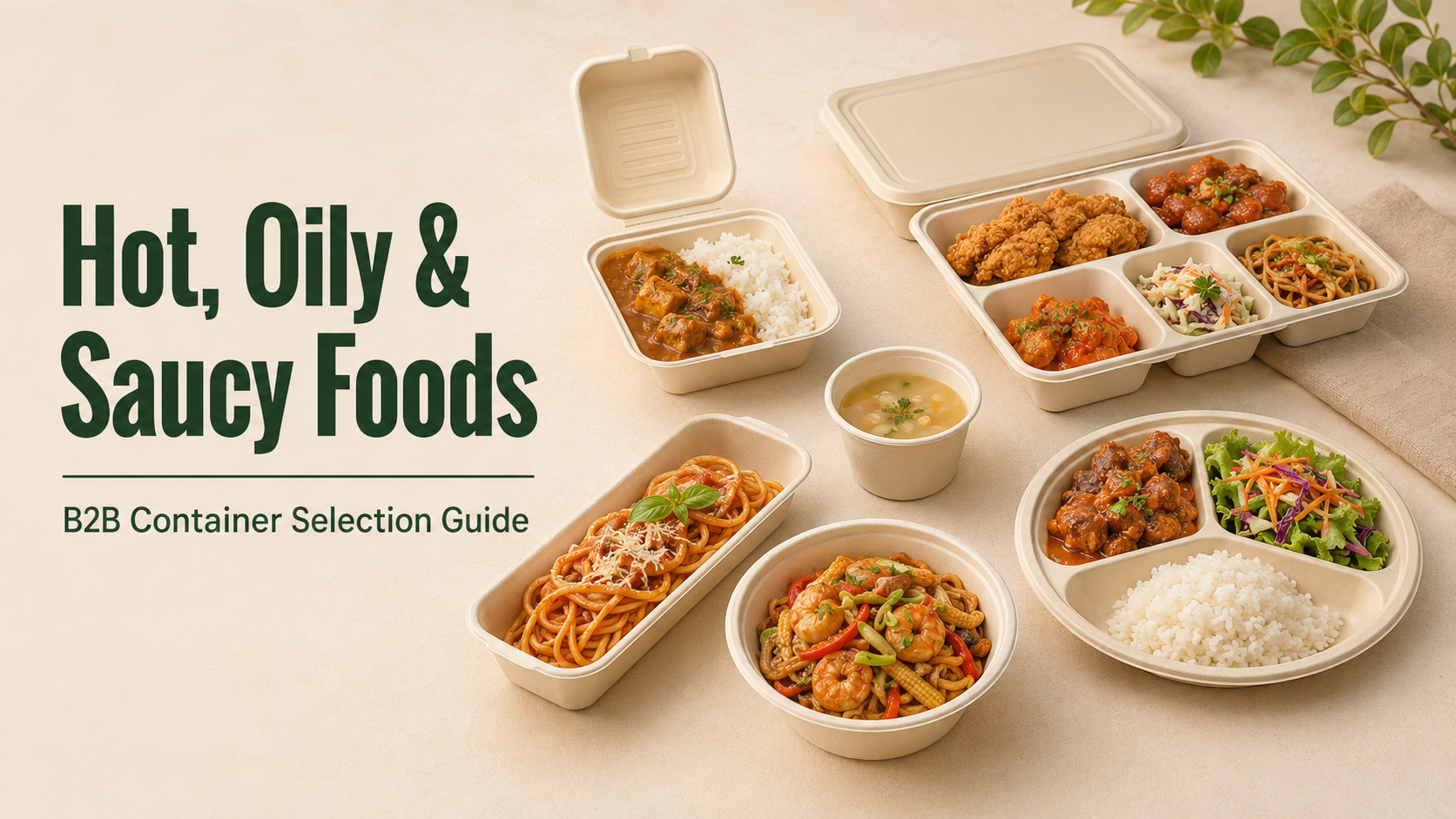
Choosing a disposable food container is relatively simple when the food is dry, light and consumed immediately.
The decision becomes much more difficult when the container needs to hold fried food, curry, noodles, pasta, barbecue, soup, sauce or a freshly cooked takeaway meal.
Hot food generates steam. Oil can penetrate weak materials. Sauces can collect around the lid and leak during transportation. Even a container that looks strong when empty may soften, deform or lose its seal after being filled.
For importers, distributors, restaurants and private label brands, packaging failure can lead to customer complaints, food spills, damaged cartons and lost repeat business.
The right container must therefore be selected according to the actual food, serving temperature, holding time, delivery method and disposal requirements—not appearance or material name alone.
Buyers who are still comparing the main material categories can first read our guide to plant-based food packaging.
What Is the Best Disposable Container for Hot, Oily or Saucy Food?
There is no single container that is best for every food application.
A suitable container should match five factors:
- The temperature of the food when packed
- The amount of oil, water or sauce
- The expected holding and delivery time
- Whether reheating or freezing is required
- The target market’s food-contact and environmental requirements
For example, a shallow tray may work well for fried snacks served immediately but may not be suitable for curry delivered for 45 minutes.
A molded fiber clamshell may be suitable for burgers, rice dishes and barbecue, while a deep bowl with a tightly fitted lid is usually a better choice for soup, noodles or meals containing a large amount of sauce.
The goal is not simply to choose a “green” material. The goal is to find packaging that protects the food, performs reliably and fits the buyer’s market positioning.
Why Are Hot, Oily and Saucy Foods Difficult to Package?
These foods expose packaging to several stresses at the same time.
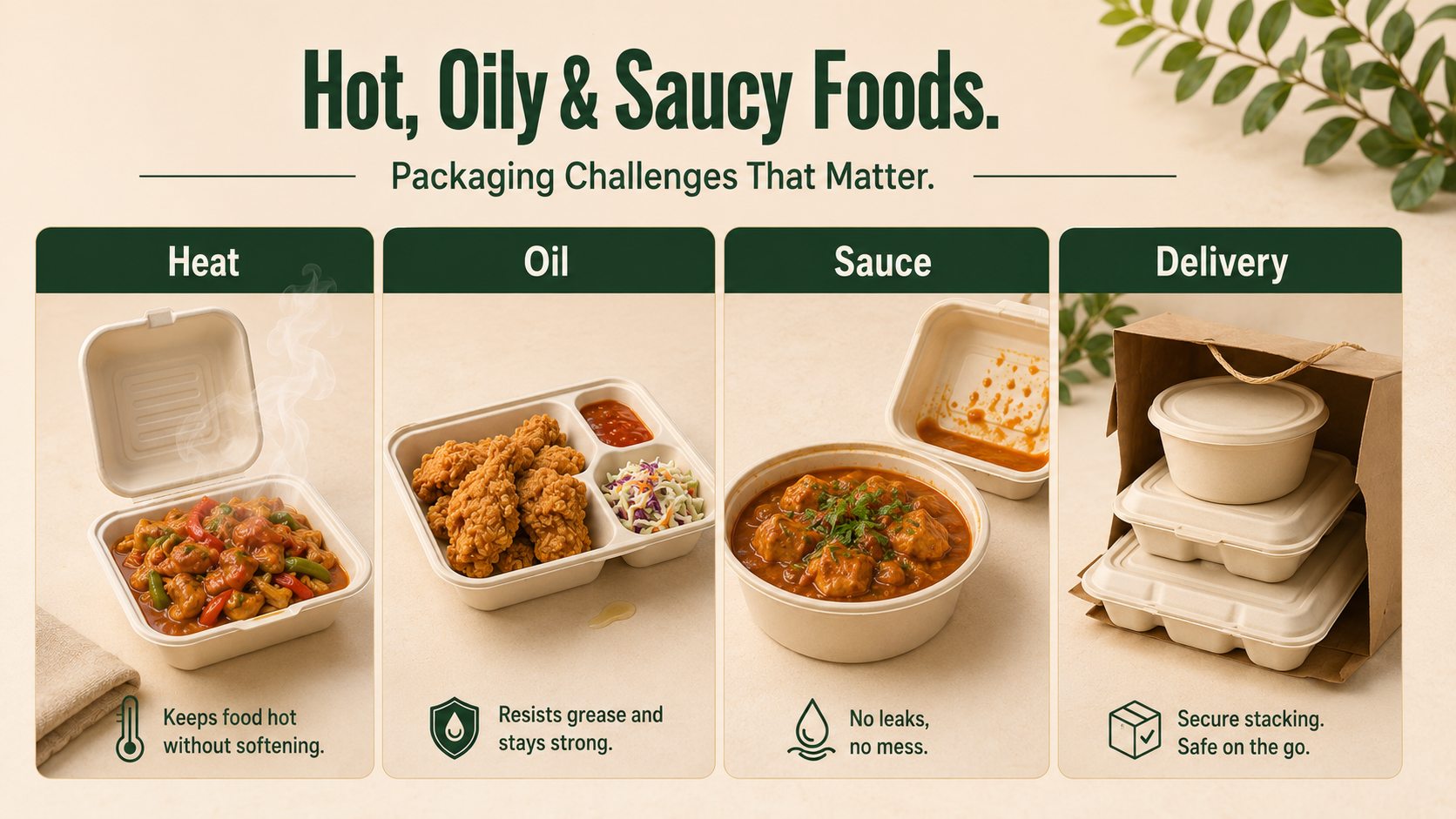
Heat, oil, sauce and delivery conditions create different packaging risks.
Heat Can Soften or Deform the Container
Freshly cooked food transfers heat directly to the bottom and walls of the container. Steam also collects inside the package, creating a warm and humid environment.
A container may appear heat-resistant during a short test but still soften after being closed for 30–60 minutes.
Buyers should therefore evaluate both the food temperature and the total contact time.
Oil Can Penetrate Porous Materials
Oil behaves differently from water.
A container may resist water but still develop dark oil marks or lose strength when used for fried chicken, barbecue, roasted meat or oily sauces.
Grease resistance must be evaluated separately from general water resistance.
Sauce Can Escape Through the Lid
A strong container body does not automatically make the complete package leakproof.
Sauce can leak through:
- Gaps between the container and lid
- Corners and hinge areas
- Weak locking tabs
- Deformed rims
- Ventilation holes
- Film seals that are not fully bonded
The complete container-and-lid system must be tested together.
Delivery Adds Movement and Pressure
Takeaway containers may be tilted, shaken, stacked and compressed during delivery.
A package that performs well while standing on a table may fail inside a delivery bag.
This is why transportation simulation should be part of every B2B sample test.
Five Questions to Answer Before Choosing a Material
Before comparing bamboo fiber, bagasse, paper or plastic, define the intended application.
1. What Food Will Go Inside?
Create a list of the actual menu items.
Examples include:
- Fried chicken
- Burgers and sandwiches
- Rice and curry
- Pasta with sauce
- Barbecue
- Salad
- Soup and noodles
- Bakery products
- Frozen prepared meals
A supplier can make a better recommendation when the food application is clearly described.
2. What Is the Packing Temperature?
“Hot food” is too general.
The supplier should know whether the food will be warm, freshly cooked or packed immediately after frying or boiling.
The hotter the food, the more important heat resistance, steam management and lid stability become.
3. How Long Will the Food Stay in the Container?
The required performance for a 10-minute takeaway order is different from the performance needed for:
- A 45-minute delivery
- A two-hour catering event
- Supermarket display
- Refrigerated storage
- Frozen meal distribution
Longer holding times usually require more extensive testing.
4. Will the Customer Reheat or Freeze the Food?
Do not assume that a container is microwave-safe, freezer-safe or oven-safe simply because of its material.
The finished product, lid and any coatings or additives must all be suitable for the intended use.
5. What Disposal Claim Will Be Made?
Plant-based, biodegradable and compostable do not always mean the same thing.
Before printing an environmental claim on the packaging, buyers should verify:
- The exact material composition
- Whether the product has a relevant compostability certificate
- Whether industrial or home composting conditions are required
- Whether the lid uses a different material
- Whether the claim is accepted in the destination market
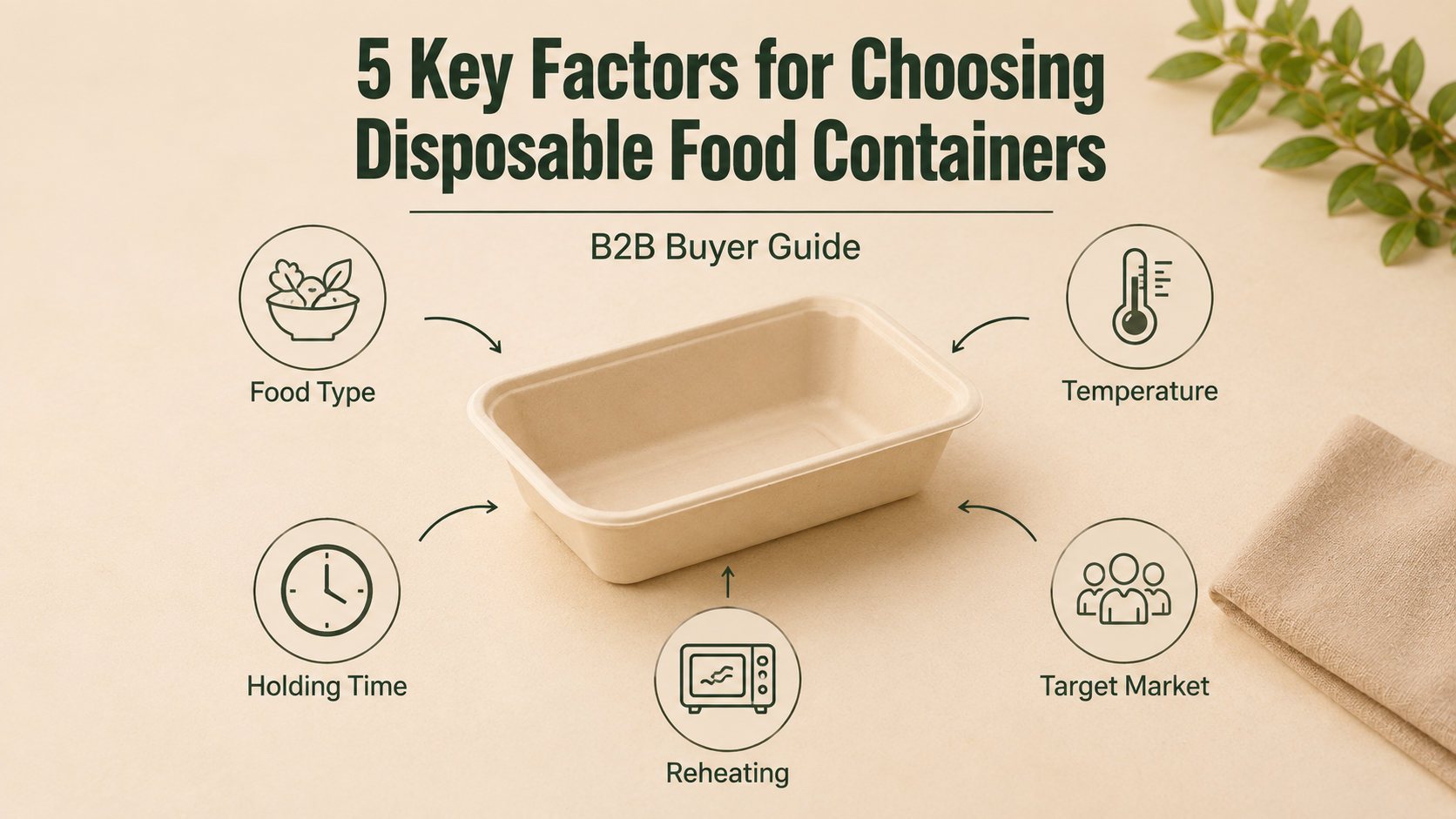
Food type, temperature, holding time, reheating and target market determine the right container.
Bamboo Fiber vs. Bagasse vs. Paper vs. Plastic Containers
The following comparison provides a general starting point. Actual performance depends on the product structure, thickness, manufacturing process, lid design and test conditions.
| Material | Common Applications | Main Advantages | Points to Check |
|---|---|---|---|
| Bamboo fiber | Hot meals, oily foods, takeaway meals, premium plant-based packaging | Rigid appearance, natural positioning, good shape retention when properly designed | Food-contact documents, oil resistance, lid fit, use conditions |
| Bagasse or sugarcane fiber | General takeaway meals, burgers, rice, catering | Widely available, molded into many shapes, often cost-effective | Softening time, grease performance, formulation and PFAS status |
| Molded paper or paperboard | Dry foods, bakery products, light meals, branded retail packaging | Good printability, lightweight, many packaging formats | Barrier coating, moisture resistance, recyclability and heat limitations |
| PP plastic | Hot food, soup, reheatable meals where plastic is accepted | Strong moisture barrier, transparent or colored options, some grades suitable for reheating | Local plastic rules, resin grade, temperature and microwave instructions |
| PET or RPET | Cold foods, salads, fruit and chilled displays | Clear appearance and strong product visibility | Usually not selected for very hot food; confirm temperature limits |
| PLA and similar bioplastics | Cold food, salads, desserts and selected compostable systems | Plant-derived positioning and clear lid options | Heat sensitivity, composting infrastructure and certification |
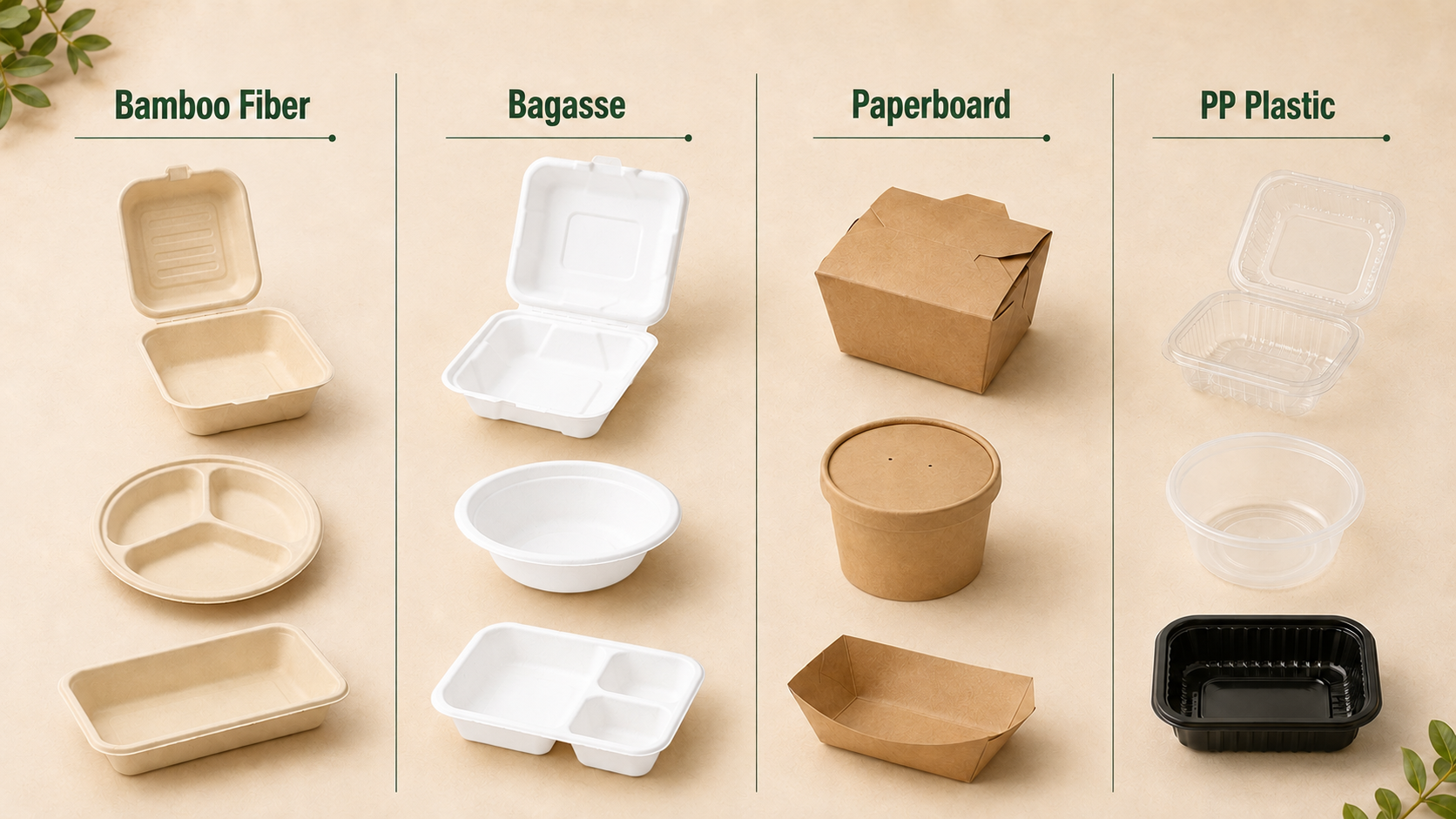
Material performance varies by product structure, coating, lid design and actual use conditions.
Bamboo Fiber Containers
Bamboo fiber containers are often selected by brands seeking a natural, plant-based alternative for takeaway, catering and retail food packaging.
Depending on the product design, they can provide:
- Good rigidity
- A natural surface appearance
- Resistance to deformation
- Compatibility with hot and oily meals
- A premium sustainable brand image
However, buyers should not judge performance from the material name alone.
Wall thickness, rim design, fiber formulation and molding quality can significantly affect strength and leakage performance.
Panabam offers different bamboo food container options for foodservice, takeaway and private label projects.
Bagasse Containers
Bagasse is the fibrous residue left after juice is extracted from sugarcane. It is commonly molded into clamshells, bowls, trays and plates.
Its advantages often include:
- A wide range of standard shapes
- Competitive pricing
- Good availability
- Suitability for many takeaway meals
However, some bagasse containers may soften during extended contact with moisture, oil or steam.
Buyers should compare actual samples instead of assuming that every bagasse product performs in the same way.
Paper and Paperboard Containers
Paperboard is commonly used for noodle boxes, food cartons, bakery packaging and printed takeaway containers.
It offers strong branding potential because logos, colors and product information can be printed directly on the package.
However, paperboard often requires a barrier layer to hold wet, oily or saucy foods.
Buyers should ask:
- What is the barrier material?
- Is it plastic, water-based or another type of coating?
- Does the coating affect recycling or compostability?
- Is the complete product suitable for the intended food temperature?
- Does the environmental claim apply to the entire container?
Plastic Containers
Plastic is not one single material category.
PP, PET, RPET and PLA have different characteristics and should not be used interchangeably.
PP is commonly used for hot food and certain reheating applications because it provides good moisture resistance. PET and RPET are more commonly used for chilled food and clear display packaging.
PLA may be used for cold applications but can deform when exposed to higher temperatures unless a specially designed heat-resistant grade is used.
Where plastic is restricted or does not fit the brand’s sustainability strategy, molded plant fiber may provide a more suitable alternative.
How to Choose Between a Clamshell, Bowl, Tray and Separate-Lid Container
The shape of the package is just as important as its material.
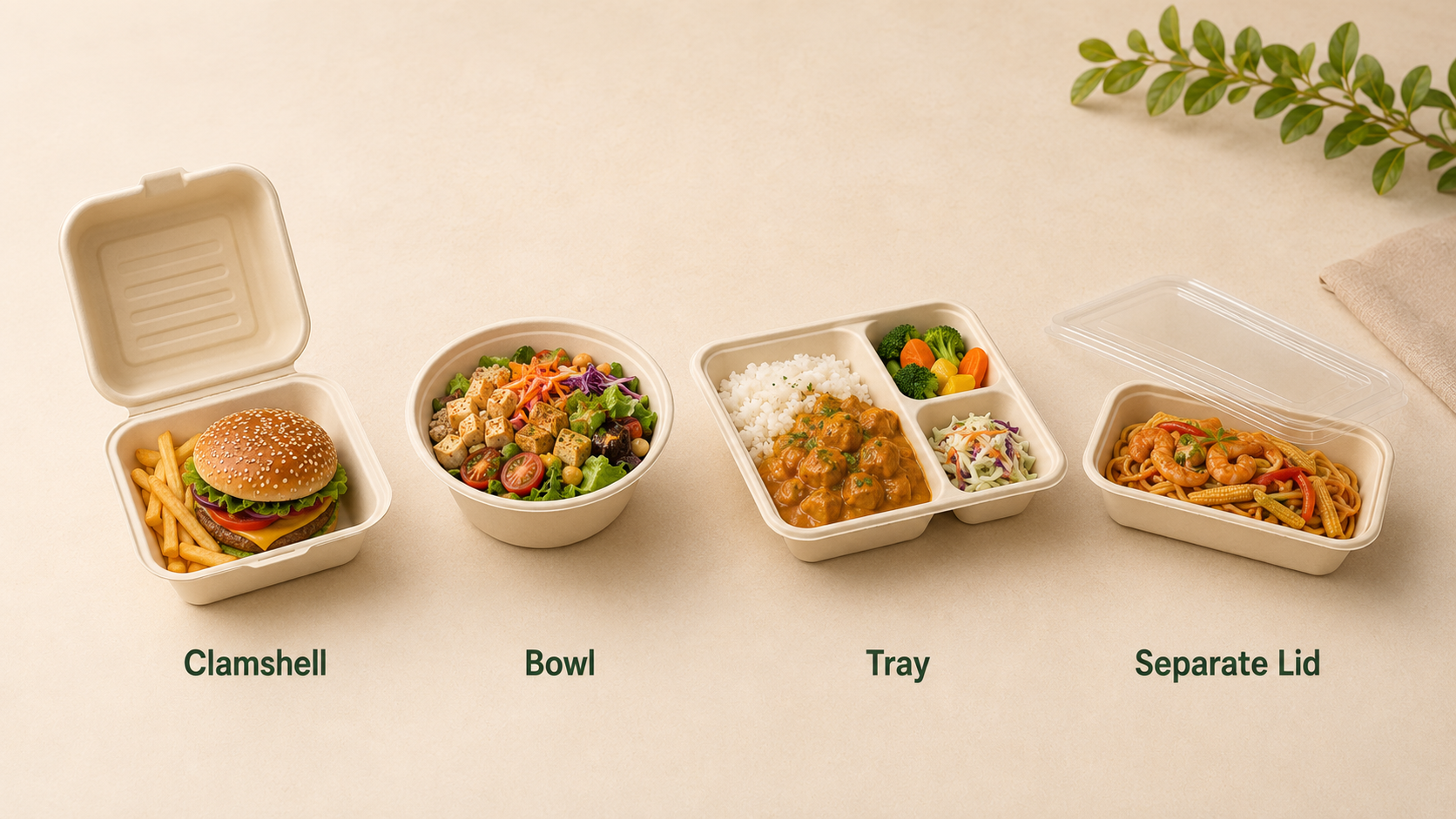
Choose the container format according to the food, serving method and delivery conditions.
Clamshell Containers
A clamshell has an integrated hinged lid.
It is commonly used for:
- Burgers
- Sandwiches
- Fried food
- Rice meals
- Barbecue
- Bakery products
- One-, two- or three-compartment meals
Advantages include easy packing, fewer separate components and efficient foodservice operation.
However, the hinge and locking tabs must be strong enough for the intended delivery conditions.
Explore Panabam’s bamboo fiber clamshell containers for takeaway, delivery and catering applications.
Bowls
Bowls are usually a better choice for foods with a high liquid or sauce content.
Common applications include:
- Soup
- Noodles
- Curry
- Poke bowls
- Salad
- Rice bowls
- Stew
- Pasta
Deep walls help reduce spills, but lid compatibility remains essential.
A bowl used for hot soup requires a different lid and test standard from a bowl used for cold salad.
Trays
Trays are suitable for:
- Catering
- Food display
- Meal preparation
- Meat or produce packaging
- Bakery products
- Compartment meals
They may be used with a separate lid, film seal, paper sleeve or outer box.
Trays are usually less suitable for liquid-heavy foods unless a secure sealing system is added.
Separate-Lid Food Containers
A separate-lid container provides more flexibility in lid material and presentation.
Possible combinations include:
- Fiber container with fiber lid
- Fiber container with clear PP lid
- Fiber container with PET or RPET lid for cold food
- Fiber container with PLA lid
- Container with heat-sealed film
This format is useful for retail display, meal preparation and applications where customers need to see the food.
How to Select the Right Lid
Many packaging failures are actually lid failures.
The lid must be evaluated according to food temperature, container shape, stacking pressure and delivery conditions.
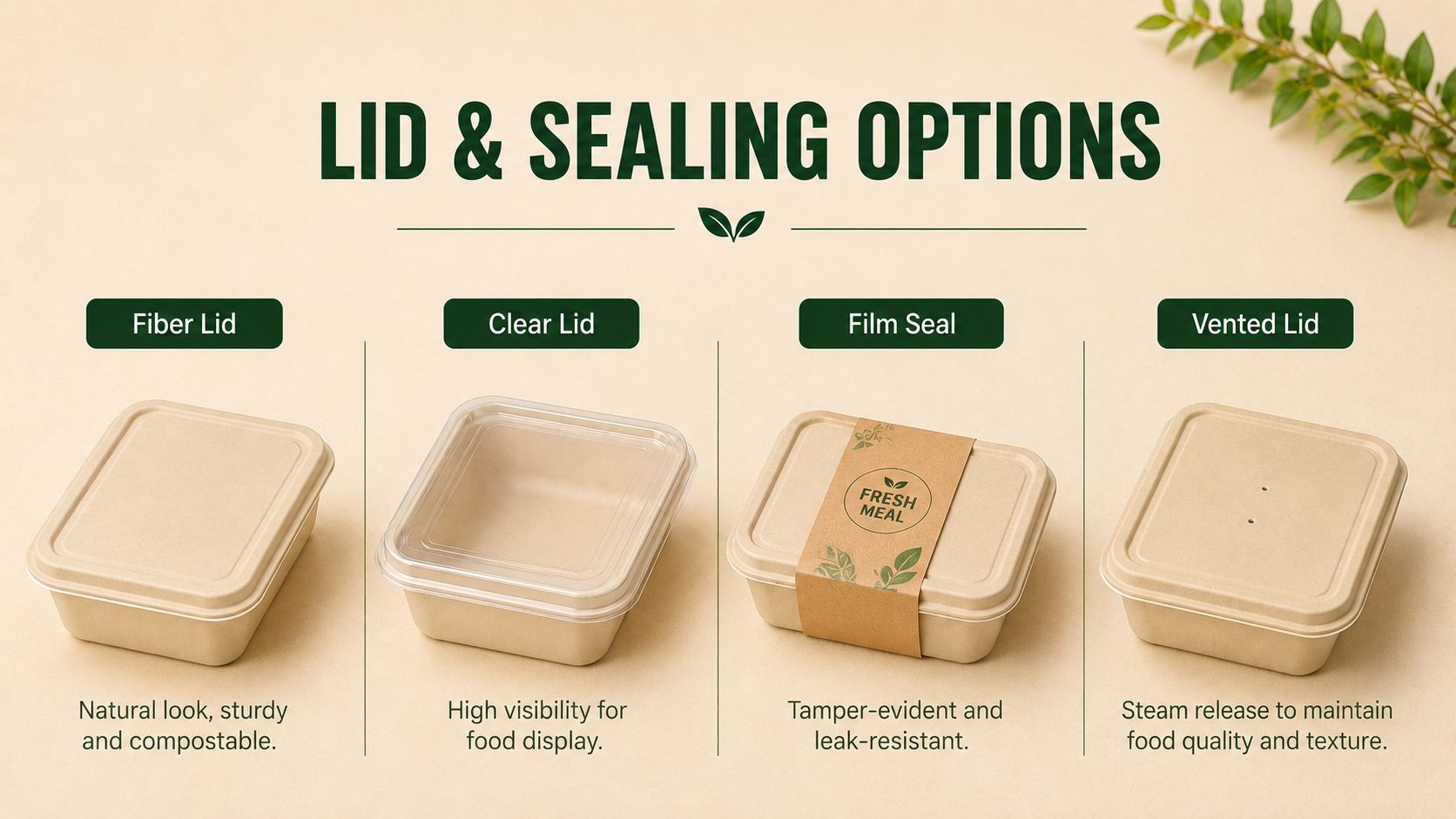
The lid and container should be tested together as one complete packaging system.
Fiber Lids
Fiber lids support a natural appearance and may help create a more consistent plant-based packaging system.
They are suitable when product visibility is not essential.
Buyers should test:
- Rim fit
- Tab strength
- Resistance to steam
- Stacking stability
- Opening and closing
- Deformation during delivery
Transparent Lids
Transparent lids are useful for salads, desserts, prepared meals and retail displays.
The lid material must match the temperature of the food.
A clear lid designed for cold salad may deform when placed over a freshly cooked meal.
Paper Sleeves and Belly Bands
Paper sleeves and belly bands are placed around a closed food container to improve branding, display product information and provide visible evidence if the package has been opened.
They may be used for:
- Brand logos and product names
- Ingredient or allergen information
- Barcodes and retail labels
- Heating and disposal instructions
- Private label food packaging
- Tamper-evident presentation
A paper sleeve does not make the container leakproof. The container body and lid must still provide the required sealing performance for the intended food and delivery conditions.
Vented and Non-Vented Lids
Vents allow steam to escape and can help reduce condensation.
However, vents may also allow liquid to leak when the container is tilted.
For fried food, ventilation may help preserve texture. For soup or curry, a non-vented, tightly sealed lid may be more appropriate.
Water-Resistant, Grease-Resistant and Leakproof Are Not the Same
These three terms are often confused.
Water-Resistant
The material can resist moisture for a certain period without immediately softening or absorbing liquid.
Grease-Resistant
The material can resist penetration or staining from oil and fat.
Leakproof
The complete package prevents liquid from escaping through the material, seams, corners and lid under defined conditions.
A container can be water-resistant and grease-resistant without being fully leakproof.
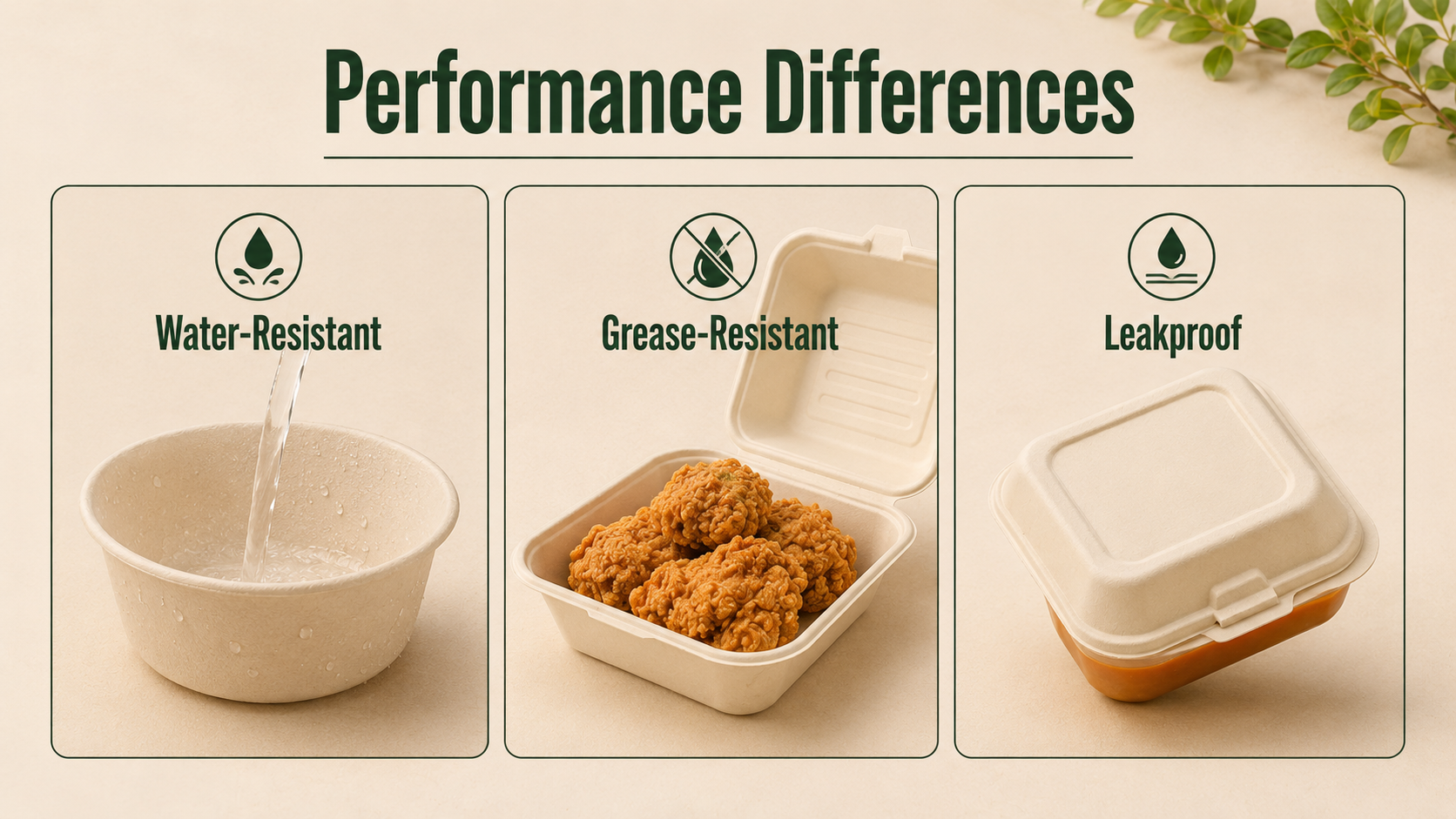
Water resistance, grease resistance and leakproof performance describe different packaging properties.
Buyers should ask suppliers to describe the exact test method behind each claim.
Microwave, Freezer and Delivery Requirements
Microwave Use
Only describe a product as microwave-safe when the finished container has been evaluated for the intended microwave conditions.
Testing should include:
- Container body
- Lid
- Printing or label
- Coating
- Adhesive
- Actual food
- Heating time
- Maximum fill volume
The lid may need to be removed or loosened before heating, even when the container body is suitable.
Freezer Use
Freezer performance should be tested for cracking, warping, moisture absorption and lid retention.
A product that performs well at room temperature may become brittle or lose its seal after freezing.
Freezer-to-Microwave Use
This is a more demanding application.
The container must tolerate:
- Low-temperature storage
- Condensation during thawing
- Rapid heating
- Steam pressure
- Changes in food volume
Do not make a freezer-to-microwave claim without product-specific testing.
Delivery Use
A practical delivery test should include:
- Closing the package while the food is hot
- Stacking multiple containers
- Placing them in a delivery bag
- Tilting and shaking the bag
- Holding for the expected delivery time
- Checking the lid, base and corners for leakage
- Evaluating whether the food texture changes
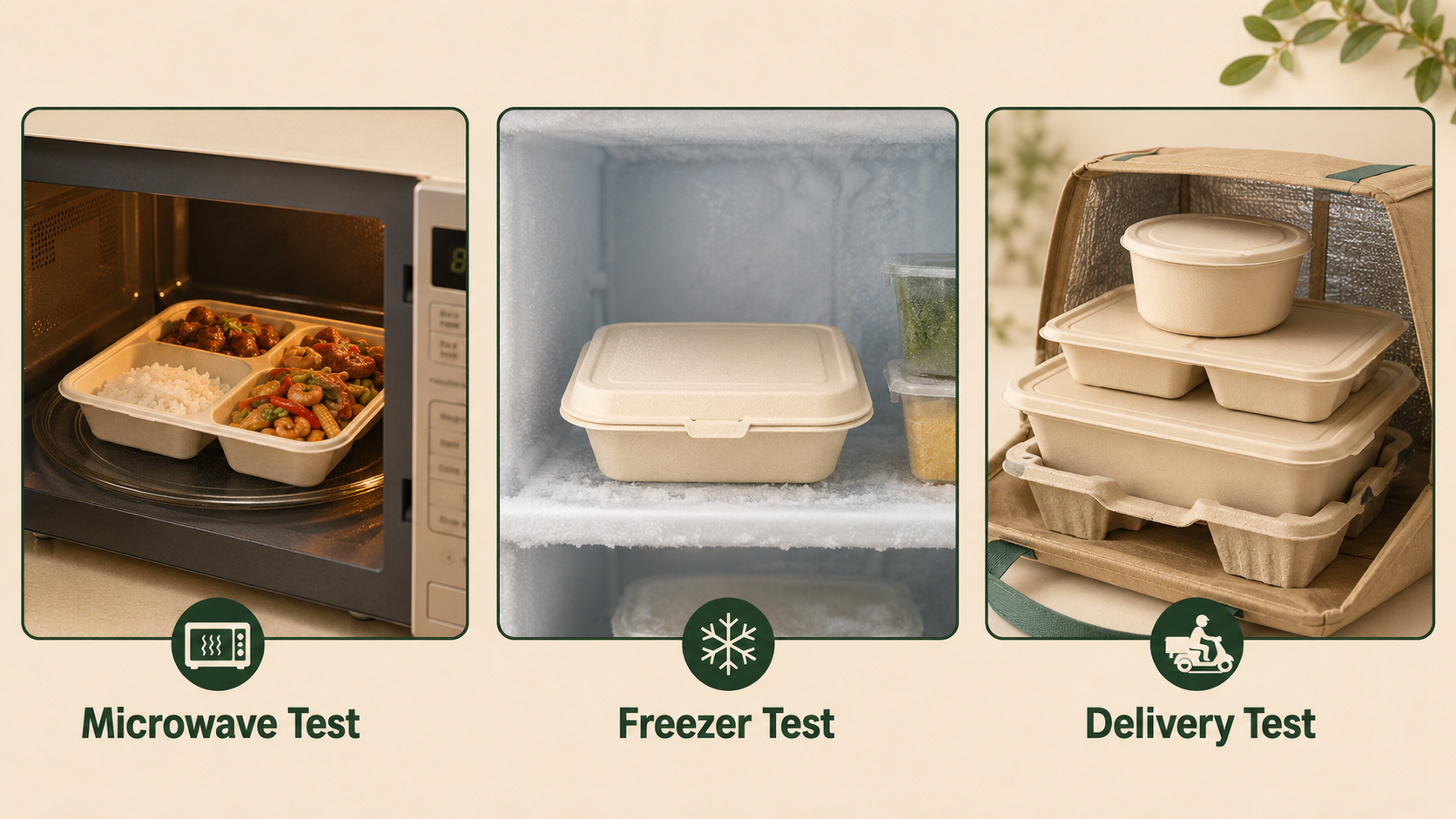
Test the finished container under actual heating, freezing and delivery conditions.
PFAS-Free and Food-Contact Requirements
Food-contact compliance is more than a general certificate.
The required documents depend on:
- Destination country
- Material composition
- Food type
- Contact temperature
- Contact duration
- Intended use
- Printed or coated surfaces
For the U.S. market, the FDA announced in 2024 that grease-proofing substances containing PFAS were no longer being sold by manufacturers for use on paper food packaging. In January 2025, the FDA also determined that 35 related food contact notifications were no longer effective. Buyers should therefore request current PFAS-related declarations and supporting test information where applicable. Learn more from the FDA’s official information on the market phase-out of PFAS grease-proofing substances.
For the European Union, food-contact materials must comply with applicable EU food-safety legislation and good manufacturing practice requirements. Buyers targeting EU markets can review the European Commission’s official guidance on food-contact materials.
For other markets, importers should confirm the latest national and regional requirements before placing a bulk order.
A practical document request may include:
- Material specification
- Product composition
- Food-contact test report
- Migration test information where required
- PFAS-free declaration or fluorine screening
- Heavy metal or restricted substance testing where applicable
- Compostability certificate when a compostable claim is made
- Quality inspection standard
- Production batch traceability
You can also review Panabam’s guide to certifications and standards for disposable tableware.
Available documents may vary by product, material and project. Buyers should confirm the required testing before production rather than after the goods are completed.
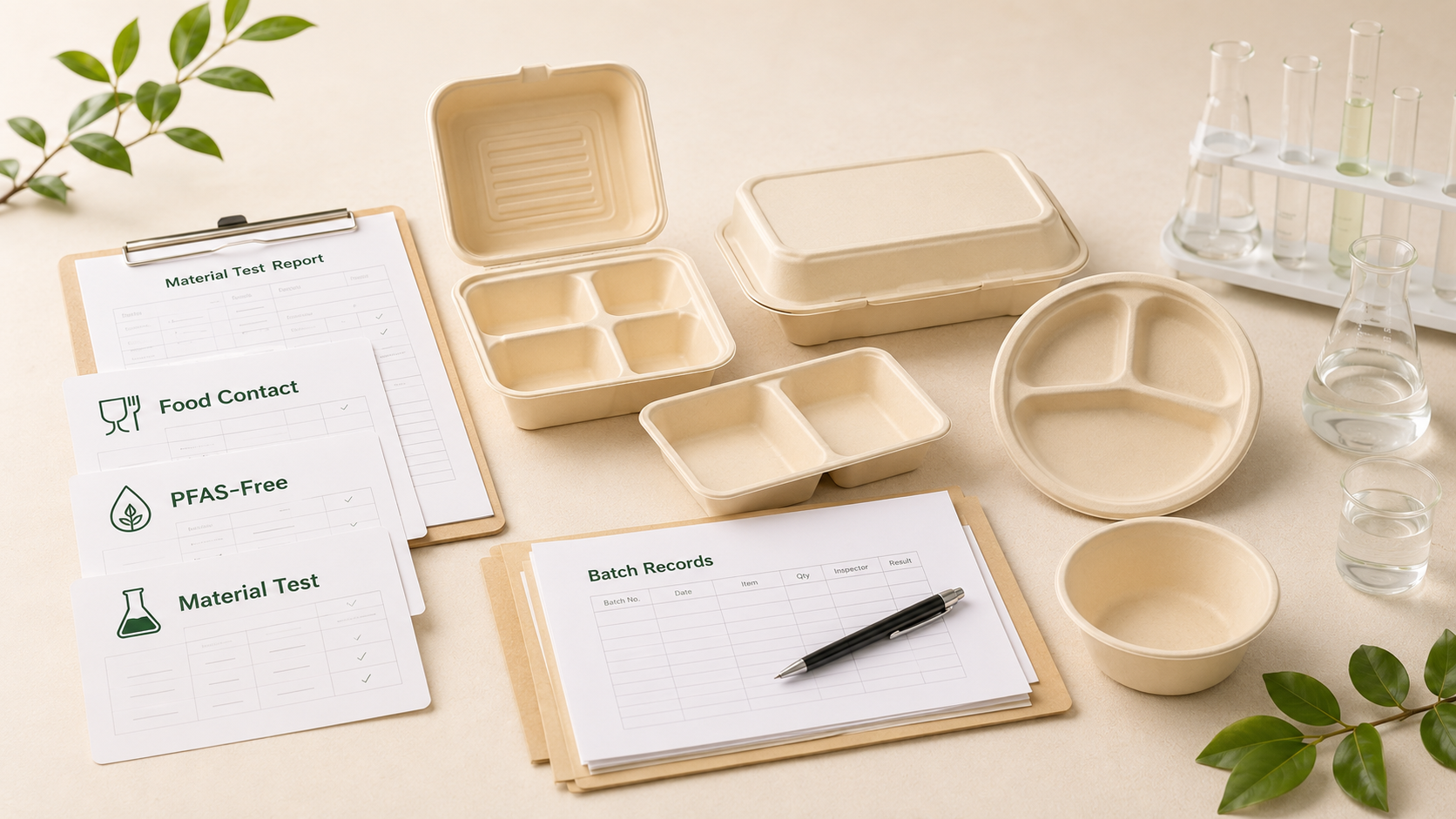
Required compliance documents depend on the product, destination market and intended use.
Common Sizes and Capacities
There is no universal size system, but the following ranges are commonly requested in foodservice projects.
| Product Type | Common Size or Capacity Examples | Typical Applications |
|---|---|---|
| Small bowls | 8–16 oz / approximately 240–475 ml | Desserts, side dishes, soup |
| Medium bowls | 20–32 oz / approximately 590–950 ml | Noodles, salad, rice bowls |
| Large bowls | 32–48 oz / approximately 950–1,420 ml | Family meals, large salads |
| Rectangular containers | Approximately 500–1,500 ml | Rice meals, pasta, prepared food |
| Clamshells | Small, medium and large formats | Burgers, fried food, takeaway meals |
| Compartment containers | 1, 2, 3 or more compartments | Meal prep, school meals, airline or catering |
| Trays | Selected by length, width and depth | Catering, display, bakery and retail food |
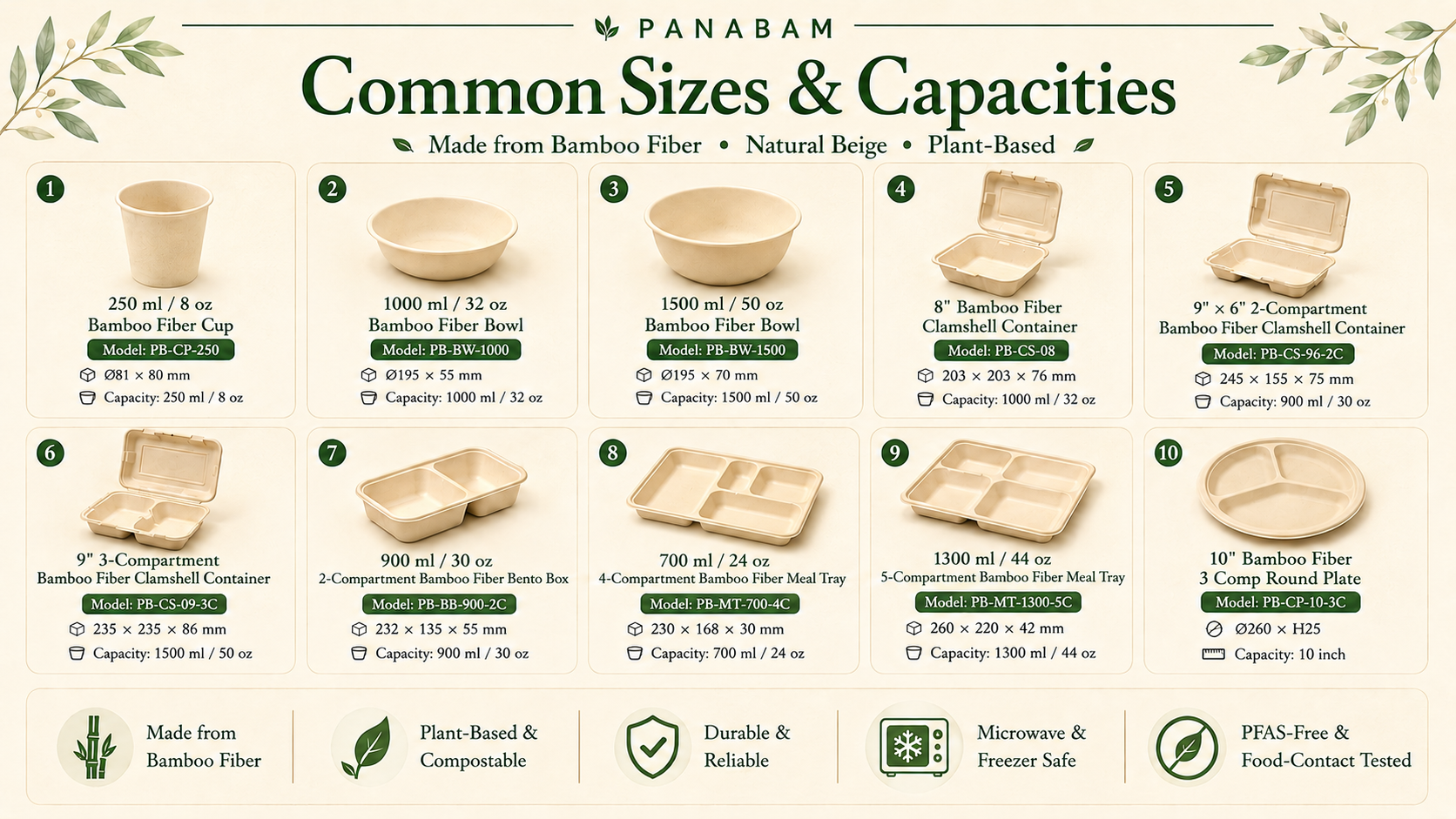
Confirm actual dimensions, usable volume, lid height and carton loading before ordering.
Capacity alone is not enough.
Buyers should also confirm:
- Internal dimensions
- External dimensions
- Usable fill volume
- Lid height
- Compartment capacity
- Carton quantity
- Carton dimensions
- Units per pallet
- Container nesting height
These details directly affect freight cost, storage space and serving presentation.
OEM and Private Label Options
For distributors, food brands and retail projects, the product is only one part of the complete packaging solution.
Customization may include:
- Custom logo
- Printed labels
- Paper sleeves
- Retail color boxes
- Product stickers
- Barcodes
- Shipping marks
- Custom outer cartons
- Instruction labels
- Mixed product sets
- Custom packing quantities
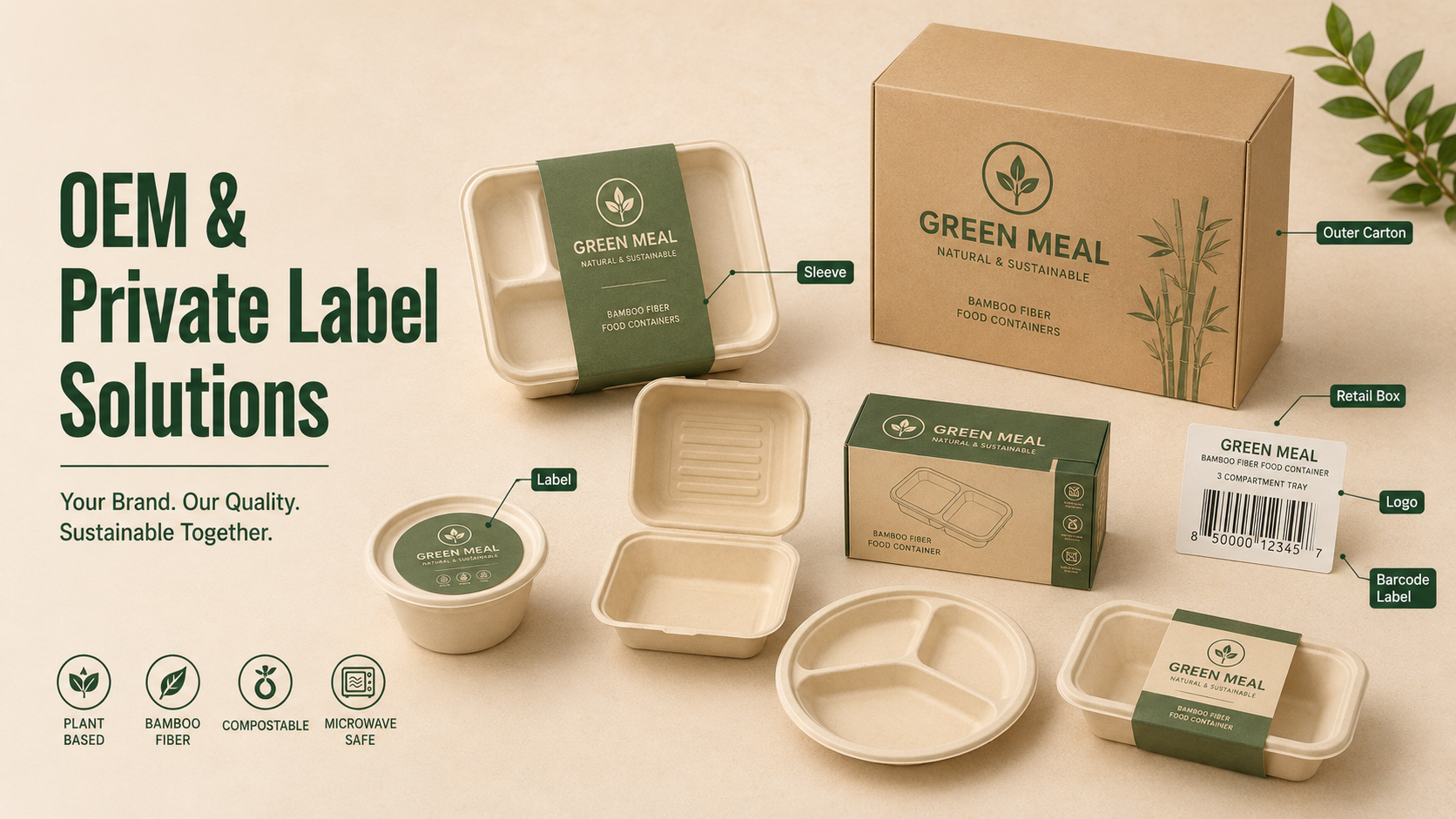
Private label projects may include sleeves, labels, retail boxes, barcodes and custom outer cartons.
Before confirming custom packaging, buyers should provide:
- Target sales channel
- Destination country
- Required language
- Product dimensions
- Units per retail pack
- Units per carton
- Barcode requirements
- Logo files
- Packaging artwork
- Required environmental claims
Panabam supports OEM and private label food packaging for bamboo fiber, plant fiber, molded fiber and wooden packaging projects.
Samples or printed mockups should be approved before bulk production.
B2B Sample Testing Checklist
A sample should be tested with the buyer’s real food and operating process.
Do not test only with cold water.
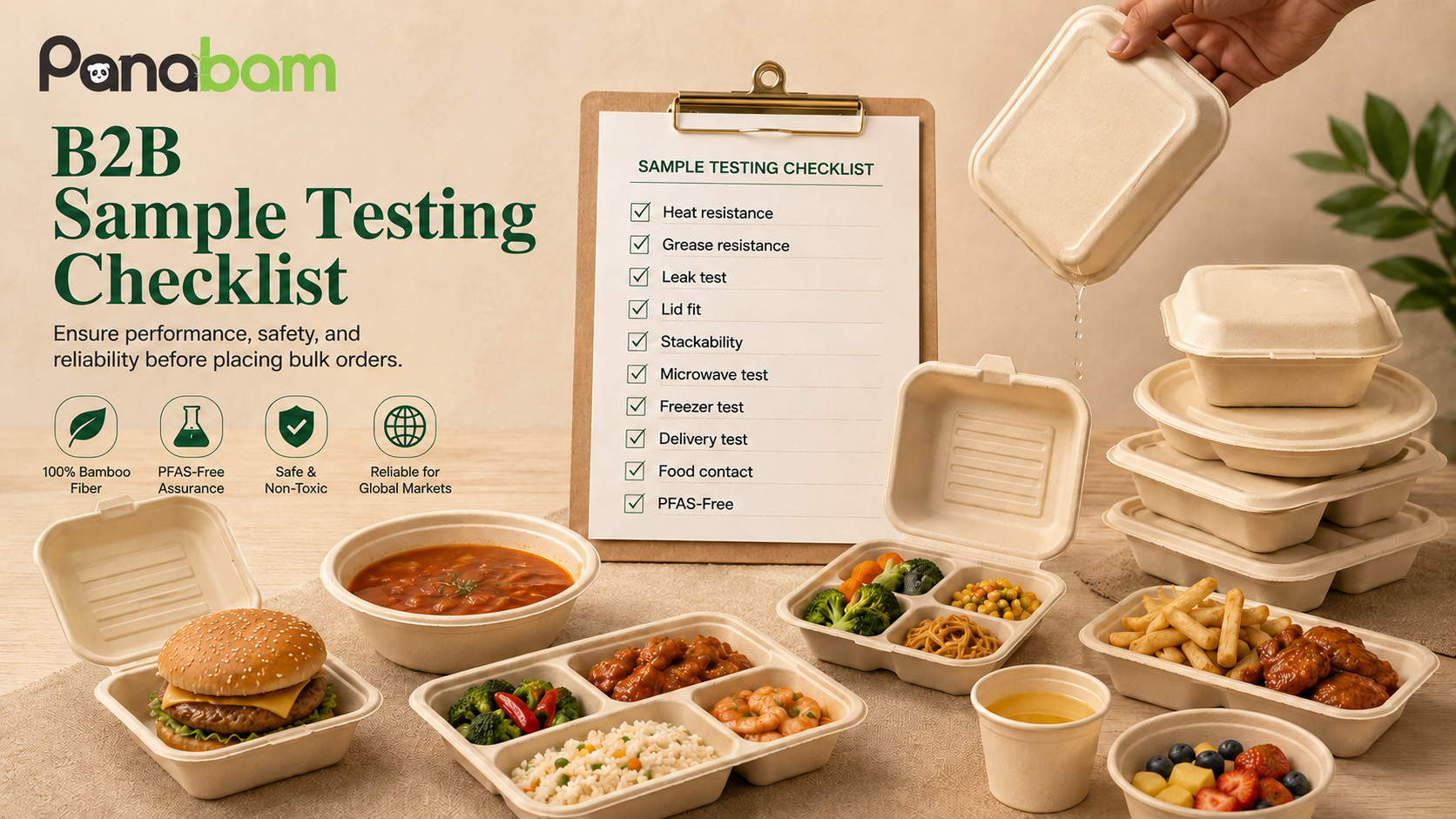
Test real food, holding time, leakage, lid fit, stacking and delivery performance before bulk ordering.
Step 1: Inspect the Empty Container
Check:
- Dimensions
- Weight
- Wall thickness
- Rim condition
- Surface quality
- Lid fit
- Locking tabs
- Hinge strength
- Odor
- Color consistency
Step 2: Fill It With the Actual Food
Use the real menu item at the actual serving temperature.
For example:
- Fried chicken with oil
- Curry with sauce
- Noodles with soup
- Pasta with tomato sauce
- Rice with meat and vegetables
Step 3: Test Different Holding Times
Evaluate the package after:
- 15 minutes
- 30 minutes
- 60 minutes
- 90 minutes
- The maximum expected delivery or display time
Step 4: Check for Physical Changes
Look for:
- Softening
- Warping
- Oil marks
- Moisture penetration
- Base deformation
- Lid loosening
- Corner leakage
- Odor transfer
- Taste transfer
- Condensation
Step 5: Simulate Delivery
Place the filled container in a delivery bag and test:
- Tilting
- Shaking
- Stacking
- Compression
- Sudden movement
- Opening after the expected delivery time
Step 6: Test Reheating or Freezing
Only perform these tests when the product is intended for such use.
Follow the supplier’s instructions and test the full package, including the lid and label.
Step 7: Record the Results
Use a simple scorecard.
| Test Item | Pass/Fail | Notes |
|---|---|---|
| Container remains rigid | ||
| No visible oil penetration | ||
| No liquid leakage | ||
| Lid remains attached | ||
| No unusual odor | ||
| No food taste transfer | ||
| Suitable after delivery simulation | ||
| Suitable after microwave test | ||
| Suitable after freezer test |
Photographs and videos can help compare multiple suppliers objectively.
Questions to Ask a Food Container Supplier
Before placing an order, ask the supplier:
- What is the exact material composition?
- Is the product suitable for hot, oily and saucy food?
- What food temperature and contact time have been tested?
- Is the product water-resistant, grease-resistant or fully leakproof?
- Which lid is recommended for this container?
- Is the lid suitable for the same temperature as the base?
- Can the product be microwaved or frozen?
- Must the lid be removed during reheating?
- Which food-contact reports are available?
- Is a current PFAS-free declaration available?
- Is the compostability claim supported by certification?
- Can samples be tested before placing a bulk order?
- What are the MOQ and lead time?
- What customization options are available?
- What are the carton dimensions and loading quantity?
- How is batch quality controlled?
- Can the supplier support export documents for the destination market?
Panabam provides material-matching and quality support to help buyers compare packaging options according to food application, performance, budget and market requirements.
Common Purchasing Mistakes
Choosing by Price Alone
A cheaper container can become more expensive when leakage, customer complaints and product replacement are considered.
Evaluate total performance, not only unit price.
Testing With the Wrong Food
Testing a curry container with room-temperature water does not represent actual use.
Use the real food, oil level, temperature and holding time.
Ignoring the Lid Material
The base may be suitable for hot food while the clear lid is not.
Always evaluate the complete package.
Assuming Every Fiber Container Is Compostable
Material origin alone does not prove that the finished product meets a compostability standard.
Check the finished product certificate and permitted claim.
Printing Claims Before Verifying Documents
Terms such as plastic-free, PFAS-free, biodegradable, compostable and recyclable should be supported before they are printed on labels or cartons.
Skipping Freight Calculations
Disposable food containers are often lightweight but bulky.
Compare carton size, nesting efficiency, pallet quantity and container loading before selecting the final specification.
Conclusion
The best disposable food container for hot, oily or saucy food is the one that performs reliably under the buyer’s actual conditions.
Start with the food application, not the material name.
Define the serving temperature, oil and sauce content, holding time, delivery process, reheating requirements and destination market. Then compare the container body, lid, material composition, test reports and sample performance as one complete system.
For many takeaway and foodservice applications, bamboo fiber and other molded plant fiber containers can provide a practical balance of strength, natural appearance and sustainable positioning.
However, every project should be confirmed through real-food sample testing.
Panabam supports food brands, importers and distributors with disposable food containers, clamshells, bowls, lids, material matching, sample preparation and private label packaging.
Contact Panabam with your required product type, size, food application, quantity, packaging requirements and destination country to receive suitable product recommendations and quotation details.
Frequently Asked Questions
What Is the Best Disposable Container for Hot and Oily Food?
Rigid bamboo fiber or well-designed molded fiber containers can be suitable for many hot and oily meals when tested for the actual food temperature and holding time. PP containers may also be used in markets and applications where plastic is accepted. The final choice should be based on product-specific testing.
Can Compostable Containers Hold Soup?
Some deep compostable bowls and containers can hold soup when paired with a compatible lid. However, not every compostable container is leakproof. Buyers should test liquid volume, temperature, holding time and delivery movement.
Are All Plant-Based Food Containers PFAS-Free?
No assumption should be made based only on the term “plant-based.” Buyers should request a PFAS-free declaration and supporting test information when required for their market.
Can Bamboo Fiber Containers Go in the Microwave?
Some bamboo fiber containers may be suitable for microwave use, but the claim must be confirmed for the specific product. The container body, lid, coating, label and heating conditions should all be evaluated.
Which Container Is Best for Curry or Food With Sauce?
A deep bowl or rectangular container with a secure separate lid is usually more suitable than a shallow tray. The lid should be tested for tilting, stacking and delivery movement.
Is a Grease-Resistant Container Automatically Leakproof?
No. Grease resistance describes how the material handles oil. Leakproof performance depends on the complete container, including its corners, rim, lid and locking system.
Should I Choose a Fiber Lid or a Clear Lid?
Choose a fiber lid when natural appearance and material consistency are priorities. Choose a clear lid when food visibility is important. In either case, confirm that the lid is suitable for the food temperature and delivery conditions.
What Information Should I Send When Requesting a Quotation?
Provide the product type, dimensions or capacity, food application, expected quantity, destination country, required lid, packaging method, logo requirements and any food-contact or environmental certifications needed.