Can You Microwave Compostable Containers?
Yes, some compostable bowls and takeout containers can be microwaved—but “compostable” does not automatically mean “microwave safe.”
Whether a disposable food container is suitable for microwave reheating depends on several factors:
- the base material
- product construction
- coatings or barrier systems
- lid material
- food type
- microwave power
- heating time
- temperature reached during use
- food-contact migration performance
- manufacturer’s intended use
Molded plant-fiber packaging such as certain bamboo fiber and bagasse containers can be designed for hot-food service and microwave reheating.
Other packaging—including some PLA containers, clear lids and multi-material paper packages—may soften, warp or lose structural stability when exposed to higher temperatures.
But there is another issue that is just as important:
A container may keep its shape in the microwave and still need to be evaluated for substances that can migrate from the packaging into food during heating.
So a truly useful microwave-safety assessment should consider both:
Physical Performance + Chemical Food-Contact Safety
The safest rule is:
Only microwave a disposable food container when the manufacturer confirms that the finished product is suitable for the intended heating conditions.
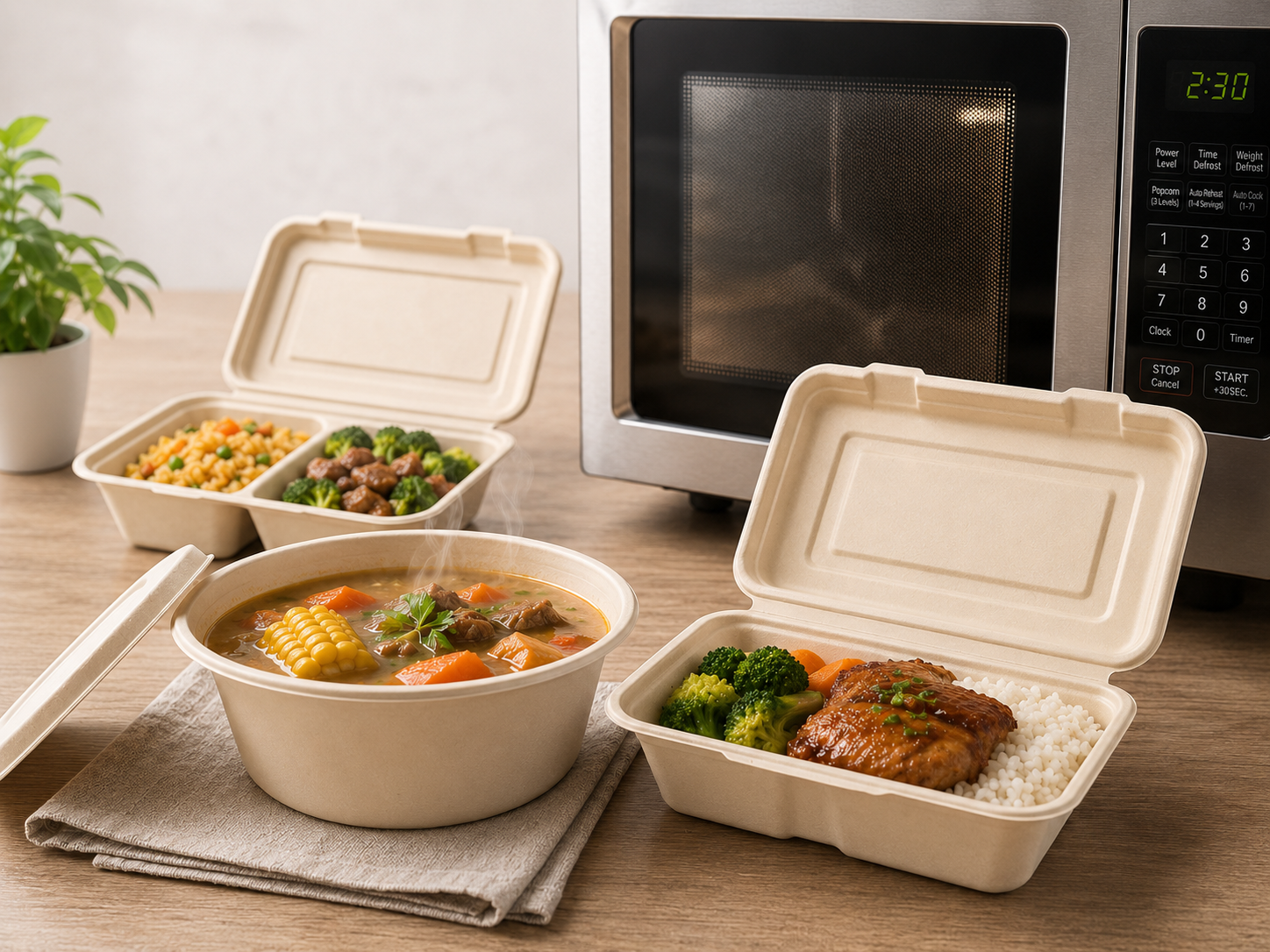
The U.S. Food and Drug Administration explains that microwaves pass through many glass, paper, ceramic and plastic containers, while the food absorbs the microwave energy.
The container can still become hot because heat transfers from the food to the packaging, and some plastic containers may melt under these conditions.
U.S. FDA guidance on microwave ovens
This means the better question is not simply:
“Is this container compostable?”
It is:
“Is this specific finished container physically suitable for microwave reheating, and has its food-contact safety been evaluated under appropriate conditions?”
Compostable Does Not Mean Microwave Safe
This distinction is essential.
Terms such as:
- compostable
- biodegradable
- microwave safe
- oven safe
- freezer safe
- food-contact compliant
describe different properties.
Compostable
Describes how a material or finished product breaks down under specified composting conditions.
Microwave Safe
Describes whether the finished container is suitable for specified microwave-heating conditions.
Oven Safe
Describes whether a container can tolerate specified conventional dry-heat conditions.
Food-Contact Compliant
Relates to whether the material or article meets applicable requirements for its intended contact with food.
These properties are not interchangeable.
A food container can therefore be:
- compostable and microwave suitable
- compostable but not microwave suitable
- microwave suitable but not compostable
- freezer safe but not oven safe
BPI, for example, currently uses ASTM D6400 as the base assessment standard for its Commercial Compostability Certification program.
That certification evaluates compostability. It is not a microwave-performance certification.
If you are comparing sustainable packaging materials more broadly, see our guide to plant-based food packaging.
If you are comparing sustainable packaging materials more broadly, see our guide to plant-based food packaging.
Microwave Safe Does Not Only Mean “It Doesn’t Melt”
This is where many discussions about microwave-safe takeaway containers become too simple.
Consumers often judge a food container by asking:
- Did it melt?
- Did it warp?
- Did it leak?
- Did it stay rigid?
Those are important questions.
But they only describe physical performance.
Food-contact safety also considers what may migrate from the packaging into food.
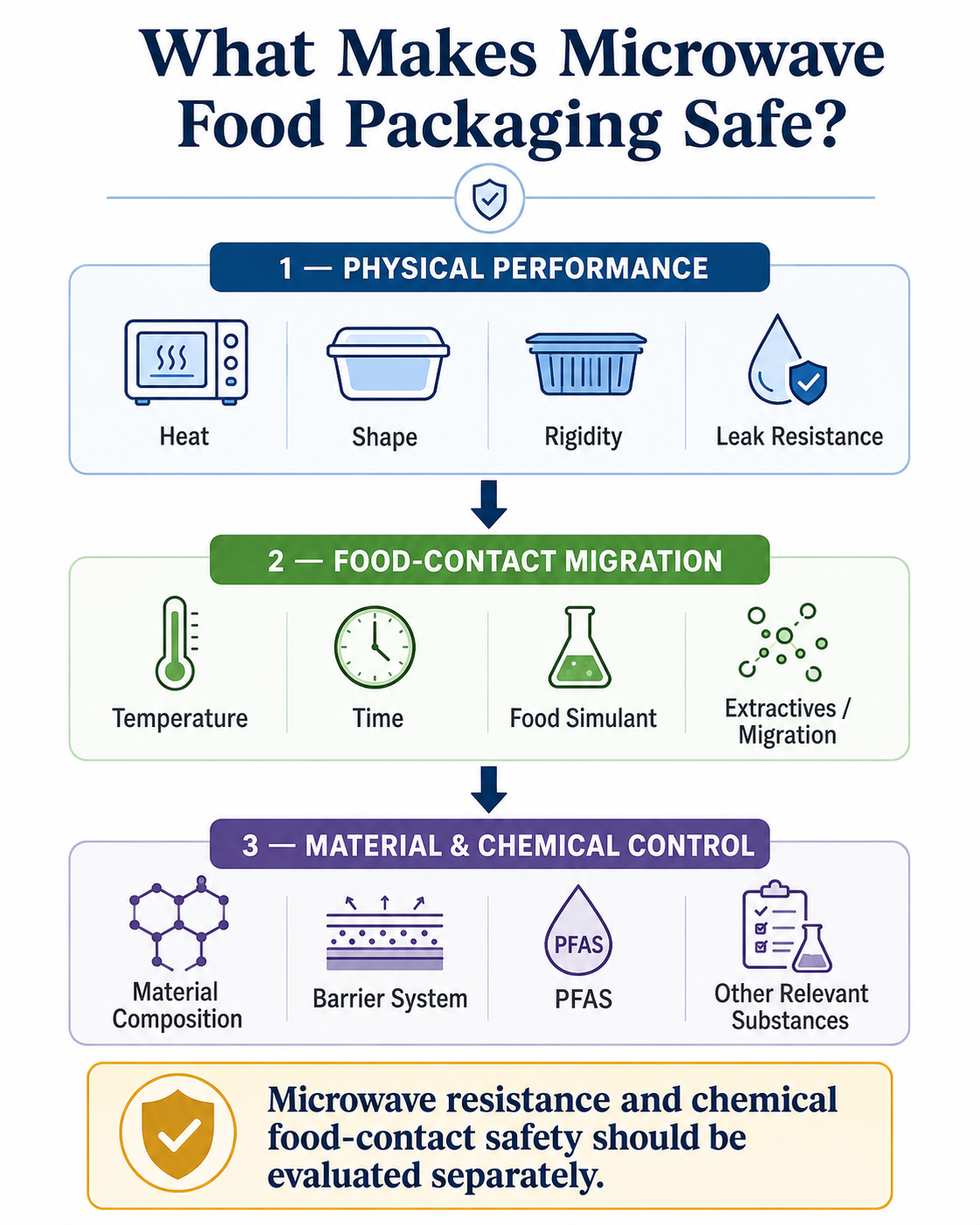
A useful microwave-safety framework therefore has three levels.
| Safety Level | Main Question | What Needs to Be Evaluated |
|---|---|---|
| 1. Physical Performance | Does the container soften, warp, crack or leak? | Heat and microwave performance |
| 2. Food-Contact Migration | Can substances migrate from the material into food under heating conditions? | Migration or extractives testing |
| 3. Specific Substance Control | Are substances of particular concern present in the formulation or treatment? | Material declaration and targeted chemical testing |
A container passing Level 1 does not automatically answer Levels 2 and 3.
Can Microwave-Safe Containers Still Release Substances When Heated?
Yes. A container remaining physically intact does not mean that absolutely nothing can migrate from the packaging into food.
Food-contact materials can contain components that have the potential to migrate under certain conditions.
Migration can be influenced by:
- material composition
- temperature
- heating duration
- food type
- fat content
- surface area
- coatings
- additives
- manufacturing process
Temperature is particularly important.
As temperature increases, molecular movement can increase, which is one reason food-contact migration assessments use defined combinations of:
Food Simulant + Temperature + Contact Time
The FDA also considers potential migration when evaluating dietary exposure to food-contact substances.
For example, in its discussion of PFAS food-contact applications, the FDA explains that exposure assessment considers the potential for substances and their components to transfer or migrate into food.
The FDA explains that certain PFAS used in food-contact applications can migrate from packaging into food. For more details, see the FDA information on PFAS in food-contact applications.
However, this does not mean that every food container releases harmful chemicals when heated.
The correct question is:
Whether substances that may migrate from a particular material remain within applicable safety or regulatory limits under the intended conditions of use.
That is why laboratory testing matters.
How Does FDA Evaluate Migration for Microwave Food Containers?
This is particularly relevant to foodservice packaging intended for reheating.
FDA chemistry guidance for food-contact substances includes specific recommendations for microwave-only containers.
The FDA notes that the temperature experienced by food-contact packaging during microwave cooking depends on factors including:
- food composition
- heating time
- food mass
- food shape
- container shape
FDA guidance states that typical microwave cooking conditions have generally been observed not to exceed approximately 130°C (266°F).
For microwave-only containers, the guidance recommends migration testing using:
- fatty-food simulant at 130°C (266°F) for 15 minutes
- aqueous-food simulant at 100°C (212°F) for 15 minutes
for the described microwave migration assessment approach.
For more details on migration testing and food-contact chemistry, see the FDA chemistry guidance for food-contact substances.
This highlights an important point:
Microwave suitability is not only about whether a container looks unchanged after heating. Food-contact migration under realistic heating conditions also matters.
What Does PANABAM’s Bamboo Fiber FDA Food-Contact Test Show?
PANABAM has third-party food-contact testing for disposable bamboo fiber tableware.
An SGS report identifies the tested sample as:
Disposable bamboo fibre tableware
with the material identified as:
Bamboo
The test was conducted with reference to:
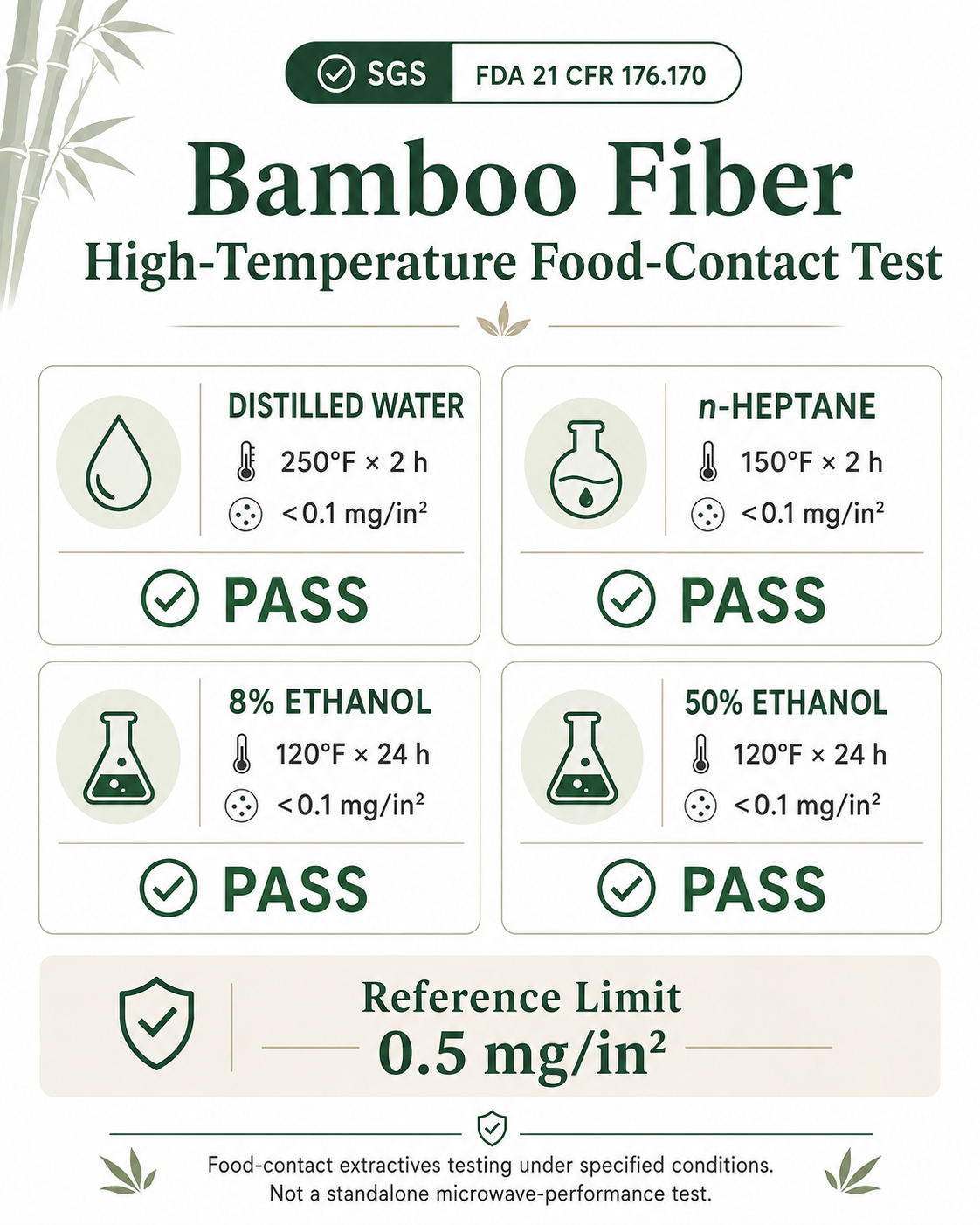
FDA 21 CFR 176.170 — Chloroform-soluble extractives.
The report included four food-simulant conditions.
| Food Simulant | Contact Time | Temperature | Reference Limit | Reported Result | Conclusion |
|---|---|---|---|---|---|
| Distilled Water | 2 hours | 250°F | 0.5 mg/in² | <0.1 mg/in² | PASS |
| 8% Ethanol | 24 hours | 120°F | 0.5 mg/in² | <0.1 mg/in² | PASS |
| 50% Ethanol | 24 hours | 120°F | 0.5 mg/in² | <0.1 mg/in² | PASS |
| n-Heptane | 2 hours | 150°F | 0.5 mg/in² | <0.1 mg/in² | PASS |
The bamboo fiber sample passed all four reported conditions.
The most notable high-temperature condition was:
Distilled Water — 250°F for 2 hours — <0.1 mg/in² — PASS
The n-Heptane condition was:
150°F for 2 hours — <0.1 mg/in² — PASS
The reported reference limit was 0.5 mg/in².
What Does This Evidence Support?
It supports the conclusion that:
The tested bamboo fiber sample met the FDA 21 CFR 176.170 extractives requirement under the specified food-simulant, temperature and time conditions.
This is useful evidence when evaluating the material for hot-food contact.
What Does It Not Prove?
It is equally important to understand what this report does not establish.
FDA 21 CFR 176.170 chloroform-soluble extractives testing is not the same as a complete dedicated microwave-performance test.
The report does not establish:
- a universal microwave time
- a recommended microwave wattage
- deformation after repeated microwave cycles
- strength retention after repeated reheating
- microwave suitability of every PANABAM SKU
- microwave suitability of every matching lid
- that absolutely no substance can migrate from the material
So it would be inaccurate to say:
“The FDA test proves that nothing is released from bamboo fiber during microwave heating.”
The more accurate conclusion is:
The tested sample remained within the applicable extractives limit under the specified high-temperature food-contact test conditions.
That distinction is important for transparent B2B communication.
What Makes a Food Container Suitable for Microwave Reheating?
Now that chemical migration has been separated from physical performance, we can look at the other factors.
1. Base Material
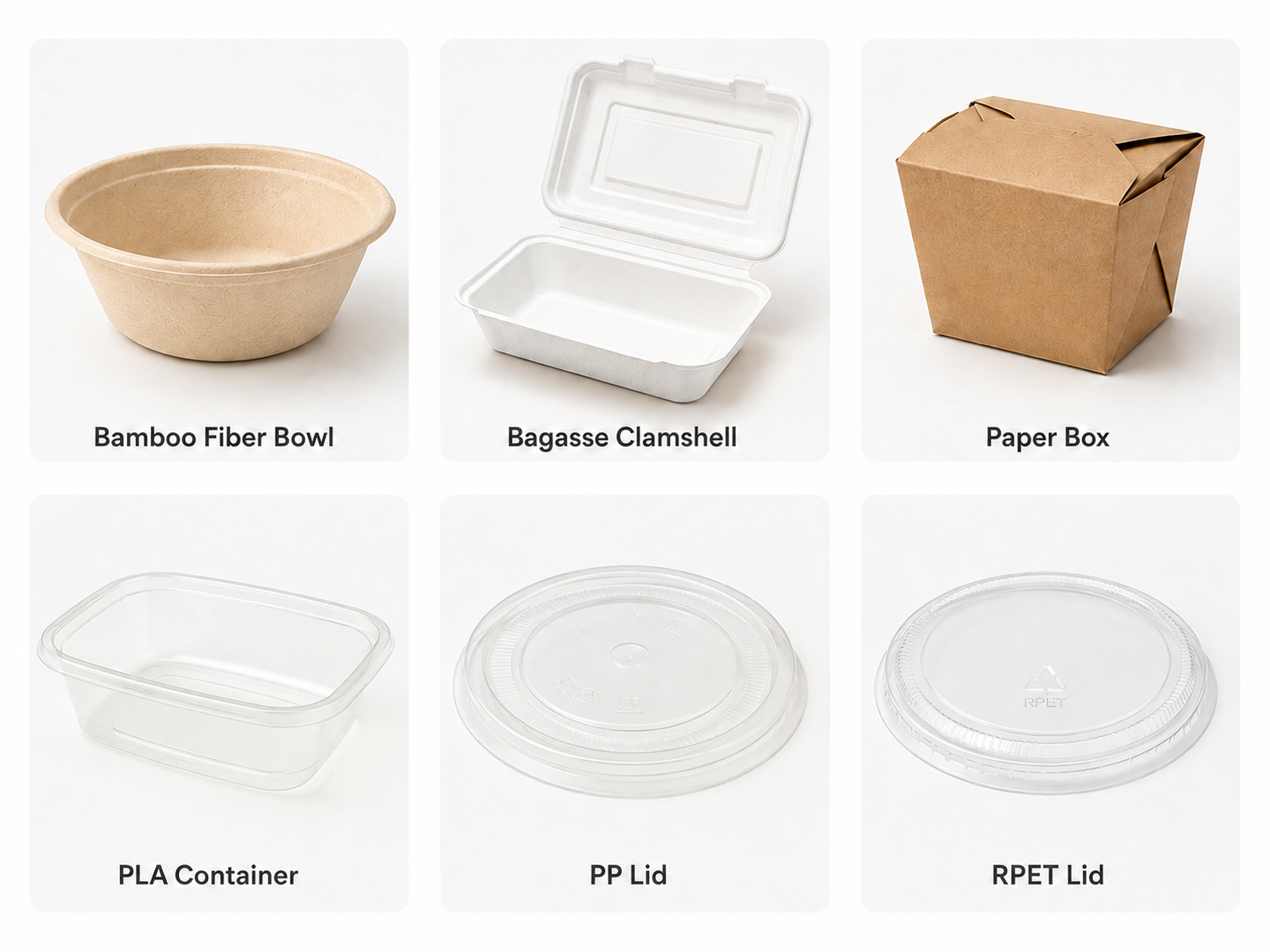
Disposable food packaging may be made from:
- molded bamboo fiber
- bagasse
- other molded plant fibers
- paper
- PLA
- CPLA
- polypropylene
- PET or RPET
- multi-material structures
Different materials react differently to heat.
A molded fiber soup bowl and a transparent PLA salad container may both be considered sustainable packaging, but they should not automatically be treated as equivalent during reheating.
2. Finished Product Construction
Products made from the same general material can still perform differently.
Factors include:
- wall thickness
- fiber density
- molding pressure
- container depth
- rim design
- reinforcement
- compartment structure
That is why a buyer should evaluate the finished SKU, not only the raw material.
3. Barrier System and Surface Treatment
This is particularly important for molded fiber and paper packaging.
A food container may need resistance to:
- oil
- water
- sauces
- moisture
Different manufacturers can achieve these properties through different formulations or barrier systems.
Those choices may affect:
- grease resistance
- heat performance
- food-contact migration
- compostability
- regulatory compliance
For B2B buyers, asking:
“What is the product made from?”
is more useful than simply asking:
“Is it eco-friendly?”
4. Lid Material
A microwave-suitable bowl may be paired with a lid that is not intended for microwave heating.
Common lid materials include:
- molded fiber
- PP
- PET
- RPET
- PLA
Evaluate the base and lid separately.
5. Food Type
The food inside the container matters.
Foods containing more:
- oil
- fat
- cheese
- sugar
- thick sauces
may create different thermal conditions from water-rich foods.
This means:
The same container may face different levels of stress with soup, curry and oily meat.
Which Food Packaging Materials Can Be Microwaved?
| Material | Common Uses | General Microwave Consideration | What Buyers Should Verify |
|---|---|---|---|
| Molded Bamboo Fiber | Bowls, plates, trays, clamshells | Can be designed for hot food and reheating | Finished-product specification and food-contact evidence |
| Bagasse | Clamshells, plates, trays, bowls | Many products are designed for reheating | Exact SKU and manufacturer instructions |
| Other Molded Fiber | Hot-food containers | Product dependent | Composition and barrier system |
| Paper / Paperboard | Boxes, cartons, bowls | Conditional | Coating, adhesives, windows and metal parts |
| PLA | Cold cups, lids, salad containers | Often more heat sensitive | Finished-product heat rating |
| CPLA | Selected hot-food applications | Better heat tolerance than standard PLA in many applications | Exact product specification |
| PP | Containers and lids | Many products are intended for microwave reheating | Manufacturer declaration |
| PET / RPET | Clear lids and cold-food packaging | Do not assume microwave suitable | Exact application instructions |
The most important phrase is:
Product dependent.
Material identification alone does not establish complete microwave safety.
Are Bamboo Fiber Containers Microwave Safe?
Properly designed molded bamboo fiber containers can be suitable for microwave reheating.
Bamboo fiber can be molded into rigid foodservice packaging suitable for applications involving combinations of:
- heat
- moisture
- food weight
- oil
- sauces
However, not every package marketed as “bamboo” has the same construction.
It may refer to:
- molded bamboo fiber
- bamboo paper
- fiber blends
- bamboo composites
- coated bamboo-based packaging
That is why material transparency matters.
PANABAM’s molded bamboo fiber tableware is specified as being made from 100% bamboo fiber.
Applicable products are designed for temperatures from approximately -40°C to 200°C, depending on the exact product and intended application.
Potential applications include:
- microwave reheating
- hot-food service
- cold-food service
- oily food
- sauces
- freezer storage
- selected oven applications
However, the exact SKU should always be confirmed.
For a broader comparison, see bamboo fiber food containers vs. plastic, bagasse and paper.
Can You Microwave Bagasse Containers?
Many bagasse containers are designed for hot-food service and microwave reheating, but the finished product should still be verified.
Bagasse is the fibrous residue left after sugarcane juice extraction.
It is widely used for:
- plates
- bowls
- trays
- clamshells
- takeaway containers
Performance can vary according to:
- pulp formulation
- thickness
- molding density
- surface treatment
- grease resistance
- moisture resistance
- food type
- microwave conditions
PANABAM also has FDA 21 CFR 176.170 food-contact extractives testing for its sugarcane-pulp tableware.
In that SGS report, all four tested food-simulant conditions passed the applicable reference limit.
However, microwave use should still be based on the specification of the exact finished bagasse product rather than assuming:
Bagasse = microwave safe
Can You Microwave Paper Takeout Boxes?
Sometimes.
But “paper” alone does not tell you the full construction.
Paper packaging may include:
- polymer coatings
- PLA coatings
- aqueous barriers
- adhesives
- inks
- transparent windows
- foil
- metal fasteners
These components can change both physical and chemical performance during heating.
If the construction is unknown, or the box contains metal components, transfer the food to a known microwave-safe container.
Can You Microwave PLA Compostable Containers?
PLA requires more caution.
PLA is commonly used for:
- clear cold cups
- transparent lids
- salad containers
- deli packaging
Many conventional PLA products are primarily intended for lower-temperature applications.
At elevated temperatures, some PLA products may:
- soften
- warp
- deform
CPLA has different heat-performance characteristics, but the term CPLA alone still does not establish microwave suitability.
The correct approach is:
Check the finished-product specification.
Can You Microwave a Compostable Bowl With the Lid On?
Only if both the bowl and the lid are suitable for microwave use.
For example:
Molded Fiber Bowl + Molded Fiber Lid
may have different performance from:
Molded Fiber Bowl + PP Lid
or:
Molded Fiber Bowl + RPET Lid
or:
Molded Fiber Bowl + PLA Lid
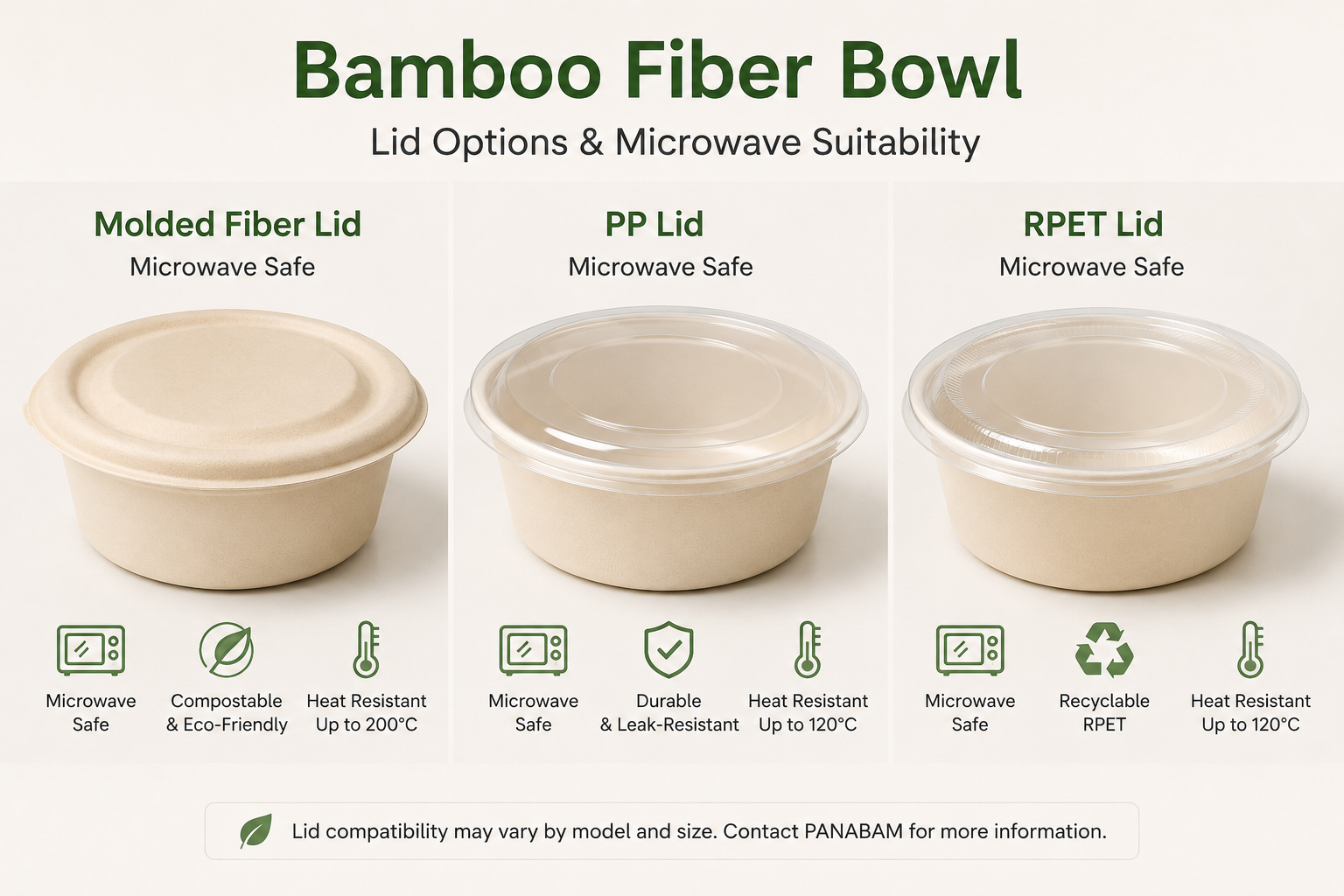
For consumers:
If you cannot confirm that the lid is microwave suitable, remove it before reheating.
For B2B buyers, ask the supplier to confirm:
- base material
- lid material
- heat rating
- microwave suitability
- intended food application
Explore our bamboo fiber bowls and lids for different foodservice, takeaway and lid-matching applications.
How Long Can You Microwave a Compostable Container?
There is no universal microwave time for every compostable food container.
A recommendation such as:
Microwave for five minutes
cannot be generalized across all materials and food types.
Heating conditions depend on:
- container material
- finished-product construction
- food quantity
- food composition
- fat content
- moisture content
- starting temperature
- microwave wattage
- lid
- heating duration
This distinction is particularly important when interpreting laboratory reports.
For example:
A bamboo fiber sample was exposed to distilled water at 250°F for two hours during FDA 21 CFR 176.170 extractives testing.
That does not mean:
Microwave the container for two hours.
A controlled food-contact extractives test and an actual microwave-use instruction are two different things.
FDA’s own chemistry guidance illustrates this distinction by giving specific microwave migration-testing conditions for microwave-only containers rather than simply relying on general high-temperature testing.
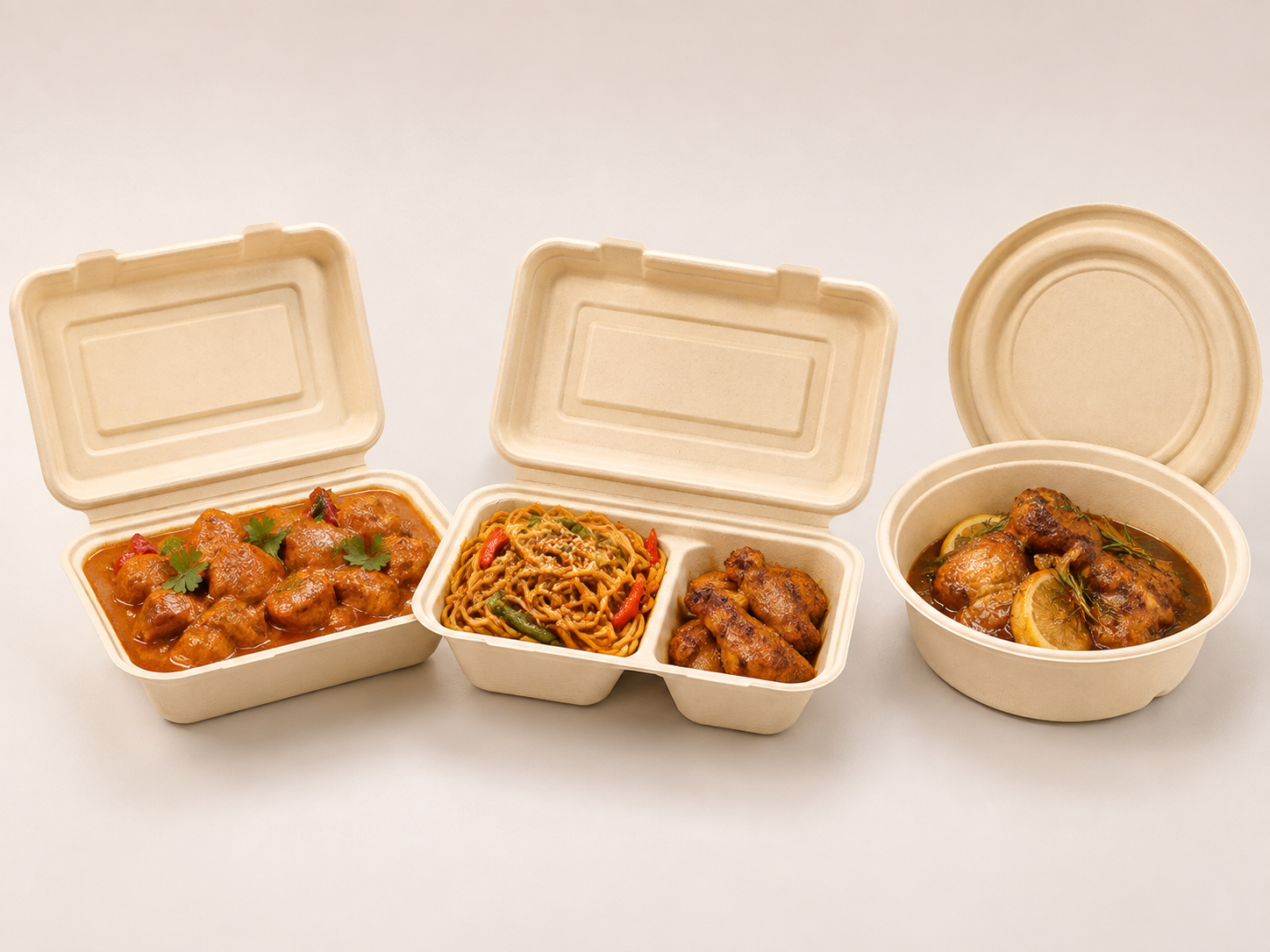
Why Hot and Oily Foods Need More Attention
Hot and oily food creates one of the most challenging environments for takeaway packaging.
Examples include:
- curry
- fried rice
- noodles
- barbecue
- roasted meat
- cheese-based dishes
- pasta
- oily sauces
The packaging must deal with:
Heat + Oil + Moisture + Food Weight + Contact Time
A container may resist heat but still perform poorly if it:
- softens
- leaks
- loses rigidity
- absorbs too much moisture
- loses lid fit
Food-contact migration can also depend on the type of food, which is another reason fatty-food simulants are used in regulatory food-contact evaluations.
For more details, read our guide to choosing containers for hot, oily and saucy foods.
Read our detailed guide to selecting containers for hot, oily and saucy foods.
What About PFAS in Molded Fiber Food Packaging?
PFAS deserves specific attention because grease resistance is important in takeaway packaging.
Historically, certain PFAS-containing substances were used as grease-proofing agents in paper and paperboard food packaging.
The FDA explains that these substances were used in products such as:
- fast-food wrappers
- microwave popcorn bags
- takeout paperboard containers
and that this type of use could result in dietary exposure through transfer or migration into food.
In February 2024, the FDA announced that PFAS-containing grease-proofing substances were no longer being sold by manufacturers for food-contact use in the U.S. market.
In January 2025, the FDA determined that 35 related Food Contact Notifications were no longer effective because the uses had been abandoned.
For more details, see the FDA market phase-out of PFAS grease-proofing substances.
For B2B buyers, this means grease resistance should not be evaluated separately from material transparency and regulatory compliance.
Ask your supplier:
- how grease resistance is achieved
- whether intentionally added PFAS are used
- what test documentation is available
For PANABAM bamboo fiber products, the product specification states that the molded fiber formulation contains no intentionally added PFAS.
How Can You Tell if a To-Go Box Is Microwave Safe?
If you searched “can you microwave to go boxes?”, use this checklist.
1. Check the Microwave Instructions
Look at:
- the product
- packaging
- carton
- technical data sheet
- manufacturer’s instructions
2. Identify the Material
Is it:
- bamboo fiber?
- bagasse?
- paper?
- PLA?
- CPLA?
- PP?
- PET/RPET?
3. Look Beyond Physical Heat Resistance
Ask whether there is relevant:
- food-contact documentation
- migration testing
- extractives testing
- chemical compliance documentation
4. Check the Lid Separately
Base and lid materials may have completely different temperature limits.
5. Consider the Food
Pay particular attention to:
- oily foods
- high-fat foods
- high-sugar foods
- sauces
6. Check for Metal
Do not treat packaging containing foil or metallic components as ordinary microwave-safe packaging.
7. Watch for Physical Failure
Stop heating if the container:
- warps
- softens excessively
- cracks
- leaks
- loses structural stability
8. When in Doubt, Transfer the Food
Use a known microwave-safe ceramic or glass container if the packaging cannot be verified.
Microwave Safe vs. Food-Contact Safe: What’s the Difference?
| Question | Microwave Performance | Food-Contact Safety |
|---|---|---|
| Does it melt? | ✓ | |
| Does it deform? | ✓ | |
| Does it leak? | ✓ | |
| Does it remain rigid? | ✓ | |
| Can packaging components migrate into food? | ✓ | |
| Are migration/extractives within applicable limits? | ✓ | |
| Are substances such as PFAS relevant to the material? | ✓ | |
| Does it meet applicable food-contact requirements? | ✓ |
A reliable food package should address both columns.
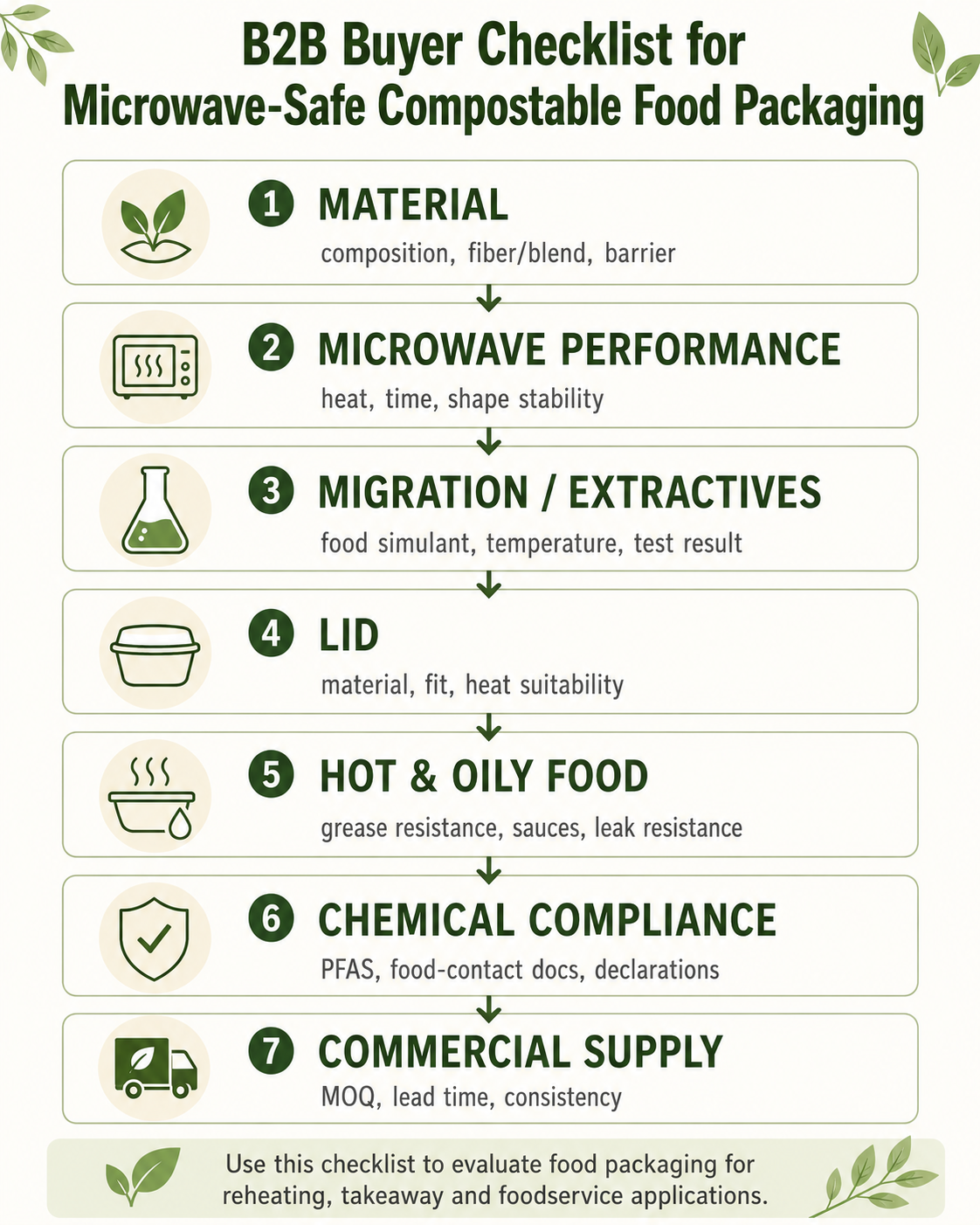
What Should B2B Buyers Ask Their Food Packaging Supplier?
For importers, distributors, supermarkets and restaurant chains, a simple:
“Is this microwave safe?”
is not enough.
Material
- What is the exact material composition?
- Is it pure fiber or blended material?
- Does it contain a coating or lining?
- How is grease resistance achieved?
- Are intentionally added PFAS used?
Microwave Performance
- Is the finished SKU designed for microwave use?
- What temperature range is specified?
- What microwave power was evaluated?
- What heating time is recommended?
- Does it retain its shape after heating?
Food-Contact Safety
- What food-contact standard has been tested?
- Which laboratory performed the test?
- Which food simulants were used?
- At what temperature?
- For how long?
- What was the applicable limit?
- What result was reported?
- Does the report apply to the same material being purchased?
Hot-Food Performance
- Can it hold soup?
- Can it hold oil?
- Can it handle sauces?
- Does it remain rigid during delivery?
- Is the lid compatible with hot-food use?
Commercial Supply
- What is the MOQ?
- What capacities are available?
- Are matching lids available?
- Can the product or packaging be customized?
- What is the lead time?
- Can quality remain consistent at commercial volume?
Why Test Data Matters More Than a Simple “FDA PASS”
For a professional buyer, seeing the word:
PASS
is useful—but incomplete.
A stronger evaluation asks:
What was tested? Under what conditions? Which food simulant was used? At what temperature? For how long? What was the limit? What was the result?
For example, these two statements communicate very different levels of information:
Weak
Our bamboo tableware passed FDA testing.
Stronger
In an SGS food-contact test conducted with reference to FDA 21 CFR 176.170, the tested bamboo fiber tableware sample was exposed to distilled water at 250°F for two hours. The reported chloroform-soluble extractives were below 0.1 mg/in² against a reference limit of 0.5 mg/in².
The second statement gives a buyer meaningful context.
That is better technical communication—and better evidence.
How PANABAM Approaches Bamboo Fiber Food Packaging
PANABAM manufactures molded bamboo fiber tableware and foodservice packaging for international B2B markets.
PANABAM has more than 10 years of production experience, operates five production lines, and has an annual production capacity of approximately 500 million pieces.
Product formats include:
- bowls
- plates
- trays
- clamshell containers
- takeaway boxes
- lids
- cups
- cutlery
Our bamboo fiber packaging can be selected according to:
- food type
- serving temperature
- oil content
- moisture
- microwave reheating
- freezing
- lid requirements
- capacity
- packaging
- destination-market compliance
For B2B sourcing, PANABAM can provide or discuss relevant technical documentation for individual products rather than relying only on general sustainability claims.
For takeaway applications, explore our compostable bamboo fiber clamshell containers.
For takeaway applications, explore our compostable bamboo fiber clamshell containers.
PANABAM also supports:
- custom sizes
- custom molds
- matching lids
- logo customization
- private-label packaging
- samples
- technical documentation
- commercial-volume supply
Learn more about our OEM and ODM food packaging services.
Frequently Asked Questions
Can you microwave to-go boxes?
Some to-go boxes can be microwaved and others cannot. Check the exact material, finished-product specification, lid and manufacturer’s microwave instructions.
Are compostable bowls microwave safe?
Some are. Compostability and microwave suitability are different properties.
Can a container be microwave safe but still release substances?
Yes. A container can remain physically intact while food-contact substances or components may still have the potential to migrate into food. Relevant migration or extractives testing helps evaluate whether levels remain within applicable requirements under defined conditions.
Does heat increase chemical migration from food packaging?
Temperature is one of several factors that can influence migration. Food type, contact time, material composition and manufacturing method also matter.
Are bamboo fiber containers microwave safe?
Properly designed molded bamboo fiber containers can be suitable for microwave reheating. The finished SKU and its intended use should be verified.
Has bamboo fiber tableware been tested under high-temperature food-contact conditions?
Yes. In one SGS report conducted with reference to FDA 21 CFR 176.170, a bamboo fiber tableware sample was tested using distilled water at 250°F for two hours. Reported chloroform-soluble extractives were below 0.1 mg/in² against a reference limit of 0.5 mg/in².
Does passing FDA 21 CFR 176.170 mean no chemicals migrate?
No. The test evaluates specified extractives under defined test conditions. It should not be interpreted as proof that absolutely no substance can migrate under every possible use condition.
Does passing FDA 21 CFR 176.170 prove microwave safety?
Not by itself. Microwave performance and food-contact extractives are related but separate considerations.
Can you microwave bagasse containers?
Many bagasse food containers are designed for reheating, but product specifications differ. Check the exact finished product.
Can you microwave paper takeout boxes?
Some can, but coatings, adhesives, windows or metal components may make others unsuitable.
Can you microwave PLA containers?
Do not assume conventional PLA packaging is microwave suitable. Always follow the finished-product specification.
Can you microwave a compostable lid?
Only when the lid itself is specifically suitable for microwave use.
How long can you microwave a compostable container?
There is no universal time. Heating conditions depend on the food, container, microwave power and manufacturer’s instructions.
Does #5 plastic automatically mean microwave safe?
No. #5 identifies polypropylene, but the resin code alone does not establish the microwave performance of a finished container.
Are compostable containers oven safe?
Not automatically. Compostability, microwave suitability and oven suitability are separate properties.
Final Takeaway
So, can you microwave compostable bowls and takeout containers?
Some can—but “compostable” alone does not answer the question.
A better framework is:
Material → Physical Performance → Food-Contact Migration → Chemical Composition → Lid → Food → Heating Conditions → Finished-Product Specification
For B2B food packaging, a container should not be judged only by whether it survives microwave heating without visibly melting.
Buyers should also consider whether the material has appropriate food-contact evidence for the intended conditions.
For example, SGS testing on disposable bamboo fiber tableware conducted with reference to FDA 21 CFR 176.170 reported chloroform-soluble extractives below the applicable reference limit under several food-simulant conditions, including 250°F distilled-water exposure for two hours.
That provides useful evidence of high-temperature food-contact performance under the specified test conditions.
But responsible technical communication also recognizes its limits:
Food-contact extractives testing is not the same as a complete microwave-performance test, and a visible lack of deformation is not by itself proof of chemical food-contact safety.
For restaurants, distributors and food brands, the strongest sustainable packaging choice combines:
- renewable materials
- transparent composition
- physical heat resistance
- microwave suitability
- food-contact testing
- migration/extractives compliance
- grease and water resistance
- lid compatibility
- destination-market compliance
- reliable commercial supply
That is the difference between packaging that simply looks sustainable and packaging that performs reliably in real foodservice applications.
Looking for Bamboo Fiber Bowls or Takeout Containers for Hot Food?
PANABAM supplies molded bamboo fiber bowls, trays, plates, clamshells and takeaway containers for B2B foodservice, wholesale, distribution and private-label projects.
Tell us:
- what food you need to package
- serving temperature
- whether customers will microwave it
- required size or capacity
- lid preference
- expected quantity
- destination market
We can help you compare suitable products, specifications, food-contact documentation, lid options, samples and customization solutions.
PANABAM Bamboo Fiber Food Packaging Manufacturer
Website: www.panabam.com Email: info@panabam.com