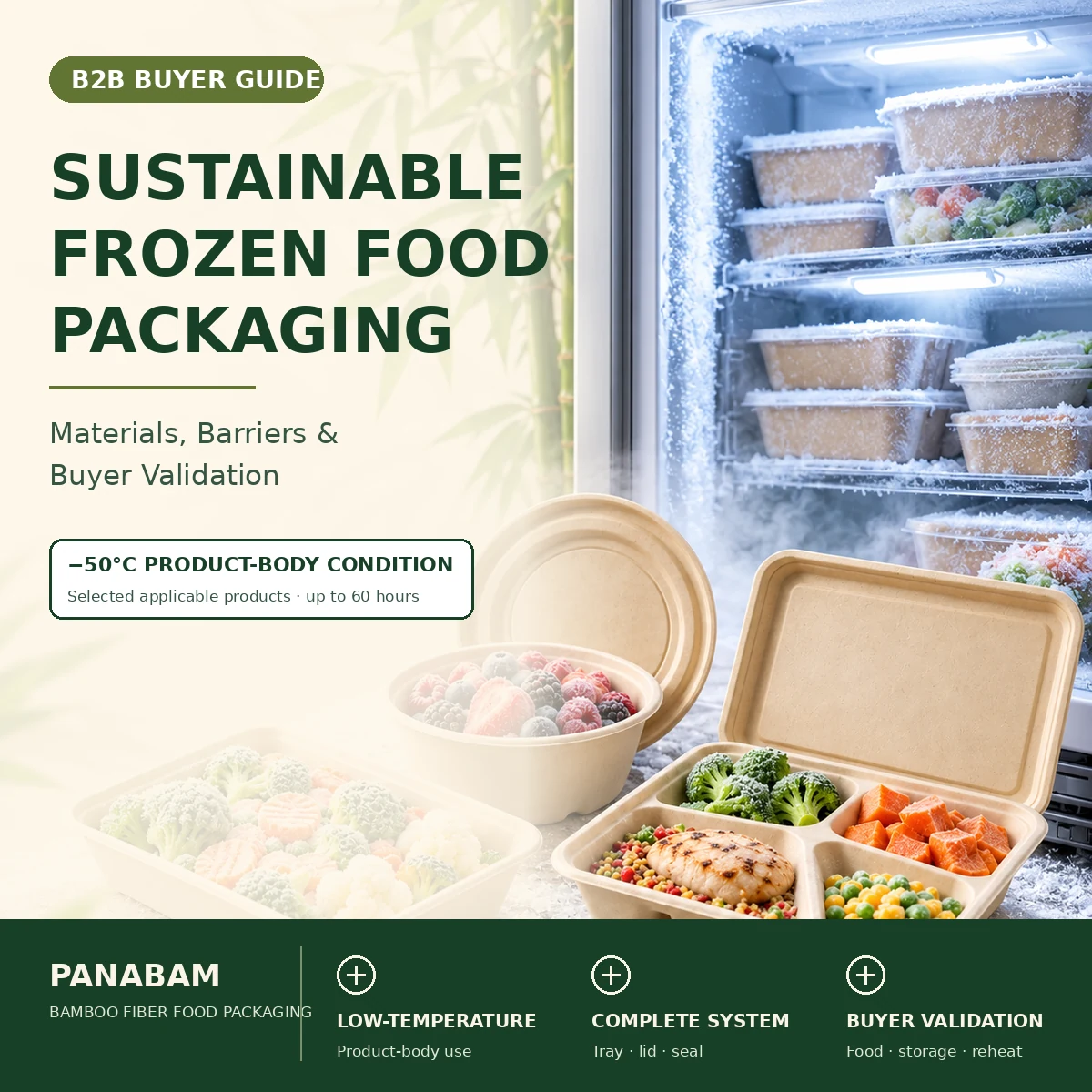
Technical review: PANABAM Product Manager and Quality Manager, each with 10+ years of relevant molded-fiber food-packaging experience
Published October 19, 2026 · Last reviewed October 19, 2026
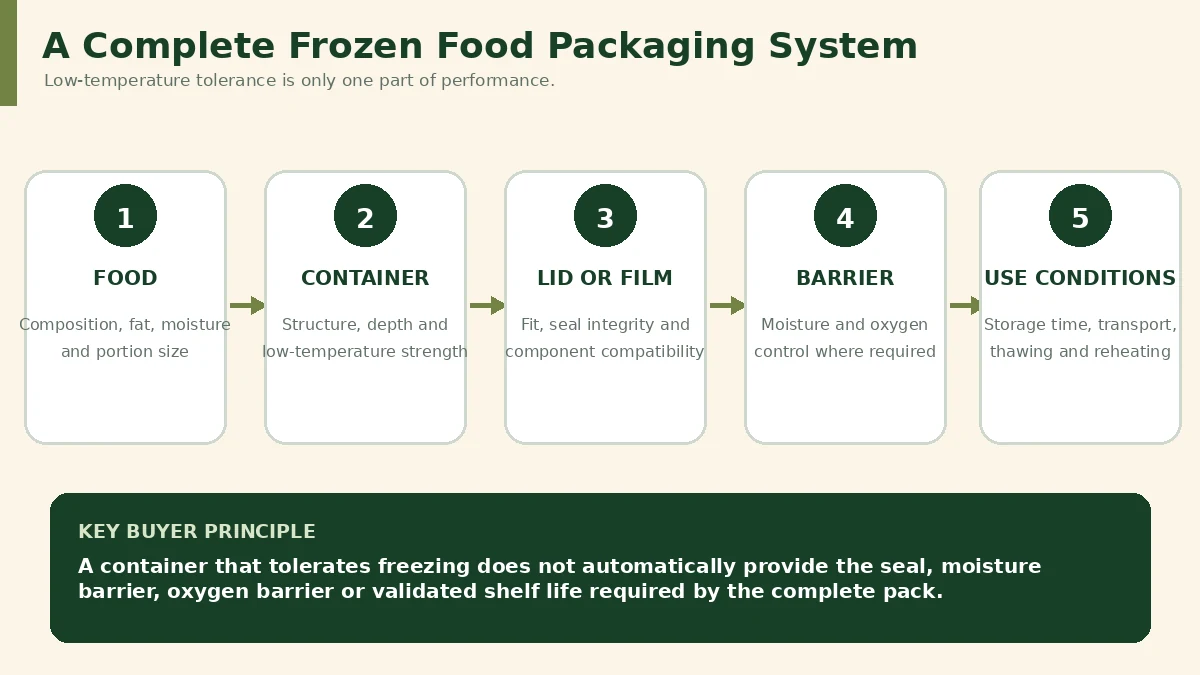
Sustainable packaging for frozen food must protect the product throughout filling, freezing, storage, distribution and, where relevant, reheating. The material must remain structurally sound at low temperature, but that is only one requirement. The complete pack may also need an effective seal, moisture- and oxygen-barrier performance, food-contact suitability and validated shelf life. A freezer-safe tray is not automatically a long-term frozen-food package.
The short answer
Choose frozen food packaging as a complete system, not by material name alone. Define the food, target shelf life, freezing and storage temperatures, filling process, sealing method, distribution stresses and reheating instructions. Then test the actual tray or container together with its lid, film, label and closure under those conditions.
In This Guide
-
The performance requirements frozen food packaging must meet
-
How packaging needs differ for meat, seafood, produce and prepared meals
-
The strengths and limitations of common material systems
-
Where molded bamboo-fiber trays and containers can fit
-
A practical validation plan and sourcing checklist for B2B buyers
What Must Frozen Food Packaging Do?
Freezing slows many processes that reduce food quality, but it does not remove the need for protective packaging. During frozen storage, exposed food can lose moisture and develop freezer burn. Temperature changes can also create condensation, stress seals and alter the way the product loads the package.
The USDA advises that packaging for freezing should keep air out and protect food from freezer burn. Its guidance notes that thin supermarket wrap allows air in and may require airtight overwrapping for longer storage. This illustrates an important commercial distinction: a tray may provide shape and support, while a separate film, lid, pouch or overwrap provides the barrier and seal. USDA: What materials are safe to freeze food in?
The National Center for Home Food Preservation states that packaging materials for freezing should be moisture-vapor resistant, durable and leakproof, resistant to oil, grease and water, easy to seal, and able to resist brittleness and cracking at low temperatures. These freezer packaging material requirements provide a useful screening framework, but commercial buyers must still validate the actual food and complete packaging system.
1. Low-Temperature Structural Integrity
The tray, bowl or container should resist cracking, splitting, warping and unacceptable loss of stiffness at the lowest expected temperature. The test should include realistic product weight, stacking and handling. A material coupon or empty container does not reproduce the stresses created by a filled pack.
For meat and seafood, frozen edges can become hard and may stress a film or closure. For fruit and vegetables, the container may also need to manage product movement, surface ice and distribution vibration. The selected system should therefore be tested after freezing, not only at room temperature.
2. Moisture Control and Freezer-Burn Protection
Moisture loss can dry the food surface and cause freezer burn. The required moisture barrier depends on the food, surface area, headspace, storage temperature, storage duration and seal. A rigid fiber tray without an airtight barrier should not be assumed to protect food for a multi-month retail shelf life by itself.
Buyers should define the moisture-vapor performance required from the complete package. In many systems, that function comes mainly from a lidding film, liner, pouch or other closure rather than the supporting tray.
3. Oxygen, Aroma and Light Protection
Fatty foods, meat, seafood and formulated meals may need oxygen control to limit oxidation, odor transfer or flavor change during their intended shelf life. Some products also benefit from light protection. These are package-level requirements. A tray can provide structure and presentation without supplying the oxygen barrier needed by a particular food.
If vacuum packaging, modified-atmosphere packaging or gas flushing is planned, the selected materials and seals must be evaluated for that process. A recent peer-reviewed review of frozen food packaging emphasizes that material choice depends on the food and processing system, and that barrier properties and seal integrity must remain effective under frozen conditions. Frontiers in Sustainable Food Systems: Frozen food packaging—recent technological advances and future perspectives
4. Seal and Closure Integrity
Seal performance can be affected by product contamination in the seal area, sealing temperature and pressure, material compatibility, package geometry and temperature cycling. A lid that fits at room temperature may behave differently after freezing, transport and thawing.
Validation should examine the entire closure system: tray flange, lidding film or lid, adhesive where used, sealing parameters and opening method. A “freezer-safe” claim for the product body does not automatically apply to a separate lid or film.
5. Food-Contact Suitability for the Intended Use
Food-contact evidence must match the actual food and conditions of use. The U.S. FDA treats frozen storage and frozen or refrigerated storage followed by reheating as distinct food-contact conditions. This does not mean that any material described as food grade is automatically suitable for every frozen-food use. Buyers should map each component and its documentation to the intended food, temperature and process. FDA: Food types and conditions of use for food-contact substances
For the European Union, food-contact materials must meet the general safety requirements of Regulation (EC) No 1935/2004. Additional requirements may apply to lids, films, coatings, printing inks, adhesives and other components. Buyers should therefore review documentation for the complete packaging configuration and destination market, not only the molded container body.
6. Distribution, Stacking and Reheating Performance
Frozen packaging may be handled by filling lines, blast freezers, cold stores, distribution centers, retailers and consumers. The pack should be evaluated for compression, vibration, drop or impact risks, pallet patterns and condensation during temperature changes.
If consumers will reheat food in the package, the frozen-to-microwave or frozen-to-oven sequence requires separate validation. The test must include the actual food because heating patterns, fat content, fill weight and moisture affect package performance.
Requirements Change by Frozen-Food Application
There is no single best material for every frozen food. The following table helps buyers define the package job before comparing suppliers.
| Application | Typical packaging priorities | Questions to resolve before sourcing |
|---|---|---|
| Frozen meat and poultry | Low-temperature toughness, puncture resistance, moisture and oxygen control, leak management, strong seals | Bone-in or boneless? Vacuum, skin pack or lidded tray? Target shelf life? Drip after thawing? |
| Frozen fish and seafood | Low-temperature integrity, moisture control, odor and oxygen protection, resistance to hard frozen edges | Whole, fillet or portion? Glazed product? Vacuum or lidding film? Retail or foodservice? |
| Frozen fruit and vegetables | Moisture control, seal integrity, resistance to surface ice, portion and dispensing needs | Individually quick frozen or block frozen? Retail bag, tray or bulk foodservice pack? Resealable? |
| Frozen ready meals | Compartment design, sealability, grease and moisture resistance, frozen-to-reheat performance | Microwave or oven? Peelable film or lid? Sauce and oil content? Heating instructions? |
| Bakery and desserts | Shape protection, moisture and aroma control, presentation, release after thawing | Frosting or delicate surface? Display in the pack? Thaw in sealed or open condition? |
| Short-term foodservice holding | Structural integrity, stacking, handling and operational convenience | How long is the food held frozen? Is the pack sealed? Is long retail shelf life required? |
The target shelf life belongs in the packaging brief, but it should not be copied from another food. Actual shelf life depends on the food formulation, processing, package, seal, storage temperature and distribution history. It must be established using the intended commercial system.
Frozen Food Packaging Materials: A Practical Comparison
Material selection should follow the required functions. The table below describes common roles, not universal performance guarantees.
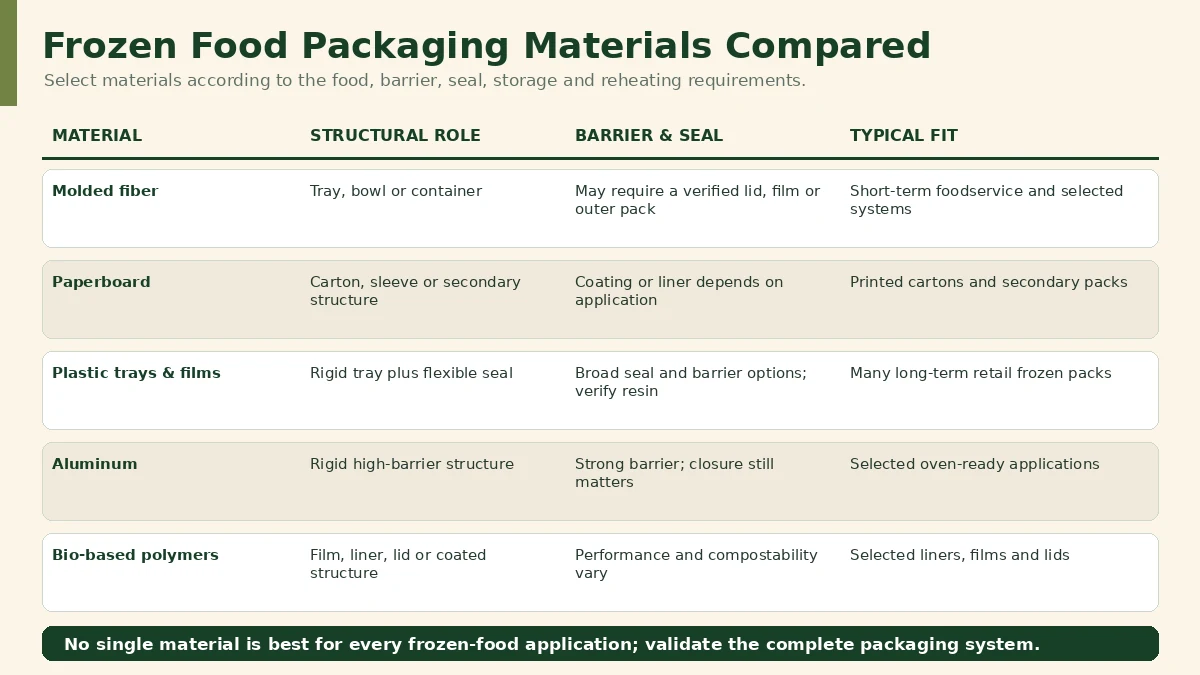
| Material or format | Potential role in frozen packaging | Main points to validate | Sustainability considerations |
|---|---|---|---|
| Molded plant fiber | Rigid tray, bowl, insert or container body; portioning and presentation | Low-temperature strength, moisture exposure, lid or film compatibility, seal design, reheating conditions | Fiber source, formulation, package weight, compatible closure and realistic end-of-life route |
| Paperboard carton | Secondary pack or, with an appropriate liner or coating, a direct-food package | Moisture resistance, grease resistance, barrier layer, seal and structural performance | Fiber sourcing, coating or laminate, recyclability in the destination system |
| Rigid plastic tray | Primary tray for sealed, vacuum-skin, ready-meal or retail systems | Resin behavior at low temperature, seal compatibility, migration and reheating conditions | Resin type, recycled content where permitted, mass, local collection and recycling access |
| Flexible film or pouch | Airtight primary pack for vegetables, fruit, meat, seafood and snacks | Puncture resistance, seal window, oxygen and moisture transmission, print and zipper compatibility | Mono- or multi-material structure, source reduction, recycling access and food-protection performance |
| Aluminum tray or foil | High-barrier tray or wrap; selected ovenable applications | Denting, closure, food compatibility and heating instructions | Material weight, recycled content, collection and contamination in the local system |
| Bioplastic or compostable structure | Selected bags, films, coatings or rigid formats | Low-temperature toughness, barrier, sealability, industrial-composting conditions and certification scope | Feedstock, additives, actual facility access and whether the complete pack is certified |
For a closer comparison of rigid packaging materials, read our guide to bamboo fiber food containers compared with plastic, bagasse and paper.
“Sustainable” should not be used as a shortcut for one material attribute. The U.S. EPA recommends a life-cycle perspective that considers raw-material acquisition, manufacturing, use and end-of-life. For food packaging, product protection also matters because a package that fails and causes food waste can undermine an apparent material benefit. EPA: Sustainable Materials Management Basics
Broad claims such as “eco-friendly” are also difficult to substantiate. The FTC advises marketers to state specific environmental benefits and to qualify compostable and recyclable claims according to evidence and facility availability. FTC: Environmental Claims—Summary of the Green Guides
Buyer rule of thumb
First specify food protection and operational performance. Then compare material use, sourcing, manufacturing, transport, food-waste risk and the actual end-of-life system in the destination market.
Where Molded Bamboo-Fiber Packaging Can Fit
The following information is product-specific to PANABAM’s applicable molded bamboo-fiber range and should not be interpreted as a universal claim for all molded-fiber packaging.
Molded bamboo fiber can provide a rigid food-contact body for trays, bowls and containers. It can be useful where the buyer needs portion control, shape protection, stacking, presentation or a plant-fiber alternative to a conventional rigid tray. Its suitability still depends on the intended frozen-food application and the rest of the packaging system.
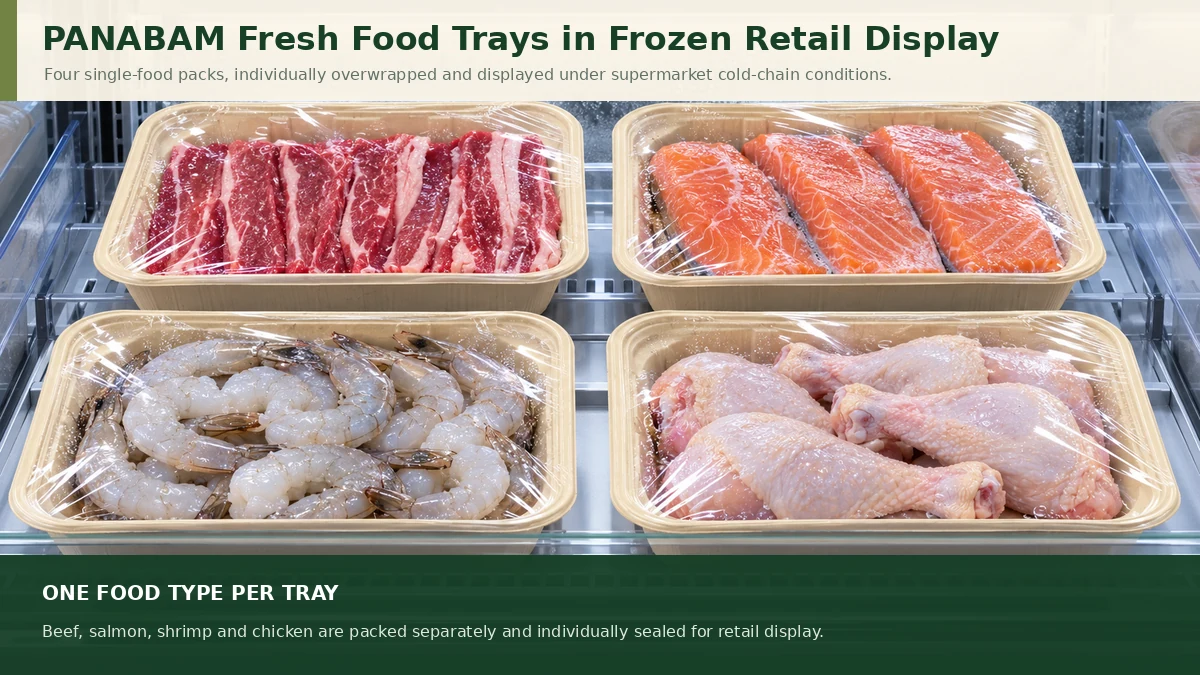
PANABAM’s current bamboo fiber range includes Fresh Food Trays and Produce Trays in multiple dimensions, together with selected bowls, serving trays and food-container formats. These formats can be evaluated for frozen meat, poultry, fish, seafood, fruit, vegetables and prepared-meal projects according to the selected SKU and complete packaging configuration. Buyers can review available plates and food trays, food containers and clamshells and bowls with lid options.
For PANABAM’s applicable core unprinted molded bamboo-fiber product body:
-
The product body is made from 100% bamboo fiber.
-
PANABAM confirms that it does not use additives, barrier agents, wet-strength agents, binders or release agents.
-
It contains no PE, PLA, plastic film or wax coating.
-
PFAS are not intentionally added, and product-specific supporting documents are available according to the selected item and project requirements.
For a detailed explanation of PFAS terminology, testing and supplier verification, read What Does PFAS-Free Mean for Food Packaging?.
Separate lids, lidding films, printing inks, colorants, labels, adhesives, coatings, composite structures, accessories and custom-developed products require their own confirmation and do not automatically inherit claims made for the unprinted molded product body.
What PANABAM’s Freezer Condition Does—and Does Not—Mean
PANABAM’s current internal product-body specification for selected applicable unprinted molded bamboo-fiber products includes freezer exposure down to −50°C for up to 60 hours.
This is a product-body condition, not a validated shelf-life claim. It does not automatically establish the suitability of lids, films, labels, adhesives or the complete packaging system, and it does not apply universally to every food or frozen-food application. It also does not by itself establish:
-
An airtight or hermetic seal
-
A specific oxygen- or moisture-transmission rate
-
Protection against freezer burn for a stated retail shelf life
-
Suitability of a separate lid, film, label or adhesive
-
A validated storage period of weeks or months
-
Suitability for every food, filling process or freeze–thaw cycle
The selected SKU, actual food, lid or film, sealing method and complete packaging configuration should be tested together. A project requiring long-term retail frozen storage may need a separately validated barrier and closure system around or above the molded tray.
Frozen-to-Reheat Projects Need an Additional Check
According to PANABAM’s current internal product-body specification, company-confirmed maximum use conditions for selected applicable unprinted molded bamboo-fiber product bodies include microwave use up to 1000 W for up to 60 minutes and oven use up to 200°C for up to 60 minutes.
These are separate maximum product-body conditions. They do not establish that a frozen package can be transferred directly from −50°C to a 200°C oven, and they do not automatically apply to lids, films, labels, printed components or every food application.
The selected SKU, actual food, fill weight, heating method and complete packaging configuration must be evaluated separately before commercial use. A frozen ready-meal project should test the full sequence: filling, sealing, freezing, frozen storage, transport, opening or venting and reheating with the actual food. Separate lids and films may have lower temperature limits than the molded body.
For more information about heating conditions, see our guide to the microwave suitability of compostable takeout containers.
A Buyer’s Validation Plan for New Frozen Food Packaging
Use a staged process so that material screening does not get mistaken for commercial shelf-life approval.
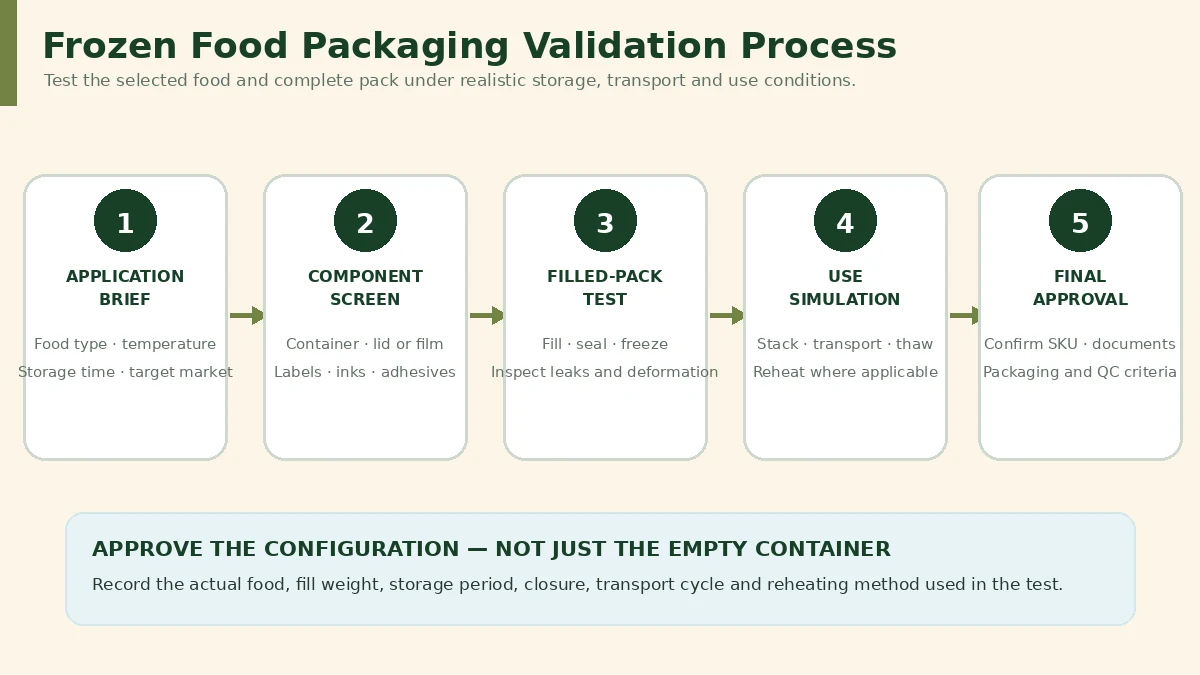
Stage 1: Write the Application Brief
Record the following before requesting samples:
-
Food type, formulation, fat and moisture content
-
Portion weight and dimensions
-
Fill temperature and filling process
-
Freezing method and lowest product or ambient temperature
-
Normal frozen-storage temperature and target duration
-
Expected temperature fluctuations during distribution
-
Tray, bowl or container dimensions and compartment needs
-
Lid, film, pouch, overwrap, label and adhesive requirements
-
Vacuum, modified atmosphere or heat-sealing requirements
-
Microwave, oven or thawing instructions
-
Destination market and required food-contact documents
-
Sustainability claim and end-of-life objective
Stage 2: Screen the Empty Components
Condition the product body, lid, film and other components at the expected low temperature. Inspect for cracking, brittleness, warping, poor nesting, loss of lid fit and changes in sealability. Include a realistic cold-handling test rather than inspecting only visually.
Stage 3: Test the Filled Complete Pack
Run trials with the real food or a justified product simulant. Use commercial fill weights, headspace and sealing parameters. Inspect after freezing and at planned intervals for:
-
Cracks, punctures, flange damage and distortion
-
Seal channels, lid lift and leakage
-
Moisture loss, surface drying and ice accumulation
-
Odor transfer, oxidation or color change where relevant
-
Stack stability, compression and pack appearance
-
Label and adhesive performance
Stage 4: Simulate Distribution and Consumer Use
Test pallet and carton stacking, vibration, impact and expected temperature cycling. If the pack will be reheated, test it directly from frozen and under the exact consumer instructions. Assess safe handling after heating as well as package integrity.
Stage 5: Validate Shelf Life and Document the Decision
Shelf-life validation should use the actual food, process and commercial package. The food business and qualified laboratory should select the relevant microbiological, chemical, physical and sensory endpoints. Record the tested configuration so that a future change to the tray, film, lid, formulation, supplier, seal setting or storage condition triggers review.
Frozen Food Packaging Buyer Checklist
Before approving a supplier or package, confirm:
Questions to Ask a Frozen Food Packaging Supplier
- Which part of the complete packaging system do you supply: product body, lid, film, label or all components?
- What low-temperature conditions have been evaluated, and were the samples empty or filled?
- Does the evidence apply to this exact SKU, or to a defined representative product family?
- What supplies the required moisture and oxygen barrier?
- Which lids or films are compatible with the tray and sealing equipment?
- What food-contact documentation is available for the intended food and use condition?
- Are reheating claims based on the product body alone or the full pack?
- Which environmental claims are supported, and do they cover every component?
- What changes would require new testing or document review?
- Can the supplier provide samples for a filled-pack freezing, distribution and shelf-life trial?
Frequently Asked Questions
What is the best packaging material for frozen food?
There is no universal best material. The correct choice depends on the food, target shelf life, freezing and storage temperatures, required oxygen and moisture barrier, sealing equipment, distribution route, reheating method and end-of-life goal. Many effective packages combine a rigid tray or carton with a separate barrier film, lid or pouch.
Is molded fiber suitable for frozen food?
Selected molded-fiber products can be suitable as trays, bowls, inserts or container bodies for frozen-food applications. Suitability must be validated at the required temperature with the actual food and complete package. The molded body should not be assumed to provide an airtight seal or long-term moisture and oxygen barrier on its own.
Does freezer-safe mean the packaging prevents freezer burn?
No. Freezer-safe usually addresses physical performance at low temperature. Freezer-burn protection depends strongly on limiting air exposure and moisture loss through the complete package, including its seal, lid, film or overwrap.
Can bamboo-fiber trays be used for frozen meat or seafood?
Selected PANABAM Fresh Food Trays can be evaluated for frozen meat, poultry, fish and seafood applications according to the selected SKU and complete packaging configuration. The buyer should test the selected SKU with the food, any absorbent component, lidding or overwrap, seal, storage duration and transport conditions. Bone edges, drip after thawing and long-term barrier needs require particular attention.
Can frozen food be reheated in the same bamboo-fiber container?
Potentially, for selected applicable product bodies and a validated complete configuration. PANABAM’s current internal product-body specification includes company-confirmed maximum conditions of microwave use up to 1000 W for up to 60 minutes and oven use up to 200°C for up to 60 minutes for selected unprinted molded bamboo-fiber bodies. These are separate conditions and do not establish direct transfer from −50°C to a 200°C oven. Confirm the specific SKU, food, fill weight, lid or film and consumer heating instructions through testing.
Is plant-fiber frozen food packaging automatically sustainable or compostable?
No. Plant-fiber content alone does not establish overall environmental performance or compostability. Buyers should review material composition, manufacturing, packaging weight, food protection, transport, certification scope, contamination and the actual collection or composting options in the destination market.
Request Frozen Food Packaging Samples and an Application Review
PANABAM supplies molded bamboo-fiber Fresh Food Trays, Produce Trays, serving trays, bowls and food containers for B2B packaging projects. To assess a frozen-food application, send us:
- The food type and portion weight
- The filling and freezing process
- Minimum and normal storage temperatures
- Target frozen shelf life
- Required tray dimensions and depth
- Lid, film, seal and reheating requirements
- Estimated order quantity
- Destination market and required documents
We can help identify candidate formats, confirm product-specific scope and prepare samples for your packaging trial. For custom dimensions, closure development or private-label projects, review PANABAM’s OEM and ODM capabilities.
Request Frozen Food Packaging Samples
Technical Review and Update Policy
This guide was technically reviewed by PANABAM’s Product Manager and Quality Manager. Each has more than 10 years of experience in molded-fiber food packaging, covering product development, material formulation, quality control, food-contact testing and export-project documentation.
This page is reviewed when relevant regulations, product specifications, application conditions or supporting documents change. Packaging and destination-market requirements may change. Buyers should confirm current product-specific documentation and complete-package suitability before making a commercial compliance or shelf-life decision.
Editorial Sources
- USDA Food Safety and Inspection Service: What materials are safe to freeze food in?
- U.S. FDA: Food Types and Conditions of Use for Food Contact Substances
- U.S. FDA: Determining the Regulatory Status of Components of a Food Contact Material
- National Center for Home Food Preservation: Packaging Materials FAQs
- EUR-Lex: Regulation (EC) No 1935/2004 on Food-Contact Materials and Articles
- U.S. EPA: Sustainable Materials Management Basics
- U.S. FTC: Environmental Claims—Summary of the Green Guides
- Frontiers in Sustainable Food Systems: Frozen Food Packaging—Recent Technological Advances and Future Perspectives